
A founder brought me a term sheet he was pleased about. The pre-money was roughly 30% above what he had modelled, and he had already told his co-founder the round was as good as done. Twelve pages in was a 2x participating liquidation preference. On any realistic exit for that business, the clause was worth more to the investor than the valuation uplift was worth to him — by a wide margin.
He is a composite drawn from several engagements and the numbers below are illustrative, but the pattern is real: founders negotiate the valuation and accept everything underneath it, and everything underneath it is where the money moves.
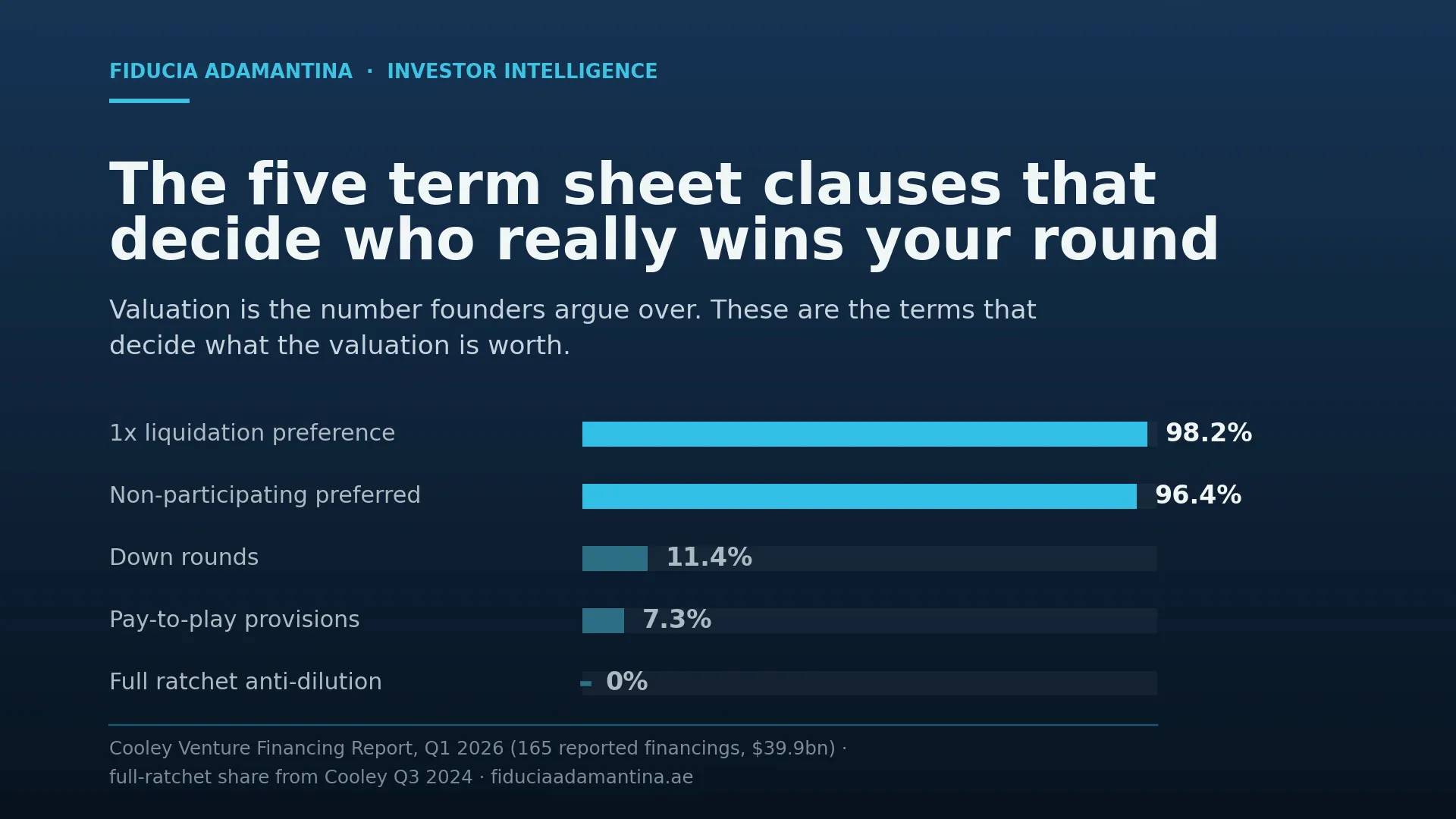
Here is the market context that makes this fixable. In the first quarter of 2026, across the 165 venture financings Cooley reported, 98.2% carried a 1x liquidation preference and 96.4% used non-participating preferred stock (Cooley, Q1 2026). The institutional standard is now overwhelmingly settled, and it settled in the founder’s favour. Which means a term sheet that sits outside it is not a matter of taste. It is off-market, and you are entitled to say so.
Five clauses do most of the work. This is what each one does, where the market sits, and what it costs you when it doesn’t.
None of this is legal advice and none of it replaces your own counsel drafting the documents. It is the commercial read that should happen before counsel starts, because by the time the lawyers are drafting, the economics are usually already agreed.
Liquidation preference: who gets paid first, and how much before you see anything
The liquidation preference decides the order and the size of the payout when the company is sold. Two variables matter: the multiple, and whether the preference is participating.
A 1x non-participating preference means the investor chooses. Either they take their money back, or they convert to common and take their ownership percentage of the exit — whichever is worth more. They cannot do both.
A participating preference means they do both. Money back first, then a percentage share of what remains.
Work it through on an illustrative exit. A company raises $10 million in total and sells for $30 million. Investors hold 40%.
- 1x non-participating: the investor compares $10 million to 40% of $30 million, which is $12 million. They convert. Common shareholders — founders and the team — split $18 million.
- 2x participating: the investor takes $20 million off the top, then participates in the $10 million remaining for another $4 million. They receive $24 million. Common splits $6 million.
Same exit. Same ownership percentage on the cap table. A $12 million swing, and the term sheet’s headline valuation is identical in both cases.
The multiple and the participation feature are the first two things I read on any term sheet, before the valuation. At 96.4% non-participating, anything else is an outlier that has to justify itself.
Anti-dilution: what happens to your ownership if the next round is down
Anti-dilution protects the investor if you later raise at a lower price per share. It adjusts their conversion price, which quietly increases the number of common shares their preferred converts into. Nobody writes you a cheque. Your percentage just falls.
Two versions exist, and the gap between them is enormous. Broad-based weighted average adjusts the conversion price partway, weighted by how much new stock is issued relative to the whole capital structure. A modest down round moves the number modestly. Full ratchet reprices the investor all the way down to the new round’s price, as though they had invested at that price from the start. On a sharp down round, full ratchet can take a meaningful bite out of common equity in a single step.
The market resolved this argument some time ago. In Cooley’s Q3 2024 print, 100% of reported deals used broad-based weighted average and 0% used full ratchet (Cooley, Q3 2024). Full ratchet is not a negotiating position at institutional stage. It is a signal about the investor, or about how weak your position is.
The clause is not theoretical either. Down rounds were 11.4% of Q1 2026 financings and pay-to-play provisions appeared in 7.3%. Roughly one round in nine still resets downward.
Board composition: the clause that decides who can remove you
This is the clause founders under-read most, and it is the one with the least reversible consequences.
A common Series A structure is a five-seat board: two founder seats, two investor seats, one independent director appointed by mutual agreement. The independent is the swing vote, which makes the process for appointing them more important than the seat count.
The board hires and removes the chief executive. Shareholders do not. A founder can hold a comfortable majority of the equity and still be removed from their own company by a board they agreed to in a term sheet.
Two questions worth asking before you sign. Who appoints the independent, and what happens if the two sides cannot agree? And which decisions need board approval versus a preferred-shareholder vote — the protective provisions list is where the practical limits on running your own company actually live.
Founder vesting: you already own it, and you are about to re-earn it
Nearly every institutional round imposes or resets founder vesting. The convention — four years with a one-year cliff — has been standard since the late 1990s and is built into every venture template and cap-table platform in use.
Founders read this as an insult. It isn’t: it protects you against a co-founder leaving in month eight with a quarter of the company. But two details inside it are negotiable and routinely left on the table.
Credit for time served. If you have been operating for three years before this round, a fresh four-year vest starting at close ignores all of it. Credit for prior service is normal and should be asked for.
Acceleration on a change of control. Single-trigger acceleration vests your shares when the company is acquired. Double-trigger vests them only if the company is acquired and you are terminated afterwards. Double-trigger is the more common institutional position; having neither is the position to avoid, because it means an acquirer can buy the company and let your unvested equity lapse.
Pro-rata rights: this clause is about your next round, not this one
Pro-rata rights let an existing investor put in enough money in the next round to hold their percentage. Standard pro-rata is reasonable and I would not spend capital fighting it — it signals commitment and makes your next raise easier.
Super pro-rata is different. It gives the investor the right to take more than their proportional share of a future round — sometimes a large fraction of it. The problem surfaces a year or two later, when your Series B lead needs 20% or more to justify leading, and a seed investor’s contractual allocation has already claimed the space. You end up negotiating with your existing investor for permission to run your own next round.
If a super pro-rata right is on the table, cap it — to a defined multiple of the standard allocation, or to a fixed amount. An uncapped one is a constraint on a round you have not designed yet.
Where to spend your negotiating capital
You will not win all five. Here is the order I work in, and the reasoning.
Spend it on liquidation preference structure and board composition. These two decide what you receive in the outcome that pays you and who controls the company in the outcome that doesn’t. They are also the two hardest to renegotiate later.
Spend a little on vesting. Credit for time served and double-trigger acceleration are usually granted when asked for and almost never volunteered.
Do not spend much on anti-dilution or standard pro-rata. With broad-based weighted average at effectively universal adoption, that fight is already won by market convention. Confirm the language, then move on. Founders routinely burn goodwill here and arrive at the board discussion with nothing left.
One thing applies across all five. These negotiations rarely go badly through ignorance of the terms. They go badly because the founder cannot model what any of them does to their own cap table, so the discussion stays abstract and the investor’s version wins by default. If you cannot say what a clause costs you at three different exit values, you are not negotiating. You are agreeing.
That modelling is the first thing we rebuild in an Investor Readiness Sprint, and it is what moves a founder from accepting a term sheet to arguing one.
That is the gap the Investor Readiness Checklist closes before you are in the room: what has to be documented and defensible before an investor’s paperwork arrives, so the conversation starts from your evidence rather than their draft.
What to do with the term sheet in front of you
Three steps, in order.
Read the five clauses above before you read the valuation again. Mark each one as market, better than market, or off-market against the figures in this piece.
Model the exit outcomes. Take your realistic exit range, not your ambitious one, and calculate what common receives under the preference structure you have been offered. If the number surprises you, that is the negotiation. Signing settles less than founders expect, too — confirmatory diligence comes next, and it can still reprice the deal.
Anchor to published standard, not to opinion. Gulf-corridor founders in particular negotiate without a local benchmark to point at, which makes it easy to accept whatever a single investor proposes as normal. No robust regional dilution dataset exists — I’ve written about what the benchmarks do and don’t say about founder ownership — so the global institutional standard is the anchor to use.
For a structured read on where you stand before the paperwork arrives, the Investor Readiness Scorecard is the fastest way to find out, and the Investor Readiness Checklist is the companion for what to fix.
A term sheet arrives near the end of a process that started months earlier, not at the start of one, and by then most of your position was set by how well your materials hold up. If the model, the cap-table scenarios and the founder narrative behind those clauses need building or rebuilding, that is what the Investor Readiness Sprint does: AED 25,000 fixed, 50% at kickoff and 50% on delivery, 2–3 weeks from complete intake, delivering the deck, a management-input operating model with sensitivities, one post-raise cap-table scenario, the founder narrative and objection notes, and a live rehearsal. It is a materials build you can buy on its own — no mandate required, it does not run your negotiation, and your lawyers still draft the documents. What the Investor Readiness Sprint buys you is the ability to answer “what does that clause cost me?” with a number instead of a pause.