Start with two numbers.
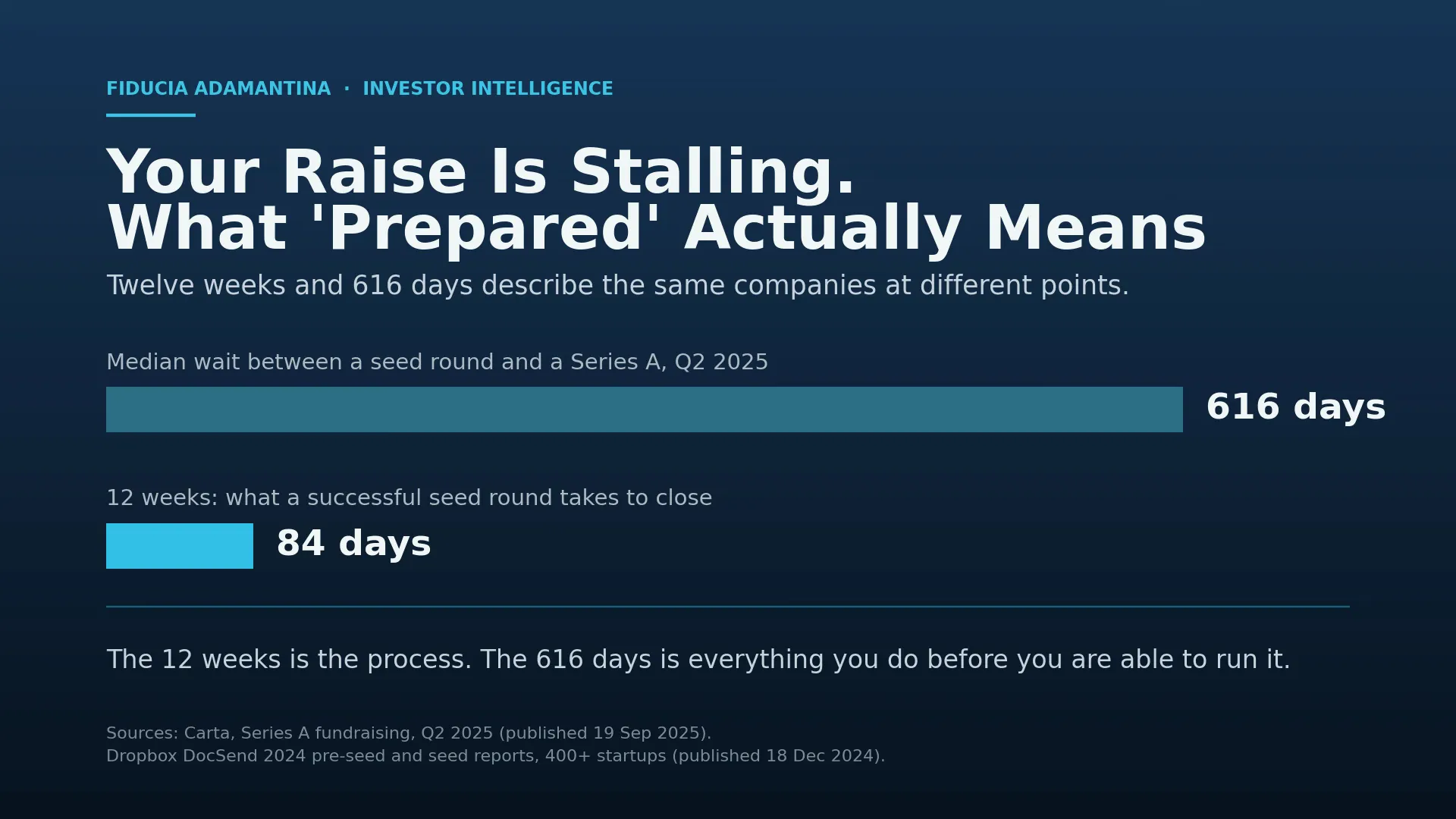
The median wait between a seed round and a Series A reached 616 days in the second quarter of 2025. That is a little over twenty months, and more than two months longer than the same measure two years earlier (Carta).
The second number: the majority of successful seed companies closed their rounds in 12 weeks or less, with pre-seed rounds averaging the same twelve weeks, across the 400-plus early-stage startups Dropbox DocSend analysed for its 2024 pre-seed and seed reports.
Those two numbers come from different datasets and measure different things, which is the point. The 616 days is the wait between rounds, and most of it goes on building a business to clear a Series A bar that keeps rising, not on raising money. The twelve weeks is what a raise takes once it is genuinely running.
So when a founder tells me they have been raising for eight months with nothing closed, my first question is not about their investor list. It is whether they ever started the twelve-week process at all, or whether they started an information-assembly project with investors watching. A round open for eight months is rarely a slow twelve weeks. It is usually twelve weeks that never began.
That distinction is the whole of what “prepared” means. It is worth being precise about, because the word usually gets used as a mood.
The Raise You Think You’re Running Hasn’t Started Yet
Here is the mechanism, and it is the part the generic advice never states.
A raise does not stall because an investor says no. A no is fast and it is information. A raise stalls because an investor says yes, and. Yes, interesting, and can you send the cohort retention by month, and the cap table with the SAFEs converted, and how did you get to that valuation.
Every one of those requests is a transfer. It converts the investor’s momentum into your homework. And homework runs on your clock, not theirs. The partner who asked has six other companies in front of them and a decaying memory of why yours was interesting. If the answer takes you eleven days to assemble, you are not eleven days behind. You are back at the beginning of their attention, with less novelty than the first time.
Repeat that four times across four investors and you have not run a bad twelve-week process. You have run a nine-month process that never had a twelve-week process inside it.
Prepared, then, has a working definition: you can answer any reasonable investor question inside 48 hours without building anything new. Not that your business is perfect. Not that you have every metric an investor could theoretically want. Only that the material required to keep a live conversation live already exists, in a form you can send.
That is a deadline, not a standard. Which is why it is achievable.
When a Raise Stalls, Founders Widen the Funnel. The Data Says That Is Not the Lever.
The instinct, when month six arrives with nothing signed, is to contact more investors. It feels like the only variable under your control.
DocSend’s seed research found that founders did exactly this, and it did not work: seed founders contacted more investors but had fewer meetings than the year before (Dropbox DocSend seed report). More outbound, less conversion. The funnel got wider at the top and narrower at the point that matters.
I read that as the clearest available evidence that volume is not the constraint. If the same materials produce the same result at forty investors that they produced at fifteen, the materials are the constraint. Widening the list mostly buys you more copies of the same stall, and it burns introductions you cannot re-run.
The Deck Edits You Are Making Are on the Wrong Slides
There is a second, quieter version of the same error. A stalling founder does not only add investors, they also edit the deck. Almost always in the same direction: more market sizing, a bigger competitive matrix.
Investor attention moved the other way. In 2024, venture investors spent 40% more time on seed-stage Team slides and 30% more on pre-seed Team slides than the year before, while the seed Competition slide received 48% less attention and the pre-seed Market Size slide 19% less. A year earlier the emphasis had sat on Competition and “Why now?” (DocSend, 2023; DocSend, 2024).
The point is not that Team slides are magic. It is that the slides founders instinctively reach for when a raise is going badly are the slides investors are spending less time on. Rewriting them buys you nothing and costs you two weeks.
Where the Weeks Actually Go
The five things investors judge before they commit are the same five every time. I have written elsewhere about what each pillar contains. What follows is the other question: what each gap costs you in time when it is missing.
Narrative: the two weeks you lose rewriting mid-process
An undefined story does not fail in the room. It fails between rooms, when the version you gave investor three contradicts the version investor one repeated to a colleague. Founders then stop the process to fix the narrative. That pause is rarely under two weeks, and it happens at exactly the moment momentum was building.
Financial model: where “send me the model” becomes a month
This is the single largest delay I see. A founder who has a deck but no management-input model is not sending a file, they are starting a project. Building a defensible model, reconciling it to actuals, and stress-testing the assumptions before an investor does takes weeks, and it takes them after the investor has already asked.
Data room: the delay that compounds
A data room requested in week two and delivered in week six does not cost four weeks. It costs four weeks plus the diligence cycle that has to restart around it, plus the impression that the company is not run tightly. Preparing one to pass first time is unglamorous work that is almost entirely front-loadable.
Valuation story: the question that restarts everything
“Why this number?” is not a negotiation opener. It is a test of whether the round was sized backwards from a milestone or forwards from a feeling. If you cannot defend the number and the round size in the same breath, you will be sent away to rethink both, and rethinking a round mid-process resets every conversation you have open.
Investor targeting: the weeks you cannot get back
Pitching the wrong capital is the only delay on this list that preparation cannot recover afterwards. Wrong-fit investors are usually polite, usually slow, and usually take three meetings to say no. Two months spent on a fund that structurally does not do your stage, sector, or geography is two months gone, and the introduction that opened the door does not regenerate.
Four of the five are pure materials problems. Which is the encouraging part: they are all fixable before you start, and none of them are fixable quickly once you have. The Investor Readiness Checklist sets out, item by item, what has to exist before a first meeting rather than after one. If you are mid-process now, read it as a delay ledger rather than a to-do list.
In a Small Investor Pool, Delay Costs More Than Time
Most of this applies anywhere. One part does not.
In the GCC the active investor pool is small enough to behave like a single room. Family offices in Dubai co-invest with funds in Riyadh and Abu Dhabi, partners sit on overlapping boards, and a process that visibly stalls does not stay where it stalled. In a deep market a slow raise costs you the raise. In a shallow one it can cost you the market, because the same twenty names will be there for your next round too, holding a memory of the version of you that could not produce a cap table.
I would not force a regional angle onto a global problem, and preparation is a global problem. But the cost of getting it wrong is not evenly distributed, and founders raising into Gulf capital carry more of it.
Prepared Means You Can Answer on Their Clock
If you want a single diagnostic before you decide anything: take the last three investor requests you received and ask how long each took to answer. Not how well. How long. If the honest answer is more than 48 hours for any of them, the raise is not slow because the market is slow.
The Investor Readiness Checklist is where I would start, and it is free. If you are already mid-process and reading this with a sinking feeling, it will show you, item by item, which of the twelve things an investor checks you cannot answer cleanly today. Our capital raising page sets out what we build for founders who are raising, and what stays separate scope.
If the checklist confirms what you already suspect, that the gap is materials and not market, the Investor Readiness Sprint exists for that specific situation. It is a fixed-fee build at AED 25,000, delivered in two to three weeks from complete intake, 50% at kickoff and 50% on delivery. It produces the agreed deck, a management-input financial model, one cap-table scenario, the founder narrative, a rehearsal, and a handover pack. Against the five gaps above, that is the narrative, the model, and the cap-table work behind the valuation conversation. The data room and the target list are not in it.
It is worth being equally clear about what the Investor Readiness Sprint does not do, because the boundary is the reason it works on a fixed fee. It does not build your data room, cure legal, accounting or governance gaps, introduce you to investors, run outreach, or guarantee a term sheet. It is independently buyable: no mandate and no success fee are required, and nothing about it obliges you to work with us afterwards.
Twelve weeks is not a promise. It is what a raise takes when the company is ready to run one. The months before that are not the market being slow.