
Your investors are not saying your revenue is fake. They are saying they cannot underwrite it.
That is the whole content of the word “lumpy,” and it is worth separating from the insult it sounds like. AED 3 million of delivered project work is real money that hit a real bank account. Nobody disputes the history. What an investor prices is the forecast, and a forecast built on revenue that has to be won again from a standing start is a forecast about your sales team, not about your revenue base. Those carry very different discount rates.
The same logic runs on the sell side, with money attached. A buyer paying a multiple is buying next year’s earnings and the ones after. The more of that number that already exists before the year starts, the less risk they absorb, and the more of the range they will pay.
What “lumpy” actually means on the other side of the table
Strip the language back and one question sits underneath: how much of next year’s revenue exists without a new sale? Subscription versus project, contract versus purchase order, retainer versus deliverable — all of it is a proxy for that. When someone calls your revenue low quality, they are saying the answer is close to zero and your projection assumes otherwise.
In my practice the founders who take this badly usually have the strongest businesses. They hear “your revenue isn’t good enough” when the message is “your revenue is good and your evidence for next year isn’t.” Those need completely different responses.
Revenue quality is three tests, not one
Most writing on this topic treats recurring revenue as one property. It is three, and they come apart in practice.
Predictability. Does the revenue arrive without a new sale? Contracted, subscribed, or committed under a framework with minimums. This is the one everybody talks about.
Durability. Once it arrives, does it stay? Retention, renewal, expansion. A subscription business losing a fifth of its base every year just fails more slowly than a project business.
Concentration. How much of it can one decision take away? Revenue can be perfectly contracted, perfectly retained, and still sit almost entirely with one client whose new CFO starts in March.
The part that gets missed: a project business can pass the first two tests, and a subscription business can fail all three. A contracting firm with three-year frameworks, an eighty-per-cent client repeat rate, and no client above a tenth of revenue is more underwritable than a software business with monthly rolling contracts and heavy churn. The billing model is only a proxy. Founders optimise the proxy and wonder why the number does not move.
The multiple doesn’t jump — the basis changes
This is where most writing on recurring revenue misleads, and precision matters because the error costs founders negotiating ground.
You will read that recurring revenue is “worth 2–3x more,” or that recurring businesses trade at 7–10x while others trade at 2–10x. Those comparisons put a revenue multiple next to a profit multiple. Different denominators. Quoting them side by side is not a premium, it is a category error.
What actually happens is more useful. Software and subscription businesses are typically valued on a multiple of ARR, in an SME-realistic band running roughly 3x–7x and reaching higher only at sustained growth well above forty per cent. Professional-services and project businesses are typically valued on normalised EBITDA, or seller’s discretionary earnings if the business runs on the owner, in a band of roughly 5.5x–8x. Both are indicative ranges rather than points, and both are global SME data: there is no published GCC or Dubai transaction multiple, and anyone quoting you one has made it up.
Run those against the same top line and the gap looks enormous — because a revenue multiple and an earnings multiple on a fifteen-per-cent margin are separated by the margin as much as by the model. Arithmetic on two bases, not a recurring-revenue premium.
The real premium is quieter and lives inside the band. Two professional-services businesses priced on EBITDA, same sector, same size: the one with contracted multi-year revenue and no concentration sits near the top of the range, the one re-winning every project from scratch sits near the bottom. Same basis, same band, materially different cheque. And whichever multiple you land on, enterprise value is not what you bank — the net-debt bridge and working-capital adjustments sit in between, which I have written about in how M&A valuation works from the seller’s side.
For an indicative read on where your own business sits, the valuation calculator walks the basis question properly. Indicative estimate only, not advice, and subject to full diligence.
Retention isn’t a talking point. It’s an input.
Here is the cleanest evidence I know that this gets priced rather than admired.
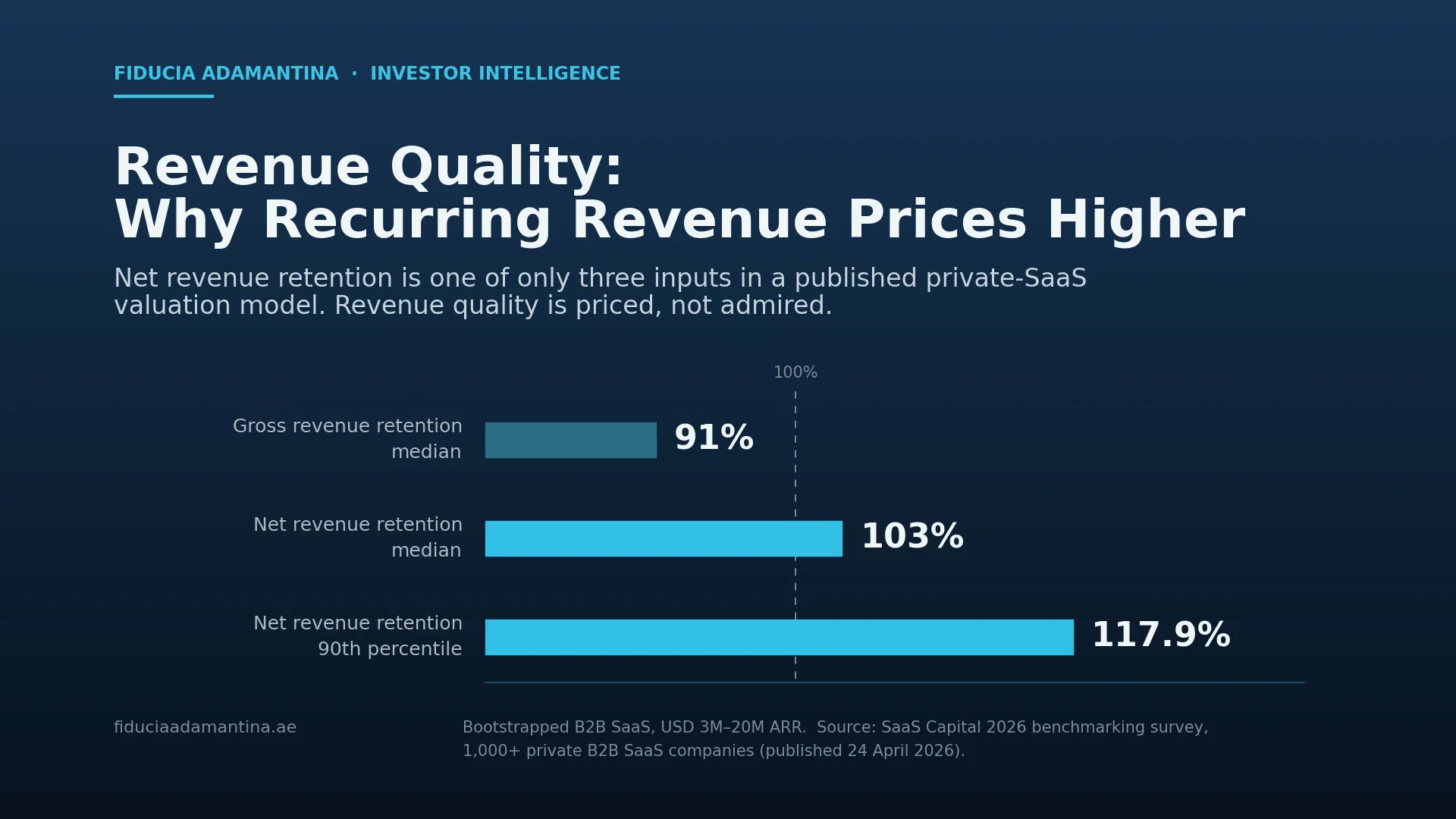
SaaS Capital publishes a private-company valuation framework built on more than a decade of data, and it runs on exactly three inputs: public market multiples, ARR growth rate, and net revenue retention (SaaS Capital, January 2025). Not brand, not team, not market size. One of three variables in a published valuation model is a pure revenue-quality metric.
Their annual survey, over a thousand private B2B software companies and now in its fifteenth year, puts the 2026 medians for bootstrapped businesses between $3M and $20M ARR at 15% growth, 103% net revenue retention and 91% gross revenue retention (SaaS Capital, April 2026). The ninetieth percentile reaches 117.9% net retention. The gap between a median company and a top-decile one on that single metric is the gap between replacing your churn and growing without selling anything new.
A second lesson from the same source: their index of public software companies sat at 7.0x run-rate revenue while the model predicted 4.8x for bootstrapped private companies and 5.3x for equity-backed ones. Private companies trade at a substantial discount to public comparables — which is why a founder benchmarking against a listed company’s multiple is anchoring to a number they were never going to get.
The 10% line: concentration is an accounting fact before it’s a deal issue
Founders tend to treat customer concentration as a soft, negotiable perception. It is a reporting threshold.
IFRS 8 requires an entity to disclose when revenues from a single external customer reach 10% or more of total revenue (Grant Thornton on IFRS 8 entity-wide disclosures). The standard-setters drew that line because that is where dependence becomes material to anyone reading the accounts. Buyers and investors did not invent their own threshold. They use that one, and it is usually among the first three questions in a first meeting.
You will find published tables claiming a specific discount at each concentration level. I would not quote them to you: they trace back to advisory firms describing their own experience, not to any dataset. What is enough to act on is that above the ten-per-cent line, contract quality and switching cost govern rather than the percentage alone. A client at a quarter of revenue on a five-year contract with integrated systems is a different risk from the same client on ninety-day terms.
So name your concentration first, with the contractual detail attached, before diligence finds it. Disclosed risk gets priced. Discovered risk gets re-traded.
What a quality-of-earnings review tests that your P&L doesn’t show
Revenue quality is also what a buyer’s accountants are hired to interrogate. A quality-of-earnings review does not check whether your revenue is real; the audit did that. It asks whether it is repeatable, separating run-rate earnings from one-off contracts, related-party work, owner-linked accounts, and the project that happened to close in December.
That is where project-heavy businesses lose the most ground, and it is why the multiple applies to the number that survives the review rather than the one you presented. The full benchmark is elsewhere on this site: which EBITDA add-backs buyers strike, and why audited accounts aren’t enough. It matters more than usual in the Gulf, where a large share of the private sector is family-owned and related-party transactions run through reported earnings as routine rather than as a problem.
Four honest ways to reprice project revenue
None of these require you to invent a subscription. All four are available inside a normal twelve-month cycle.
1. Separate contracted backlog from pipeline, and never present them together. Most founders show one “expected revenue” line. Split it into signed and contracted, verbally committed, and pipeline, each with its own conversion assumption. Investors do this to your model anyway. Doing it first converts a challenge into a disclosure.
2. Publish your repeat rate by cohort. If sixty per cent of the clients who bought in 2024 bought again in 2025, that is recurring revenue in every sense a buyer cares about, whether or not a contract calls it that. It is almost always sitting uncounted in your accounting system. Most project businesses are more durable than their own reporting makes them look.
3. Convert the top of your client base to committed agreements with minimums. Not full retainers, which most clients resist. A multi-year framework with an annual minimum moves that revenue from pipeline to contracted, and frameworks are already normal practice in most services markets.
4. Fix the concentration you can and disclose the rest. If one client sits at thirty per cent, the twelve-month answer is usually two or three new mid-sized accounts rather than one replacement whale. Where you cannot fix it, contract length and switching cost are what you build instead.
All four run through the financial model, which is where this evidence either exists or is silently missing. Our Financial Model Mistakes Guide covers the specific errors that make a revenue forecast unusable to an investor — undifferentiated revenue lines and unsupported forward assumptions being the two I see in almost every model I review. It is the fastest way to find out whether your model tells the revenue-quality story or hides it.
The same lever pays twice
Almost every other preparation task pays once. A better deck helps you raise and is worthless in a sale. A clean data room helps in a sale and does little in a seed round. Revenue quality does both on the same evidence, because a growth investor and a trade buyer are asking a version of one question: how much of this continues without you selling it again?
That is why it belongs at the front of the preparation sequence. When we run an Investor Readiness Sprint — the fixed-fee build of the deck, the management-input financial model, one cap-table scenario, the founder narrative and the rehearsal pack — the revenue-quality evidence usually decides whether the model is defensible or merely tidy. The Investor Readiness Sprint builds those materials; it does not remediate the underlying business, and the founders who get most from it have already done the four moves above. If you would rather diagnose than build, the Investor Readiness Scorecard is the shorter route.
Either way, start with the model. Take the Financial Model Mistakes Guide, open your own forecast beside it, and find out whether your revenue base can be underwritten by someone who has never met you. That is the test being applied, on a raise and on an exit, and it is one you can pass with the revenue you already have.
Frequently asked questions
What is revenue quality?
Revenue quality is how underwritable your revenue is — how much of next year's number already exists without a new sale. It breaks into three separate tests: predictability (is it contracted or does it have to be re-won), durability (do customers stay and expand), and concentration (how much of it can one customer take away). Recurring revenue tends to score well on all three, which is why it prices higher, but it is the three properties that get priced, not the billing model.
Does recurring revenue really increase business valuation?
Yes, but not the way most articles describe it. Revenue quality rarely moves a company between valuation bands — it moves you within your band, and it can change which earnings basis you get multiplied on (ARR, EBITDA or SDE). The headline claims you see online, like 'recurring revenue is worth 2-3x more', usually compare a revenue multiple against a profit multiple, which are different denominators and not comparable.
How do investors treat project revenue?
They discount the forecast, not the history. Project revenue that has already been delivered is real money and nobody disputes it. The problem is the projection: if every dirham of next year has to be re-won, an investor underwrites the sales capability rather than the revenue base, and prices the uncertainty. Contracted backlog, repeat rates by cohort, and multi-year agreements with minimums are what move it back.
How much customer concentration is too much?
Ten per cent is where it stops being a private matter. IFRS 8 requires an entity to disclose any single customer representing 10% or more of revenue, so the accounting standards themselves treat that as the materiality line, and buyers use the same one as an opening question. Above that, what matters is contract quality and switching cost, not the percentage alone — the honest move is to name your concentration first rather than let diligence find it.
Can a project-based business ever have high revenue quality?
Often, yes. A contracting or professional-services business with multi-year framework agreements, high client repeat rates, and no customer above ten per cent of revenue can be more underwritable than a subscription business losing a fifth of its base every year. The billing model is a proxy. What is actually being tested is whether next year's revenue exists before the year starts.