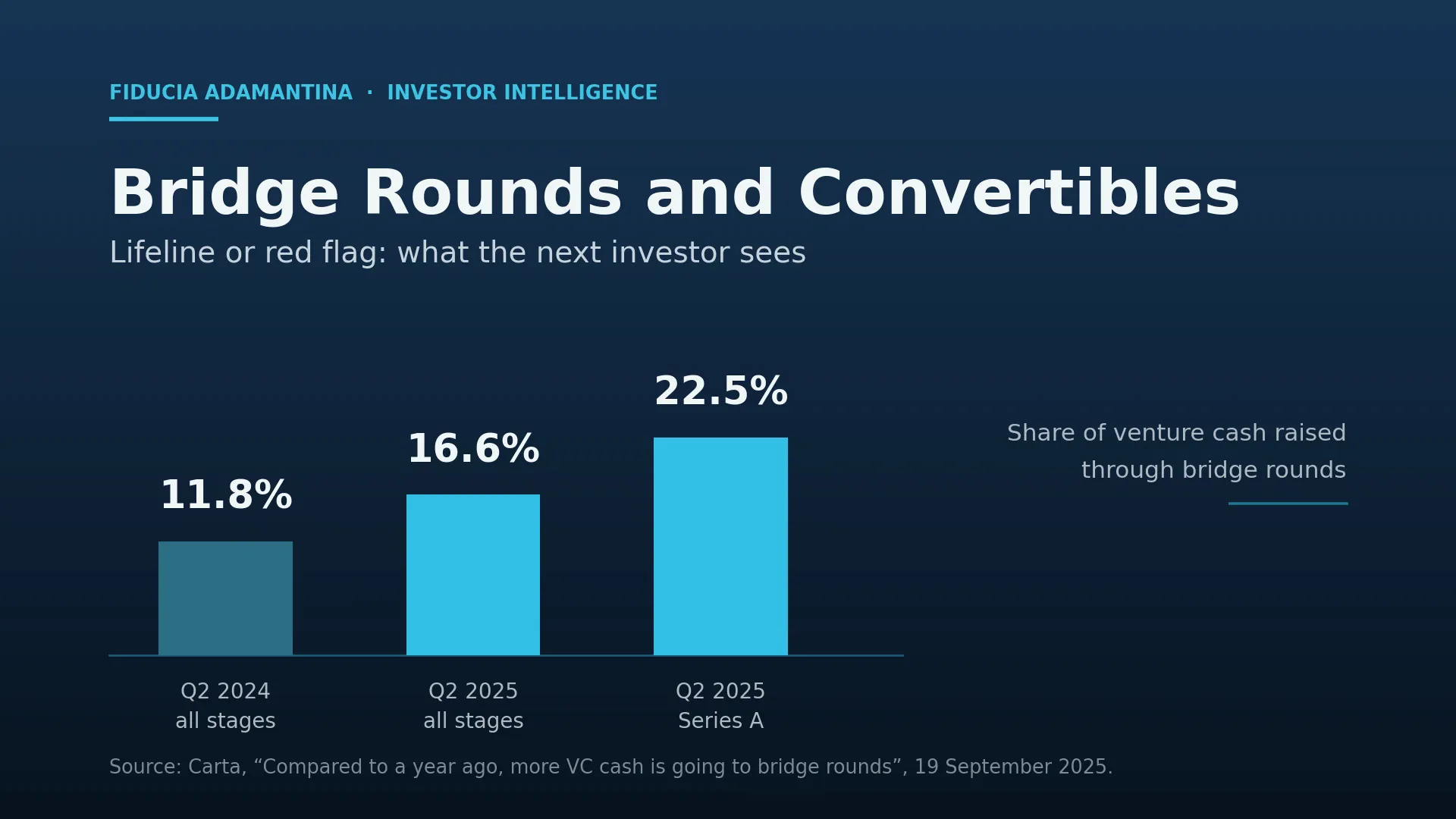
In the second quarter of 2025, 16.6% of all the cash startups raised on Carta came through bridge rounds, up from 11.8% a year earlier. At Series A the figure was 22.5%, the highest of any stage (Carta, September 2025).
So the honest answer to “does a bridge make us look like we are failing” is: not by itself. It is too common for that. What decides how yours reads is the reason attached to it and the terms you sign. In our practice I have seen founders raise a bridge that made the Series A easier, and founders raise one that quietly set the ceiling on their next valuation eighteen months before they got there. The instrument was identical in both cases.
A bridge is a statement about your last round, not your next one
A bridge round, or extension round, is money raised between priced rounds, usually on a convertible note or a SAFE and usually without a new valuation. It converts into equity when the next priced round closes.
That structure is the point. You are borrowing against a price you have not agreed yet, and everything below follows from that one fact.
The reason bridges have become normal is not that founders got worse. It is that the gap between rounds got longer. Carta put the median interval between primary funding rounds at 696 days in Q2 2025, about 23 months, against roughly 600 days two years earlier. Size a raise for an 18-month runway on the old timetable and the arithmetic runs out before the next round arrives. That is a planning problem, not a performance one, and the fix belongs in how you size the round rather than in a bridge.
It is also not a general capital freeze, and calling it one costs you credibility in the room. Carta recorded $30.4 billion raised in Q1 2026 with the down-round rate at 11.4%, down from a peak of 22% in 2023. The problem is concentration, not scarcity: more than 60% of that capital went to AI companies, and Carta put the median Series A valuation for an AI foundational-model startup at $300 million against $55 million for a non-AI startup at the same stage (Carta, May 2026). Outside that concentration the market is slower for you specifically, which is the subject of our longer read on raising outside AI in 2026.
The two bridges investors can tell apart
Every bridge falls into one of two categories in the mind of the person diligencing it later.
The milestone bridge. You have a named, dated thing you are buying: a contract that lands in Q3, a unit-economics threshold, a regulatory approval, a second market live. The bridge is sized to reach it with margin. When the Series A investor asks what the money was for, there is a sentence that ends in a number.
The runway bridge. You needed cash. The plan is to keep going and see. There may be good reasons for it, but there is no sentence at the end, and diligence finds that out fast.
There is a second thing the next investor reads: who wrote the cheque. A bridge funded by your existing investors, at meaningful size relative to their position, is the strongest signal available to you: the people with the most information about your company chose to add to it. A bridge where insiders sat out and outsiders came in is a yellow flag, and everyone at the next table knows how to read it. Before taking a bridge from a new party, find out why the existing holders are not leading it. Your Series A investor will ask, and you should not hear the answer for the first time from them.
The cap and the discount decide more than the headline number
A bridge converts on whichever term is better for the investor: a valuation cap, or a discount to the next round’s price. Take a $1.5 million bridge on a $12 million post-money cap with a 20% discount, and assume the Series A prices at $25 million pre-money. The discount works out to an effective $20 million. The $12 million cap is lower, so the cap is what applies, and the bridge investor converts into 12.5% of the company as it stands immediately before the new money lands.
Now compare that with not bridging. Hold the Series A price at $25 million pre-money and put the same $7.5 million of total capital in either way.
- With the bridge: $1.5 million on the cap, then a $6 million Series A. After the round the bridge investor holds about 10.1%, the new fund 19.4%, and everyone who was on the cap table before the bridge holds about 70.5%.
- Without it: one $7.5 million Series A at the same price. The new fund holds 23.1%, and the prior holders keep about 76.9%.
Same money in, same price, more than six percentage points of the company gone. That gap is what the cap cost, and on a post-money SAFE it falls on the existing holders rather than on the incoming round: you and your earlier investors, not the new fund. The general form of this arithmetic is in what your round actually costs you.
So a cap set generously in a hurry is a real price, not a placeholder. And stacking bridges is where cap tables break: two bridges at two caps, an MFN clause pulling the better terms across both, and a next round that has to clear all of it before the founder sees a share. One bridge is a bridge. Three is a story about a company that could not reach the other side, and it will be read that way. Our piece on cap table red flags has the fuller catalogue of what that looks like from the investor’s seat.
The thinner the market you are raising into, the more the cap matters, because there is nothing to calibrate it against. In our practice a Gulf bridge is usually a private conversation with two or three existing holders rather than a process, and no competing term sheet ever arrives to tell you the number was wrong.
Note or SAFE matters less than founders think, except on one point
The instrument debate absorbs more founder attention than it deserves. A convertible note is debt: it accrues interest and carries a maturity date. A SAFE is neither, and has no maturity date. Both convert on a cap or a discount, and both dilute you the same way when they do.
The one asymmetry worth your attention is the maturity date. If a note matures before your Series A closes, the holder acquires the right to ask for repayment, at precisely the moment you have the least cash and the weakest hand. Notes do not usually get called, but the option exists, and it changes the tone of every conversation you have with that investor in month eleven. If you take a note, set the maturity beyond your realistic Series A close, then add six months, because your realistic close is optimistic.
Whichever you choose, model the conversion before you sign rather than discover it afterwards. The version we see most often is a model that shows the raise but not the conversion, so the deck and the cap table are telling two different stories by the time an investor checks. Our Financial Model Mistakes Guide sets out that error and the others that surface in diligence.
Structuring one that does not price your Series A for you
Ordered by how much money each one moves.
- Size it to a milestone, with margin. Work backwards from the evidence you need, add three months, and raise that. A bridge that runs out two months short costs you the dilution and buys you nothing.
- Treat the cap as a price. If your Series A ambition is $25 million pre-money, a $12 million cap has already conceded half of it. Negotiate it as hard as you would a priced round, because economically that is what you are doing.
- Get the insiders in first. Their participation is the signal. Go outside once you can say the existing holders are in.
- Cap the stack. One bridge, one cap, one set of terms. Resist the second instrument with different economics.
- Write the story down now. One paragraph: why the bridge, what it bought, what changed. Put it in the data room. If you cannot write it today, the diligence version will not be better in nine months.
What founders skip past
Cut burn instead. Unglamorous and frequently correct. A bridge that buys six months costs real ownership; six months of reduced spend costs you nothing but the plan you had.
Non-dilutive debt. Venture debt and revenue-based facilities are the honest comparison to a bridge, and in our practice founders reach for the bridge without ever pricing the two side by side. The comparison is in venture debt versus equity.
A smaller priced round. If your metrics support a price at all, a modest priced round is usually cleaner than a bridge with an aggressive cap. It sets a reference point, removes the conversion overhang, and requires no explanation later.
Before you take the money
Most of the bridges I would argue against are not bad decisions about capital. They are timing decisions taken with an incomplete picture, by founders who could not yet answer on paper what the next investor was going to ask.
If you are weighing one now, start by finding out where your materials stand. Our free Investor Readiness Scorecard takes a few minutes and tells you whether the gap between here and a Series A is a capital problem or a preparation problem. If the model is what is missing, start with the Financial Model Mistakes Guide instead.
And if the answer is that the raise materials themselves need rebuilding before you speak to anyone, that is what our fixed-fee Investor Readiness Sprint is for: AED 25,000, two to three weeks from complete intake, 50% at kickoff and 50% on delivery. It builds the agreed deck, the management-input model, a cap-table scenario that shows what your bridge actually converts into, the founder narrative, a live rehearsal and an editable handover pack. It does not introduce you to investors, run your process or guarantee a term sheet, and it does not require you to appoint us on the raise afterwards. An Investor Readiness Sprint is a materials build and nothing more than that: it will not tell you whether to bridge. What it will do is make sure that when you go out, the conversion is already in the model and you are not explaining it for the first time in a diligence call.
A bridge should be a decision you made, not one that made itself in month nine. Founders raising capital is where that conversation usually starts.