“Why two million?”
Forty minutes in, the meeting had gone well until that point. The founder gave the honest answer, which was a version of it felt about right: two million was what companies like his seemed to raise. The meeting did not recover, and he spent the drive home assuming he had been caught out on the number.
He had not. He had been caught out on the derivation. The investor had no view on whether two million was correct, and no way of forming one in forty minutes. She was testing whether the number came from somewhere. A founder who cannot derive their round size usually cannot derive their hiring plan, their burn, or the milestone the money is supposed to buy.
(That founder is a composite drawn from engagements in our practice, as are the worked numbers later in this post. The pattern is real and common; the specifics are illustrative.)
Round size is the first number in your raise that is entirely yours. The valuation gets negotiated; the terms are drafted by someone else. The amount is your claim about what the next phase of the company costs. Treat it as a claim and it works for you. Treat it as an arithmetic output and it is the softest thing in your deck.
“Why two million?” is a test, not a question
There are three answers to that question, and investors tell them apart immediately.
The first is the market answer: this is what seed rounds are. It fails because it tells the investor you are pricing off other people’s companies. It also fails on the facts. Carta recorded over 60% of all venture capital raised on its platform in Q1 2026 going to AI companies, with foundational-model startups raising at Series A at a roughly $300 million median valuation against roughly $55 million for a non-AI startup at the same stage (Carta, State of Private Markets: Q1 2026). A blended median drawn from that market is two markets averaged together. If you are not in the first one, the number you are copying was set by companies you are not competing with for capital.
The second is the runway answer: this gives us 18 months. Better, because it has an input. Still incomplete, because it says nothing about what the 18 months are for. The investor hears a request to be kept alive.
The third is the milestone answer: this funds the specific evidence that makes the next round raisable, plus the time it takes to raise it. Every part of that can be interrogated and every part has a source inside your own business. It is the only one of the three that survives a follow-up question, and there is always a follow-up question.
The 18-month runway plan quietly under-funds you
Nearly every guide to round sizing tells you to raise 18 to 24 months of runway. Almost none of them check that figure against how long a round now takes to happen.
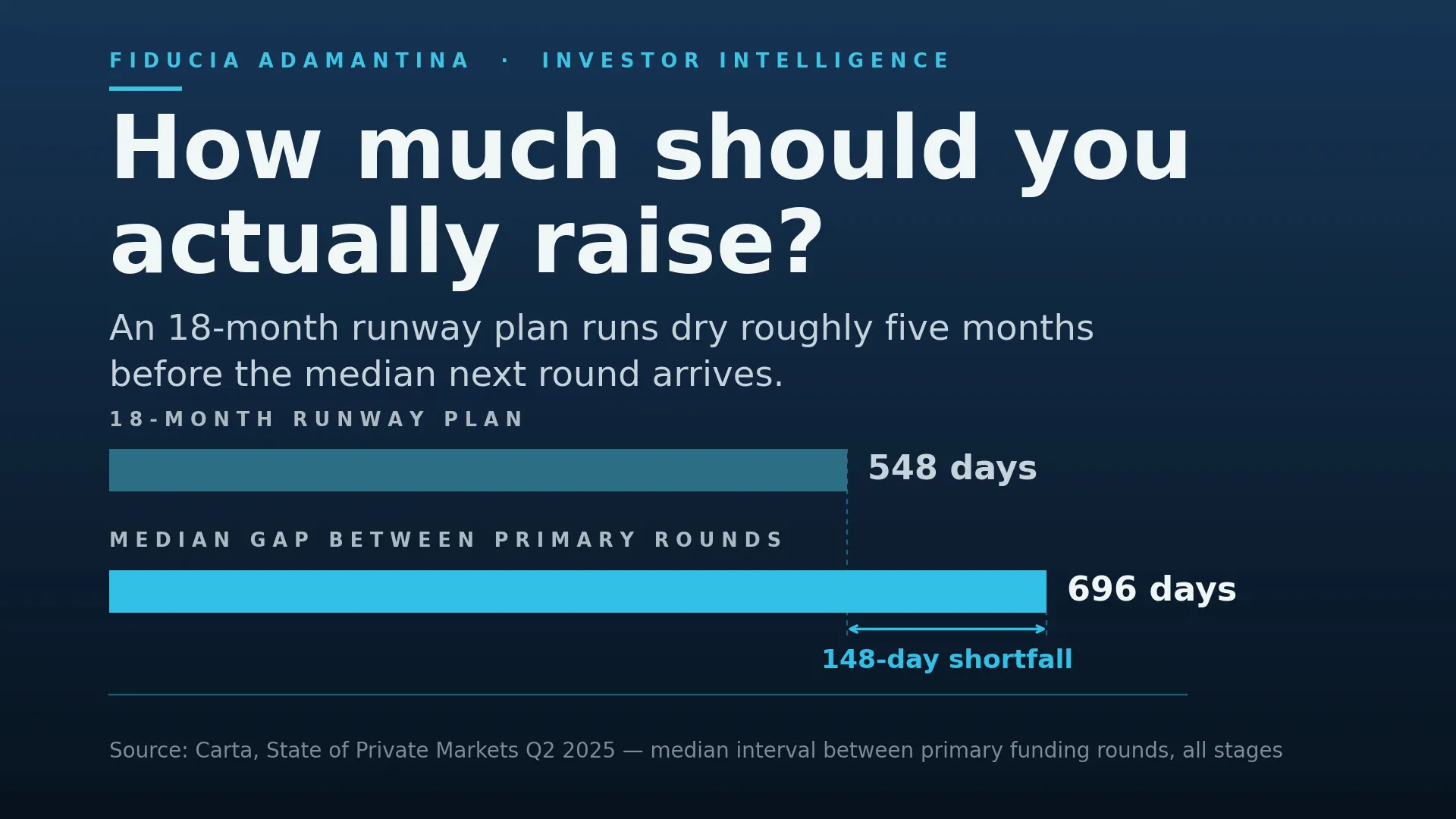
Carta puts the median interval between primary funding rounds at 696 days, about 23 months (Carta, State of Private Markets: Q2 2025). Two years earlier the median was roughly three months shorter, near 600 days (Carta, bridge rounds, September 2025). The gap between rounds has been widening.
Read that against an 18-month plan. At the median, a founder who raises 18 months of runway runs out of money about five months before the next round would have happened. They do not arrive at the milestone late. They arrive at the fundraise with a cash position visible to everyone they pitch, which is the worst available negotiating posture.
The rule is not wrong because 18 months is a bad number. It is wrong because it is runway to a date, when what you need is runway to a milestone plus a raise. The plans that hold up state three components separately: months to the milestone, months of raise process, months of named buffer. When a founder shows me a single runway figure with no split, the raise process has almost always gone unbudgeted.
What under-raising actually costs
Founders under-raise for a good reason: dilution. Raising less looks like keeping more. The arithmetic supports that right up until the money runs out early, and then it reverses hard.
The visible cost of running short is the bridge. Carta’s numbers show 16.6% of all cash raised by startups on its platform in Q2 2025 came through bridge rounds, up from 11.8% a year earlier. At Series A specifically, bridges accounted for 22.5% of all cash raised (Carta, bridge rounds, September 2025). More than one dollar in five going into Series A companies was buying time rather than growth.
Bridges have lost much of their old stigma, which is useful: a company needing four more months of ARR growth to clear a higher bar should take the four months. But a bridge taken from weakness is expensive in ways the headline dilution number does not show. It is usually priced or capped by existing investors who know exactly how much cash you have left, and it adds a second conversion event to the cap table, which compounds into the next priced round. The full arithmetic of what a round costs you is usually worse than the term sheet’s headline percentage, and stacked instruments are the main reason.
The dilution you avoid by raising 20% less is frequently smaller than the dilution you take in the emergency round twelve months later. Under-raising defers dilution. It rarely reduces it.
Over-raising is not the safer error
The correction is not “raise as much as you can get.”
Over-raising costs you twice. The first cost is immediate: you sell more of the company than the milestone required. The second is delayed and more dangerous. A larger round sets a valuation you then have to grow into before anyone will price you higher, and if your next 23 months of evidence cannot justify it, the following round is flat or down. That failure now stands out more than it used to: Carta put the down-round rate at 11.4% in Q1 2026, back in line with 2019 and 2020 levels. When roughly one round in nine is a down round, being that one is conspicuous.
A third cost appears on no cap table. Money that arrives before the plan is ready gets spent on the plan you had, not the plan you learned. Excess capital at seed reliably funds premature hiring, and premature hiring is how a company reaches Series A with a burn rate it has to explain and a revenue line that did not keep pace.
The right size funds the evidence, plus the raise, plus a named buffer. Then it stops.
Size the round backwards: the four inputs
Most founders build the number forwards. They open the model, project the hires they want, add a marketing budget, sum the burn, multiply by a runway figure, and read off the total. The number comes out of the spreadsheet and gets a story attached afterwards. Reverse it, and four inputs do all the work. Each is answerable from inside the business, which is exactly why the resulting number holds up under questioning.
1. The milestone, stated as evidence rather than ambition. “Get to Series A” is not a milestone. “$1.4m ARR with net revenue retention above 105% and a paid channel at nine-month payback” is a milestone. It is falsifiable, which is what makes it credible.
2. The operating cost of reaching it. Built bottom-up: named roles with start months, the sales and marketing spend that produces the pipeline, the infrastructure that carries the volume. Not a growth percentage applied to today’s burn. A top-down model cannot produce a defensible round size, because it never costed anything; the bottom-up build investors actually engage with starts from hires and unit costs and works up.
3. The raise window, budgeted as real months. Against a 696-day median between rounds, budgeting six months of process is not conservative. It is close to observed reality, and it belongs in the plan as its own line rather than absorbed into optimism. If you have never run a raise end to end, cost it from someone who has, which is one of the reasons founders bring in capital-raise advisory before the plan is fixed rather than after.
4. A buffer with a name. “Twenty per cent contingency” tells an investor nothing. “Four months of buffer, because our enterprise sales cycle has run between five and eight months and two of the three deals in the plan sit at the long end” tells them you have thought about the specific way this could go wrong.
Add the four together and you have a number. More usefully, you have the four sentences that sit underneath it, and those sentences are the real deliverable, because they are what you say when you are asked.
To hold the rest of the raise story to the same standard, our Investor Readiness Checklist walks the material an investor will interrogate, in the order they will interrogate it.
When the market data won’t give you a benchmark
Founders raising in the Gulf meet a sharper version of this problem. Regional data is strong on capital deployed and deal counts and weak on anything usable as a stage benchmark. There is no reliable, current, MENA-only median pre-money valuation by stage: the one public benchmark blends the Middle East with Southeast Asia, reports means rather than medians, sits behind a paywall, and runs only to H1 2024. Round sizes come in ticket-size bands, and a handful of mega-deals distort any average drawn from them. The full picture is in our MENA startup funding benchmark.
Most founders read that as a disadvantage. It is closer to the opposite. Where no credible market number exists, nobody in the room can anchor against you with one. Milestone-backwards derivation is not the fallback in that environment; it is the only method with standing, and a founder who arrives with it is arguing on ground of their own choosing. The discipline generalises. Even in data-rich markets, a benchmark tells you what other companies raised, never what your company needs.
What to say when they ask
The answer to “why this number” should take about thirty seconds and sound like this:
“We’re raising to get to $1.4m ARR with retention above 105%, which is what the Series A funds we’ve mapped want to see. That takes four hires, eighteen months, and about $1.6m of operating cost. We’ve budgeted six months to run the next raise and four months of buffer against our enterprise sales cycle running long, which at our burn by then is another $1m. That’s $2.6m.”
Nothing there is clever. Every clause is checkable. That is the point: an investor can push on any single assumption without the structure collapsing, and you can concede a point without conceding the number.
That answer is not written the night before the meeting. It is the output of a model, a hiring plan, and a milestone definition that agree with each other, and getting those three to agree is most of the work of preparing to raise. Building exactly that is what the Investor Readiness Sprint does: the deck, the bottom-up operating model carrying use of funds, runway and milestone logic, one cap-table scenario, and the rehearsal to deliver it. It is a fixed-fee build, two to three weeks from complete intake, bought on its own terms with no mandate or success fee required. Scope and price sit on the Investor Readiness Sprint page.
Start shorter. Work through the Investor Readiness Checklist against your own raise and count how many of the four inputs above you can answer today. If you want a structured read on where the gaps sit, the Investor Readiness Scorecard takes about five minutes.
The number itself rarely moves much once a founder does this work. What changes is that they can say where it came from, and the second set of meetings stops asking twice.