A founder walked me through a 47-tab spreadsheet last month. The TAM slide projected the GCC software market at $4.8 billion by 2030. Three weeks of modelling work. The first investor question, “What’s your customer acquisition cost in Saudi versus the UAE?”, wasn’t in the file.
That gap, between a model that looks ready and one a MENA investor will trust, is what this post is about. Not how to build one from scratch; that is a finance textbook. This is what a fundraising model needs to do specifically in this region, and where founders most often lose the room.
Why MENA investors read your model differently
The default startup model in 2026 is built for a generalist US Series A reader. It tells a three-to-five-year story to an exit, headline growth on month 60, and a TAM slide that assumes the global market.
That structure travels poorly to a meeting with a GCC sovereign-linked fund, a Riyadh family office, or an ADGM-licensed regional VC. Three reasons.
First, the time horizon is different. Bloomberg reported in late 2025 that Middle East startups hit a record fundraising year, with sovereign and institutional capital increasingly underwriting companies on 7-to-10-year horizons. Wamda’s 2025 wrap-up confirmed the region closed the year at $7.5 billion in venture funding. The capital base in this market is patient by structure, and a model that compresses the path to liquidity into 36 months reads as someone else’s pitch.
Second, the cost base on the page is rarely the cost base in the region. A software cost template lifted from a US source will allocate engineering, sales, and infrastructure in ratios that do not match a founder operating across Cairo, Dubai, and Riyadh. The numbers signal that the founder has not internalised the operating reality.
Third, the questions are different. A regional family office or sovereign-backed fund will press on currency exposure, regulatory pathway, regional unit economics by market, and how the cap table accommodates strategic investors with longer hold periods. A US-styled model has answers to none of these as a default.
The fix is not a “MENA template.” It is understanding which assumptions get tested in the meeting and modelling them deliberately.
One calibration before the detail: the model is a single pillar of readiness, not the whole structure. Fifteen minutes with the free Investor Readiness Scorecard will tell you whether the pillars around it hold up — legal structure, pitch materials, strategic positioning — and name the gaps an investor will find before they find them.
The three numbers a MENA investor will check first
Almost every first-meeting model walk-through I sit in opens with the same three questions.
Run-rate revenue, this month. Not pipeline. Not forecast. Last month’s collected revenue annualised. If the answer is a range, the meeting tone shifts within two minutes.
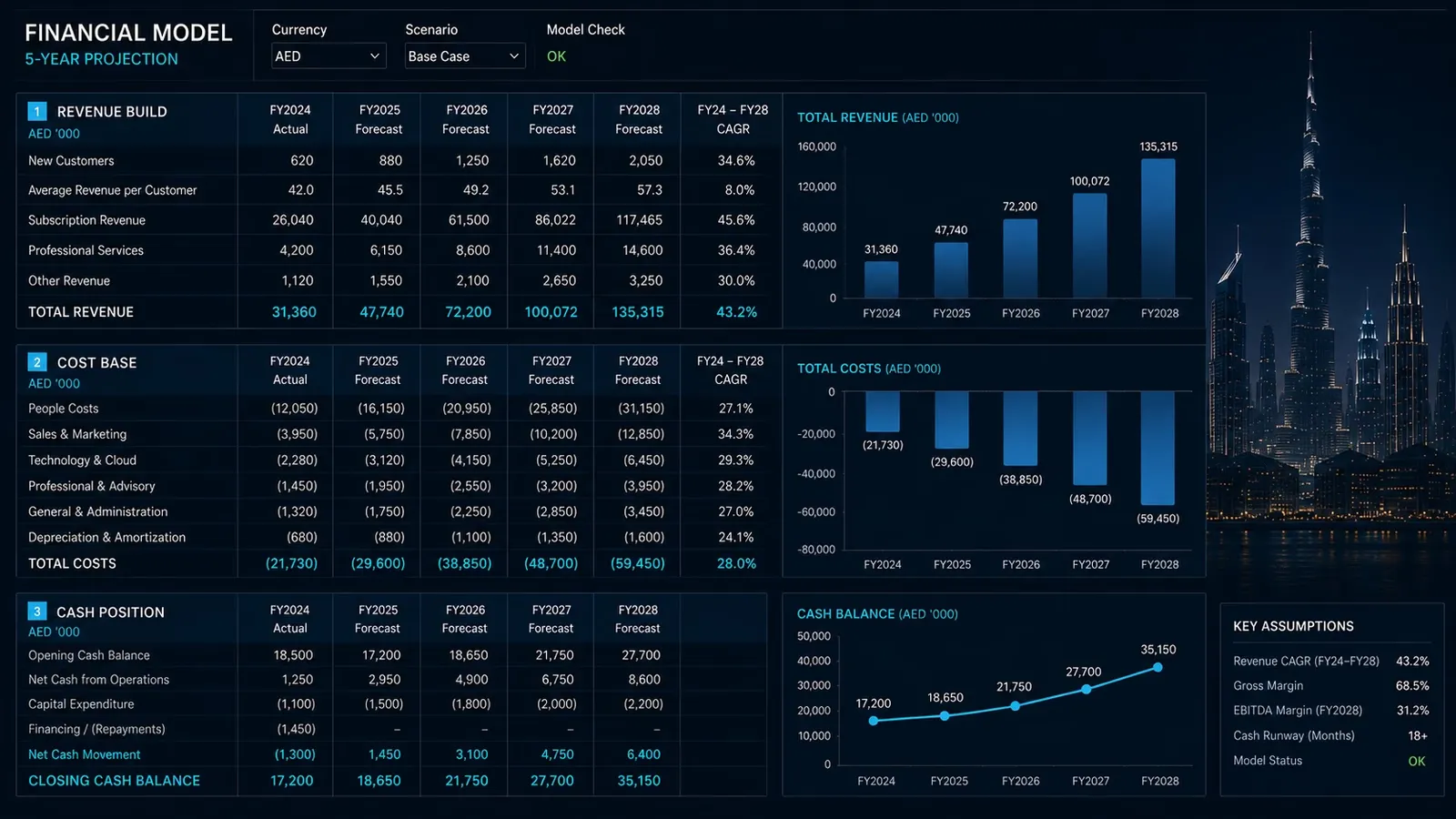
Burn and runway, measured against the actual cash balance. A founder who says “we have 18 months of runway” without naming the monthly burn rate and the current cash position is asking the investor to take an assumption on faith. The model should show the cash balance line on a monthly basis, alongside the burn, alongside committed pipeline.
Customer acquisition cost, by market and by channel. Not blended CAC. CAC in Saudi looks different from CAC in the UAE, which looks different from CAC in Egypt. Different sales cycles, different channel mix, different price elasticity. A blended number hides the question every investor in this region asks: which market is actually paying off?
If the model can answer these three cleanly, the meeting is about strategy. If it cannot, the meeting is about the model.
Build revenue bottom-up, not from a TAM slide
The fastest credibility loss in a fundraising model is the line “we capture 1 percent of a $X billion market.” Every investor reads it as filler. A bottom-up forecast, built from number of customers, average contract value, broken out by segment and by market, is harder to build and dramatically more defensible.
Bottom-up forces the founder to confront the assumptions that drive growth. How many sales reps. How long is the cycle. What is the conversion rate from pipeline to closed. What is the average deal size by tier. Those are the numbers a serious investor will probe, not the TAM.
The discipline pays off in the room. A founder with a bottom-up build can adjust an input live (“what if our enterprise close rate is 15 percent instead of 25 percent?”) and walk through the impact on the next twelve months. A founder with a top-down model can only say “I’ll need to check.”
The MENA cost base most models miss
The cost side is where most fundraising models in this region reveal their non-regional origins.
Engineering costs vary by where the team actually sits. A Cairo or Karachi engineering hub costs a fraction of a Dubai-based team. If the model shows a Gulf-only cost structure, it understates feasibility. If it shows an Egypt-only structure, it understates customer-success costs and regional sales infrastructure. Most regional companies operate on hybrid bases. The model should reflect it.
Localisation hiring quotas (Saudisation in KSA, Emiratisation in the UAE) are not optional inputs. They shift the cost ramp meaningfully as the company scales in either market, and a model that does not account for them will be re-priced by the investor in the room.
Free-zone operating costs (DIFC, ADGM, DET) are real line items. So are visa renewal cycles, mandatory medical insurance for staff, and the fixed cost of an audited UAE entity once revenue crosses the corporate tax threshold. None of these break a model on their own. Their absence signals that the founder has not yet operated a UAE entity at scale.
Currency risk: the silent assumption gap
Most models I review state a single reporting currency on the cover page and leave the FX assumption implicit. That is where regional investors press hardest.
If revenue is in SAR and costs are in AED, the cross-rate must be modelled explicitly. Both currencies are pegged to the US dollar, but stability is not a guarantee, and a sovereign-linked fund will want to see that the founder knows the difference.
If revenue is in EGP, the position is more serious. The Egyptian pound has depreciated meaningfully against the dollar through 2024 and 2025 after the Central Bank moved to currency flexibility. Modelling Egyptian revenue at the original rate without a sensitivity is a red flag, not a simplification. The minimum sensitivity table covers three scenarios: pegs hold, EGP devalues further over the period, and SAR de-pegs (low probability, high impact, and a question a sovereign-linked fund will ask). A two-line note in the assumptions tab is enough. The absence of it is the issue.
Unit economics and the path to profitability
Investors across the board, from Gulf seed funds to growth equity, are pressing harder on the path to cash-flow breakeven than they were two years ago. The hockey-stick growth narrative without an underlying margin story has lost its currency.
The minimum standard now: LTV-to-CAC ratios shown by cohort, not as a blended headline number. Payback period measured in months, with the underlying churn assumption visible. A specific month, not a year, when monthly cash burn turns positive on the base case.
If the model is built bottom-up and the cost base is accurate, these numbers fall out of the existing structure. They are not an additional exercise. They are how a serious investor reads what the model already says.
The AI question is now standard, even for non-AI businesses. A regional investor will ask how AI affects the cost base, the margin profile, or the competitive position over the next 24 months. A line in the model, not a slide.
Sensitivities investors will actually press
A single base-case projection invites scepticism. Three scenarios (base, downside, upside) with the cash position visible on each signal financial maturity.
The downside case is the one investors will press first. Pricing down 10 percent. CAC up 30 percent. Churn up 200 basis points. The question is not whether the model still hits the Series B target. The question is whether the business survives without an emergency raise. If the downside case shows cash running out in month 14, the investor needs to see how the founder responds operationally: what costs come out, what hires get paused, what runway extension is available.
Three scenarios. Cash position visible on each.
The model is a conversation, not a deliverable
The single biggest determinant of how a fundraising meeting goes is not the model itself. It is whether the founder can walk through it.
A founder who built the model, line by line, can answer the assumption question with a number. A founder who outsourced the model, to a consultant, an associate, or a template, gets stuck on the second probe. The model becomes the meeting.
The work in the weeks before a raise is not building the model. It is owning it. Defending each input. Knowing which assumptions are conservative, which are stretches, and which are the ones the investor will press hardest.
That work is part of the Investor Readiness Sprint, an independently buyable materials build. The model is one of its core outputs alongside the pitch deck, cap-table scenario, and founder narrative. The fixed scope does not include building the data room or independently validating the valuation.
Where to start
Before booking a Sprint conversation, the most useful first step for a founder preparing to raise is to benchmark their current model against the mistakes that most often kill credibility in MENA fundraising rooms. We have collected the most common ones, the cost-base errors, the FX gaps, the unit-economic shortcuts, into a single short reference: our Financial Model Mistakes Guide.
The Guide sits inside the Investor Readiness Scorecard resource library. The Scorecard takes about fifteen minutes and gives a structured view across its four categories — legal structure, pitch materials, financial clarity, and strategic positioning — the same ground investors test in a first meeting. Founders who score weakest on financial clarity benefit most from the Sprint.
If the Scorecard surfaces model and presentation gaps, the Investor Readiness Sprint can rebuild the defined model, deck, cap-table scenario, and narrative for AED 25,000 in 2–3 weeks from complete intake. It stands alone and excludes data-room work. Paid fees are eligible for the optional 90-day raise-mandate credit. Credited only if we take the raise mandate.
Founders who walk into a MENA investor meeting with a model they own, an honest downside case, and an answer to every probe in the assumption sheet are the ones who get a second meeting.