
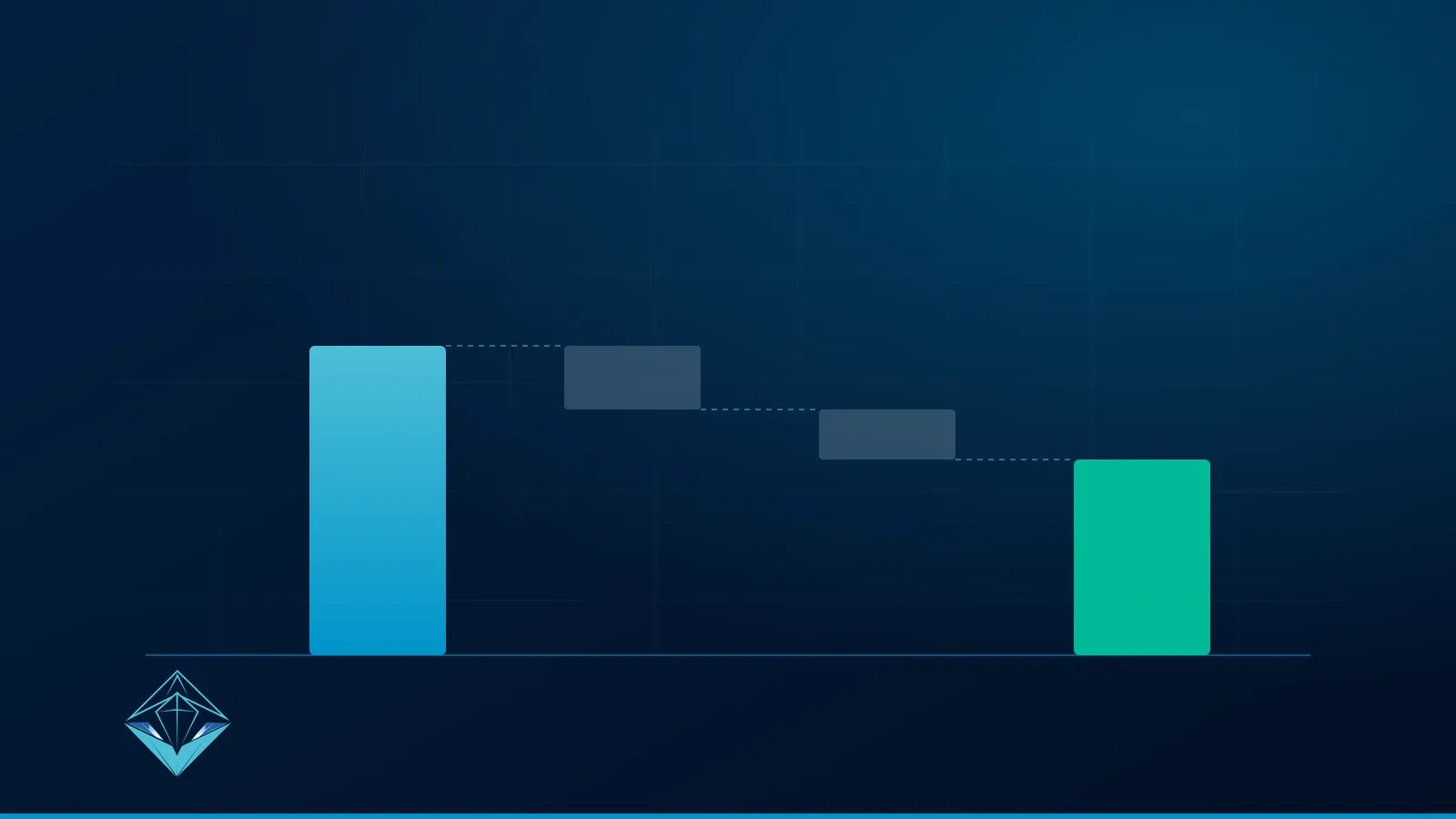
Two businesses present the same “adjusted EBITDA” to the market. After diligence, one’s number holds and the other’s is cut by a fifth — and since the multiple applies to whatever survives, the second seller just lost a fifth of their price without a single term changing. The adjusted EBITDA a seller presents and the EBITDA that survives an independent quality-of-earnings review are different numbers. This is the benchmark for that gap: what a QoE actually tests, which add-backs buyers strike, why audited accounts don’t settle it, and the reason normalisation is heavier work in the Gulf.
An honest note on the data
Hard quality-of-earnings statistics — how often a QoE moves EBITDA, by how much, which add-backs get rejected — are largely proprietary to the advisory firms that run the engagements, and the public figures are US-centric. The defensible spine here is therefore US/global: SRS Acquiom on purchase-price and working-capital adjustments, GF Data on sell-side QoE and valuation, and the University of Sheffield’s Audit Reform Lab on why audits miss earnings problems. No GCC- or MENA-specific QoE-adjustment dataset exists, so we don’t quote a regional percentage; the Gulf read is qualitative, grounded in the IFRS-for-SMEs related-party regime and the region’s family-business economy. And where you’ve seen “5–15% of EBITDA gets cut” or “30–50% of LOIs re-trade,” treat those as practitioner rules of thumb from secondary blogs — we’ve deliberately left them out because no primary source stands behind them.
What a QoE tests: the EBITDA waterfall
A QoE walks reported EBITDA → normalised EBITDA → run-rate EBITDA, testing every add-back, normalising working capital, and isolating one-time items, so everyone prices off what the business sustainably earns rather than a flattering snapshot.
The reason it sits on top of an audit is that an audit confirms compliance with accounting standards — not that the earnings are real or repeatable. The evidence for that gap is stark: auditors failed to identify material going-concern uncertainties in 75% of significant UK corporate failures between 2010 and 2022, with the Big Four issuing prior-year warnings in under 40% of cases (University of Sheffield Audit Reform Lab, via CFA Institute). A clean audit is necessary; it is not the number a buyer underwrites.
The add-back taxonomy — and which ones buyers challenge
Most disputes are about a familiar set of adjustments:
- Excess owner compensation — only the spread over a market-rate replacement is defensible, never the full salary. This is the single most-contested add-back and the one founders most often overstate.
- Genuine one-offs — legal settlements, fines, one-time professional fees. The trap is the “one-off” that quietly recurs every year.
- Personal expenses run through the business — vehicles, travel, owner perks.
- Below-market rent on owner-held real estate, and related-party or non-recurring revenue.
There is no published statistic for how many of these get struck, and we won’t invent one. The honest rule is that defensibility is about documentation and recurrence, not category — an add-back you can evidence line by line survives; one you can’t, doesn’t. What the data does show is who holds the pen when an add-back is contested: purchase-price-adjustment mechanisms now appear in well over 90% of private-target deals (up from about half fifteen years ago) (SRS Acquiom 2026, via Mondaq/Fasken) — the contractual hook that lets a buyer reset the price to the number that survives.
The number that survives: presented vs accepted EBITDA
Getting this number right before going to market is measurable money. Sellers who commissioned a sell-side QoE were associated with 7.4x TEV/EBITDA versus 7.0x for those who didn’t — across 360 transactions since Q3 2024, with the lift most pronounced on deals over US$50m of enterprise value (GF Data, via Middle Market Growth). It’s an association, not proof of causation — but a 0.4-turn difference multiplied across the whole EBITDA base is real, and the discipline behind it (a defensible number) is exactly what a buyer rewards.
The opportunity is the adoption gap. By one experienced practitioner’s estimate, at least 90% of private-equity-backed sellers run a QoE versus only about 50% of founder-led lower-middle-market businesses — so founders routinely walk into a buyer-side QoE unprepared, and meet the buyer’s version of their earnings for the first time across the table. This is the same discipline as a sell-side due-diligence pass and the broader exit-readiness work: present a number you can defend, before someone else recalculates it for you.
Working capital: the second number that re-prices at closing
Even when the headline price holds, a second mechanism quietly moves cash: the net-working-capital peg and its post-close true-up. And it runs in the buyer’s favour. Across SRS Acquiom’s study of over 1,200 private-target deals, buyers’ proposed working-capital calculations were reviewed and ultimately accepted in seven of every ten cases; the average buyer’s initial claim was 0.9% of transaction value, and 24% of claims exceeded 1% (SRS Acquiom Working Capital PPA Study, via DealLawyers). When the seller’s working-capital position isn’t documented and defended, the buyer’s number becomes the final number. It’s the same lesson as the EBITDA add-backs: defend the figure line by line, or concede it after close.
The GCC read: IFRS-reported SMEs and owner-expense entanglement
There’s no Gulf QoE dataset, but there is a clear structural reason normalisation is heavier here. Around 75% of the GCC private sector is family-owned (with the figure widely put even higher — around 90% — in the UAE and Saudi Arabia), so owner, family and related-party transactions are woven through reported earnings far more than in the US mid-market (Gulf Family Business Council & McKinsey, via Zawya).
The reporting backbone a GCC QoE tests against is IFRS for SMEs Section 33 / IAS 24, which require related-party transactions to be disclosed and bar an arm’s-length claim unless it can be substantiated (IFRS Foundation) — precisely the entries (owner comp, owner-held property rent, family-entity sales) a buyer re-tests. And the governance signal is real: only about 33% of GCC family businesses report fully effective governance practices, and roughly 15% survive the second-to-third-generation handover — a proxy for the financial-controls and reporting-discipline gaps a buyer-side QoE surfaces as succession drives a wave of family-business sales.
What it means for a founder-seller
The headline you negotiate and the cash you keep are separated by a number you may not control: the EBITDA — and the working capital — that survive an independent review. Closing that gap before you go to market is the entire point of commercial & financial due diligence on the buyer’s side and exit-readiness preparation on yours. Start by getting your number defensible: pressure-test it against an indicative valuation range, see how to prepare your business for sale, what a full diligence request list looks like, and where your sector’s earnings multiples actually sit — because that multiple applies to the number that survives, not the one you present.
Sources
Sell-side QoE and valuation: GF Data, via Middle Market Growth (7.4x vs 7.0x; QoE-adoption estimates attributed to a named practitioner, not a dataset). Purchase-price and working-capital adjustments: SRS Acquiom 2026 Deal Terms Study, via Mondaq/Fasken and SRS Acquiom Working Capital PPA Study, via DealLawyers. Audit vs earnings quality: University of Sheffield Audit Reform Lab, via CFA Institute. Reporting regime: IFRS for SMEs Section 33 / IAS 24, IFRS Foundation. GCC family-business structure and governance: Gulf Family Business Council & McKinsey, via Zawya (2015 — a structural, slow-moving statistic). All hard QoE-adjustment figures are US/global; no GCC-specific QoE-adjustment dataset exists, and unsourced “EBITDA-cut” and “LOI re-trade” rules of thumb are deliberately excluded.
Frequently asked questions
What is an EBITDA add-back — and what is adjusted EBITDA?
An EBITDA add-back is an expense added back to reported earnings to show what the business would earn for a new owner — stripping out one-time, non-recurring, or owner-specific costs (excess owner salary, personal expenses run through the business, one-off legal fees). The result is 'adjusted' or 'normalised' EBITDA: the run-rate earnings a buyer actually underwrites. The catch is that only add-backs you can evidence line by line survive a buyer's review — and the deal multiple applies to the number that survives, not the one you present.
What is a quality of earnings (QoE) analysis?
A QoE is an independent test of how real and how repeatable a company's earnings are. It walks reported EBITDA to a normalised, run-rate number by testing every add-back, normalising working capital, and isolating one-time items — so a buyer (or a well-prepared seller) knows what the business actually earns on an ongoing basis. It sits on top of an audit, not in place of one: an audit confirms the accounts comply with the standards; a QoE asks whether the earnings are sustainable. The multiple in a deal applies to the QoE number, not the headline EBITDA.
Which EBITDA add-backs do buyers challenge?
The ones without a paper trail. Owner compensation is the most contested — only the spread over a market-rate replacement is defensible, never the full salary. Buyers also scrutinise 'one-off' items that recur, personal expenses run through the business (vehicles, travel, owner perks), below-market rent on owner-held property, and related-party or non-recurring revenue. There is no published 'X% of add-backs get rejected' figure; the test isn't the category, it's documentation and recurrence. An add-back you can't evidence line by line is one a buyer will strike.
Does a QoE actually change the price?
It's associated with a higher one. US data shows sellers who commissioned a sell-side QoE achieving about 7.4x EBITDA versus 7.0x for those who didn't — and the gap is widest on larger deals. More structurally, a purchase-price-adjustment mechanism now appears in well over 90% of private deals, and buyers' post-close working-capital calculations are accepted in roughly seven of ten cases — so when the seller's number isn't defensible, the buyer's number wins. Preparing the surviving number before going to market is how you stop that swing happening to you.
Is there GCC-specific quality-of-earnings data?
No. Hard QoE statistics are largely proprietary to the firms that run the engagements, and the public figures are US-centric — there is no Gulf adjustment dataset, so we don't quote a regional percentage. The GCC read is qualitative and structural: around 75% of the GCC private sector is family-owned, owner and family transactions are woven through reported earnings, and the IFRS-for-SMEs related-party rules are exactly what a buyer-side QoE re-tests. Heavier normalisation work, not a different method.