
Two conversations, same month. A regional corporate group tells you it wants to take a stake in your business, and somewhere in the second meeting the word “acquisition” appears, framed as a natural next step once you know each other better. Separately, a growth fund tells you it wants to lead your next round and put fuel behind the plan you already have. Both are offering you capital. Only one of them is trying to eventually own you.
Founders bring me this fork more often than any other fundraising question, and they almost always frame it wrong. They ask which offer is worth more. The better question is which kind of money it is, because a strategic partner and a financial investor are buying two different things, and the difference decides how much of your company, your autonomy, and your future you keep.
The two kinds of money on your table
Strip away the pitch and there are two economic engines behind almost every cheque a growing company receives.
A financial investor is buying a return on your growth. It puts money in, expects the business to be worth materially more in four to six years, and makes its money when it exits its stake. Venture funds, growth-equity firms, most private-equity funds, and many family offices sit here. Their model depends on the business continuing to compound, usually with you running it.
A strategic is buying what your business does for theirs. It is an operating company, or a group of them, and it values you partly on your standalone numbers and partly on what it gains inside its own operation: a product it can sell to its customers, a market it can enter faster, a capability it would otherwise have to build. That second layer is why a strategic can sometimes pay more, and why it rarely wants to leave you independent forever. Every practical difference that follows, price, control, speed, and your life the day after, comes from that one distinction.
What a financial investor is actually buying
A financial investor underwrites a number. It models where your earnings or valuation can get to, discounts for risk, and decides what it can pay today to hit its target return. That discipline is why financial money is more formulaic: several funds looking at the same company tend to converge on a similar range.
Because the fund is not folding you into an existing operation, it needs the business to keep working, which usually means it needs you. That dependence is where your negotiating power comes from. Financial investors generally take a minority or a control-with-continuity position, keep the brand, keep the team, and back the management that is already there. What they take instead is dilution, a set of governance and economic rights, and a clock: they have their own investors to return capital to, so there is always an eventual exit on the horizon, even if it is years away.
At the smaller end, where most GCC founders raising their first institutional round sit, the financial investor you meet is rarely a headline sovereign fund. It is a regional growth fund, a family office writing direct cheques, or a lower-mid-market private-equity firm, and how those firms price and screen a company is its own discipline.
What a strategic wants that a fund never will
A strategic starts from a different question: not “what return can I make on this” but “what does owning this do for us.” When the answer is a real synergy, revenue it can generate through its own distribution, or cost it can strip out by absorbing your overheads, it can justify a richer number than any financial buyer working off your standalone cash flow. That is the strategic premium, and it is genuine.
The trade-off is everything that is not the price. A strategic that takes a minority stake today is usually doing it to learn the business, secure a position, and keep other acquirers out. Integration, control, and a reduced or eventually redundant founder role are the direction of travel, not the exception. For some founders that is exactly the point: a clean, well-priced route out of a company they are ready to hand over. For others it is the part of the deal they did not see coming.
In the GCC this matters more than in most markets, because the active acquirer set is unusually broad. Listed corporates, sovereign-linked platforms, and family conglomerates all buy companies here to import capability rather than to flip them, and I have mapped who the strategic acquirers in this region actually are. The benchmark every regional conversation still starts from is Uber’s $3.1 billion acquisition of Careem in 2019, a strategic purchase of market position and local capability, not a financial bet on standalone returns.
The GCC map: who is actually writing cheques
The regional picture is specific enough to change the decision, so it is worth being concrete.
On the financial side, GCC-based capital has scaled fast, but most of it is aimed high. Aranca’s late-2025 study, GCC Private Equity in a New Era of Scale and Strategy, records GCC investors deploying roughly $42 billion across 21 global deals in the third quarter of 2025 alone, an average near $2 billion per transaction, with sovereign wealth funds and state-backed platforms anchoring the activity alongside a more active base of traditional private-equity firms. The implication for a founder: the biggest pools of regional capital write cheques far above a typical growth round, so the investor who actually funds your Series A is a regional growth fund, family office, or mid-market firm well below those headline numbers.
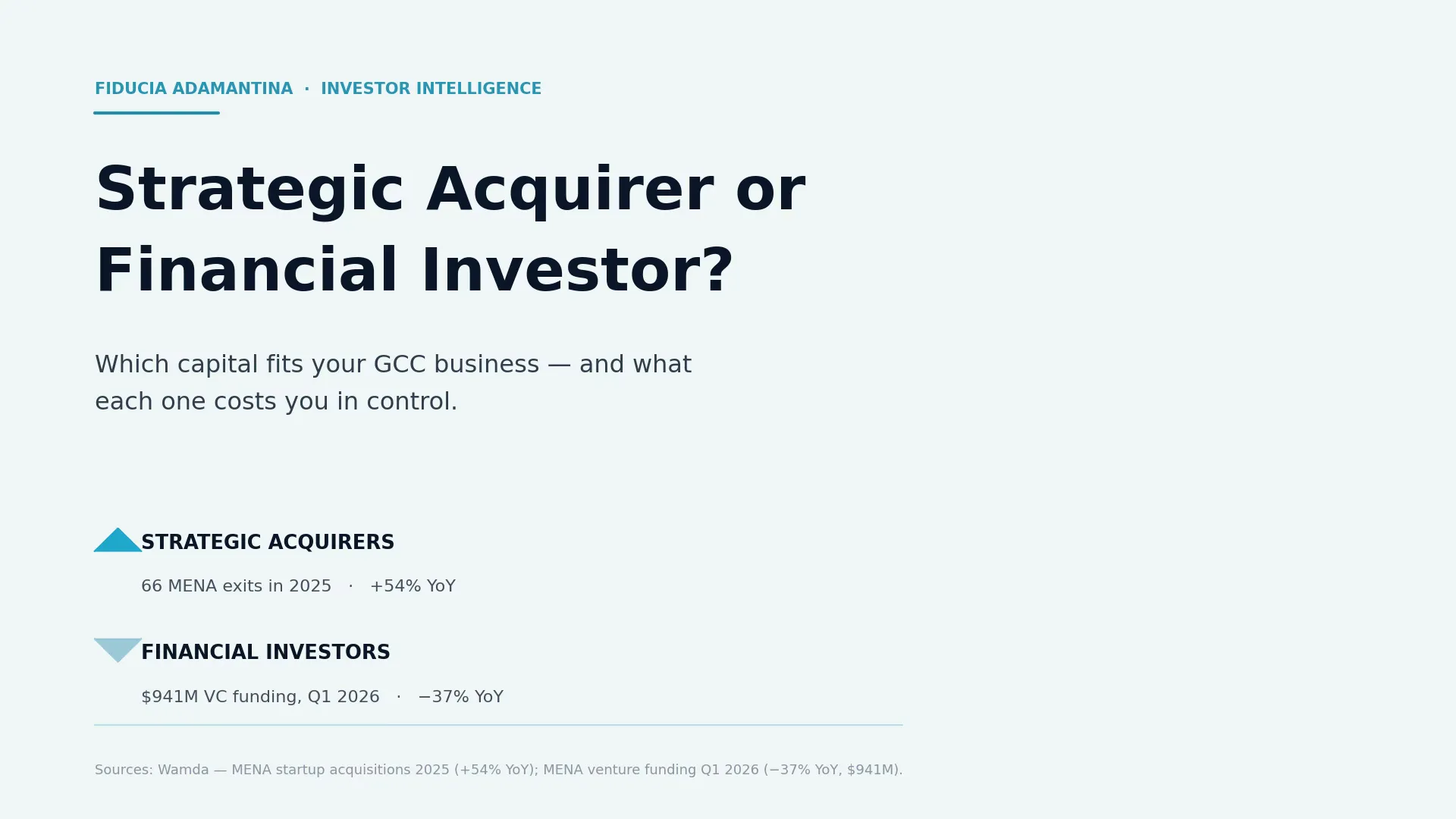
On the strategic side, the exit market has never been busier. Acquirers bought 66 MENA startups in 2025, up 54 percent on the year, the region’s most active year for exits on record, according to Wamda, even as first-quarter 2026 venture funding fell 37 percent year on year to $941 million. More strategic buyers at the table, slower cheques from the funds. If a corporate group is circling you right now, that mix is not a coincidence.
The real question: autonomy or acceleration
Once you know which kind of money you are looking at, the choice resolves into a single tension: how much autonomy you are willing to trade for how much acceleration.
A financial round protects your independence and buys you time, at the cost of dilution and a future exit you will eventually have to deliver. A strategic partner can hand you distribution, credibility, and capability you could not build alone, at the cost of your independence and, often, your seat. Neither is the right answer in the abstract. It depends on what you want from the next five years, whether the milestone in front of you needs fuel or a parent, and how you would feel the day someone else sets the agenda.
Price sits inside that tension rather than above it. The strategic has the higher ceiling when the synergy is real; the financial investor sets a disciplined floor that several funds converge on. I have worked through how each type prices a GCC business, and who tends to pay more in a companion piece, but you cannot know your answer in the abstract, only against real offers.
When a strategic “investment” is an acquisition on layaway
The most expensive mistake I see is treating a strategic minority investment as if it were just a financial round with a corporate logo attached.
It usually is not. Strategic minority deals frequently carry a right of first refusal on any future sale, a right to match a competing offer, board rights, or exclusivity that quietly removes your ability to run a real process later. Individually each term looks reasonable. Together they can mean that the day you decide to sell, you have exactly one possible buyer, at a price with no competition to lift it. The “investment” was an acquisition on layaway, and you signed the option away at the friendliest stage of the relationship.
This is the raise-versus-sell question I have written about for founders weighing another round against a sale, pulled one step earlier. A strategic offer often opens the sell path before you were consciously looking for it, which is why it deserves the scrutiny you would give an outright acquisition, not the lighter read you give a term sheet.
Run both offers against each other
The way you find out which path is right is not to reason it out alone. It is to create a real choice and let the offers reveal it.
That starts with knowing your own number and your own gaps before anyone else does. Run the comparison honestly: what a financial round leaves you owning after dilution and a later exit, against what a strategic deal pays today and what it costs you in control, anchoring the value side to a real range rather than a hope with our work on how to value a business for a transaction. To keep the market read current, our GCC Fundraising Snapshot, which sits alongside the Investor Readiness Scorecard in our resource library, gives you sector splits and cheque sizes so you are pricing against real numbers rather than the headline.
The founders who navigate this fork well understand both their materials and their unresolved company risks before anyone else frames them. The Investor Readiness Sprint can build the defined deck, model, cap-table scenario, and pitch preparation for a financial round. It does not clean the underlying financials, build the data room, or make the strategic-versus-financial decision for you. Preparation improves the choice only when the remaining company work is handled separately.
Deciding in practice
If a corporate group and a fund are both circling you, do two things in order.
First, get an objective read on where you stand. The Investor Readiness Scorecard is a free self-assessment that scores your cap table, model, narrative, and data room and surfaces the gaps either a strategic partner or a financial investor will find. Run it before you respond to anyone, so you enter the conversation knowing your weak points rather than discovering them under someone else’s diligence.
Then work the specific offers against your real numbers. If your lean is towards a financial round, the Investor Readiness Sprint delivers the fixed investor-facing materials in 2–3 weeks from complete intake. Paid fees are eligible for the optional 90-day raise-mandate credit. Whether we take a raise mandate at all is solely our decision, on our capacity and our read of the company. If a strategic is on the table and you cannot tell whether their money is an investment or the first move of an acquisition, book a strategy session and we will read the actual terms with you before you sign anything you cannot take back. The costly choice here is not strategic or financial. It is deciding by default, on the counterparty’s timeline instead of your own.