
The message is short and flattering. A competitor’s CEO, or a corporate development director you have never met, has been following what you have built and wonders whether you would ever be open to a conversation about the future.
Nothing about that message is accidental. The sender chose the timing, chose the framing, and chose to make contact at the one moment when there is no other buyer at your table. Each of those choices is worth money, and none of them was yours.
What happens next is usually decided in the first two weeks, long before anyone talks about price.
An approach is information about the buyer, not a verdict on your company
Most founders read an unsolicited acquisition offer as validation. It is better treated as intelligence about the buyer. An approach usually tells you something specific: a gap in their roadmap they would rather buy than build, a competitor they want off the board, a budget cycle that closes in March, or a corporate development team with a target number of deals to source this year. It tells you very little about what your company is worth, because the only person in the conversation with a view is the one who wants to buy it.
In our practice, the founders who handle this well share one habit. They spend the first fortnight collecting information rather than producing it.
What the research actually says about selling to a single buyer
Every advisory firm writing about inbound offers says the same thing: competition raises the price, so never sell to one buyer. It is repeated often enough that it is rarely examined, and the underlying evidence is more interesting than the slogan.
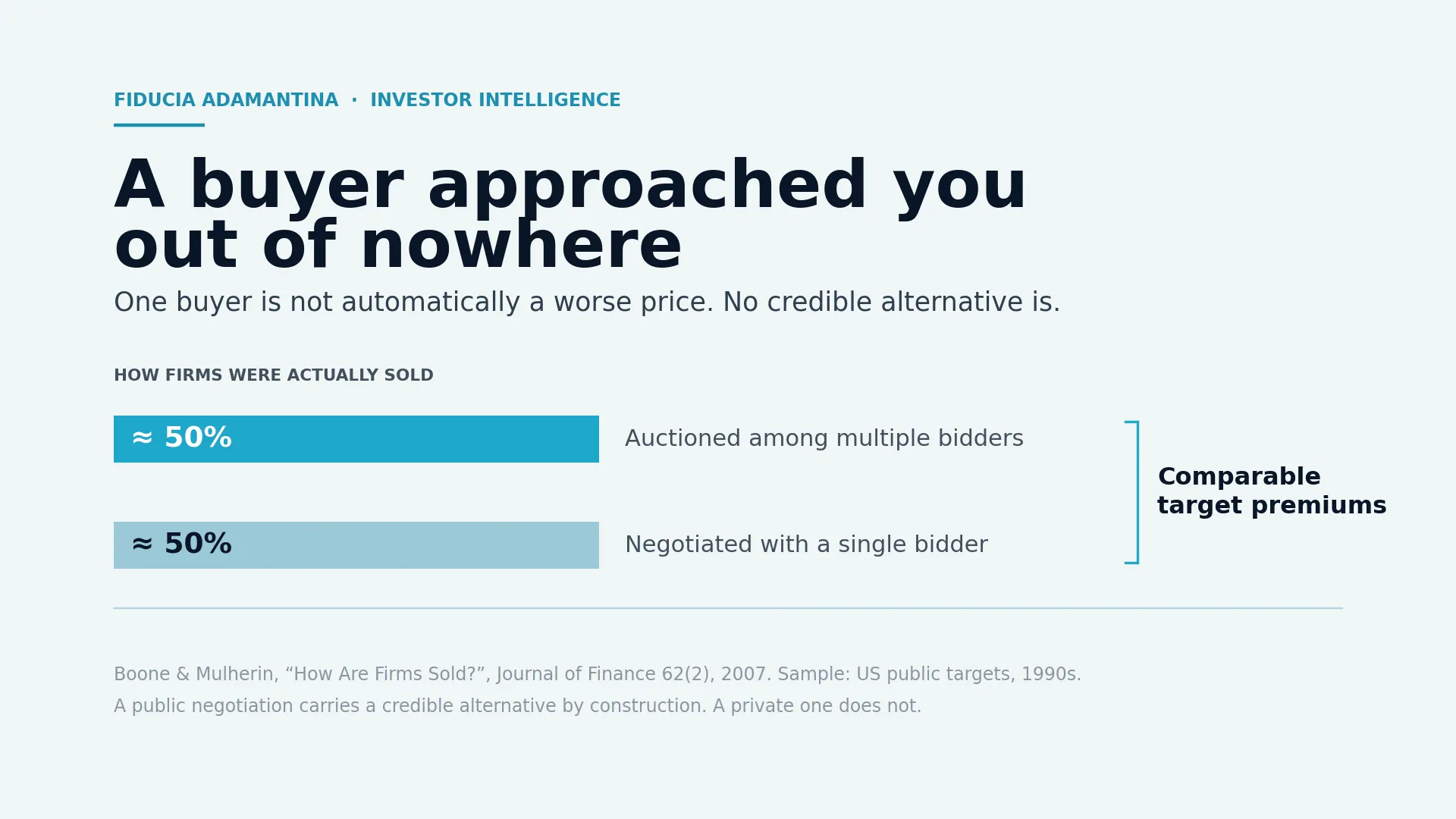
Audra Boone and Harold Mulherin studied how firms are actually sold and published the results in the Journal of Finance in 2007. Reading the private, pre-public phase of each deal out of SEC filings — who signed a confidentiality agreement, and when — they found that roughly half the targets ran an auction among multiple bidders, while the other half negotiated with a single bidder. The finding that gets quoted least is that the wealth effects for target shareholders were comparable across both routes. On the face of it, selling to one buyer cost those sellers nothing.
Read that too quickly and you conclude you can safely negotiate alone. The reason that is wrong sits in the sample: these were US public companies in the 1990s, and a public board negotiating with a single bidder is not actually alone. It carries fiduciary duties, the deal becomes disclosable, and any agreed price sits in public view where a rival can outbid it. The second bidder never has to appear. The possibility of one is priced in from the first meeting.
A private company approached quietly has neither the disclosure nor the threat. That is the real mechanism: what protects your price is not the auction, it is the existence of a credible alternative. A public negotiation comes with one built in. A private one does not, unless you build it.
Boone and Mulherin’s own headline conclusion points the same way. Their argument is that the public record badly understates how much competition is present in a takeover, because most of it happens privately, before anything is announced — public bidding is only the visible tip of it. Competition is usually there. It is simply not always visible, and in a quiet private approach it is not there at all unless you put it there.
The advice survives, then, but for a different reason than the one you are usually given. And the difference tells you what you actually have to manufacture, which is the subject of the rest of this piece.
The first two weeks: the four things you still control
You do not control whether the buyer is serious, what they will eventually offer, or how long their internal approval takes. You control four things, and all four are cheap.
What you say. The first reply should be short, warm, and commit to nothing. It thanks them, does not decline, and asks them to put their thinking in writing: what interests them about the business, and what they imagine a structure looking like. An approach a buyer will not repeat in writing is rarely a real one.
What you share. Nothing yet. Not revenue, not margin, not the customer list, not a number.
How fast you move. Buyers who want to be the only party at the table create urgency deliberately: a board meeting next week, a window that closes, an offer that may not stand. Almost none of it is true. Slowing the timetable by three weeks costs a genuine buyer nothing and costs an opportunist their entire strategy.
Who else knows. Your co-founder and, if you have one, your chair. Not the leadership team, not the investors you are friendly with, not the lawyer who does your commercial contracts.
The most expensive sentence in this sequence is a casual answer to “do you have a number in mind?” It anchors the price, reveals your floor and hands over a deadline in one breath. The longer list of what founders give away in early conversations is worth reading before the second call: what not to tell a buyer.
Three tests that separate a serious buyer from a free look
You can qualify an approach for the cost of two conversations. Three questions do most of the work.
Who approves this? Ask for the name and function of the person who signs off, and what the approval path looks like. A corporate development associate mapping the market is not the same animal as a CEO with board authority. Both use the same friendly language.
How does it get funded? Cash on the balance sheet, a committed acquisition facility, seller financing, an earn-out, or a fund that would need to raise for it. These carry completely different odds of ever completing. Ask early, before it feels rude to ask.
What will you put in writing before diligence? A serious buyer will give an indicative value range in a letter before you open the books, and you should be able to test that range against how buyers arrive at an M&A valuation. One who insists on seeing everything first and discussing value afterwards has designed the sequence to their advantage.
The pattern is reliable. Serious buyers answer all three without flinching, because they have the answers and want to prove they are worth your time. The ones who are shopping negotiate the questions themselves. A fuller set to work through before anything is signed: 12 questions to ask a potential acquirer.
The NDA is not the protection you think it is
A confidentiality agreement is worth signing and worth very little. If a competitor signs one, spends six weeks in your data and then walks away, they still know your customer concentration, your pricing, your churn, and which two accounts would hurt to lose. No clause takes that back.
Stage the disclosure instead. Aggregated figures first. Granular detail only once there is an indicative range on the table worth the risk. Named customers, contract terms and key-person dependencies only inside a real process, late.
This weighs more heavily in the Gulf than in a large market, and not for cultural reasons. The credible buyer set for a mid-market GCC business is often a small number of family groups, regional strategics and funds whose principals sit on each other’s boards. A process that leaks here does not leak into a newspaper. It leaks into a phone call, and it reaches your largest customer before it reaches your second bidder.
Before you answer the second email, it is worth knowing what a buyer would actually find. The Exit Readiness Scorecard is a free diagnostic that scores your business against what acquirers check first: the concentration, dependency and documentation gaps that decide whether an indicative number survives diligence. It takes a few minutes, and it is the cheapest work you will do on this.
When one approach justifies opening a process
If one credible buyer has worked out that your business is worth owning, the analysis that got them there is usually available to two or three others. Sector logic is not proprietary. The approach in your inbox is evidence that a buyer set exists, not evidence that it contains one member.
Opening a process does not mean a full auction with a hundred-page information memorandum and a nine-month timetable. The minimum useful version is narrow: identify three to five genuinely credible alternatives, approach them quietly while the original buyer is still warm, and run them in parallel rather than one after another. Sequential conversations give each buyer a veto over your timetable. Parallel ones give you the alternative that, per the research above, is doing the actual work on price.
The cost is a few weeks of preparation and one uncomfortable message telling the first buyer they are not the only conversation. That message is also the highest-return thing most founders in this position ever send. Buyers price exclusivity, and they know precisely what it is worth to them. What running this properly involves is set out in our M&A strategy and execution work; for the wider picture of who does this in the region, see our review of M&A advisory firms in Dubai.
The question underneath the question: sell, or raise?
Unsolicited approaches cluster at growth inflections. The quarter your numbers become legible to outsiders is often also the quarter a funding round would make sense. So the approach forces a question the founder may not have wanted to answer yet, and the honest answer is frequently not “sell.”
If what you want is capital and speed rather than an exit, that is a raise, and the buyer’s interest is a data point rather than a plan. The two paths need different preparation: an acquirer is underwriting risk they will own, an investor is underwriting growth they will fund. The Investor Readiness Sprint exists for the second case, a fixed AED 25,000 build over two to three weeks covering the pitch deck, the financial model, one cap-table scenario and the founder narrative. It builds the materials. It does not make the underlying company investor-ready, and it does not run the raise.
If you do want to sell, but not this year, the approach is still useful: it tells you which buyer archetype finds you interesting, which is the beginning of an exit plan rather than a reaction to one. Strategic and financial acquirers differ on almost everything downstream, from price to what happens to your team: strategic acquirers versus financial investors.
Being approached is not a reason to sell. It is a reason to decide.
Exclusivity is where the leverage transfers
One structural point to hold onto, because it is where the money is actually lost. A letter of intent almost always carries exclusivity, typically 60 to 90 days in which you may not talk to anyone else. Everything you built by running a parallel process disappears the moment you sign it, and the buyer knows the calendar as well as you do. Price reductions arrive in week nine, not week two, and by then you have no alternative and considerable sunk cost.
That is why the work happens before the LOI, not after: why deals fall apart between LOI and close.
What to do this week
Reply briefly. Ask for their thinking in writing. Share nothing. Tell almost no one. Run the three qualification questions before you agree to a second meeting. Then find out what a buyer would actually find, with the Exit Readiness Scorecard.
If the honest answer turns out to be that you want capital rather than an exit, the Investor Readiness Sprint is the build for that path. If it is an exit, the decision is no longer whether to respond. It is whether you walk into that conversation with one buyer or with alternatives, and that is worth deciding deliberately and early. It is the call we take founders through in a strategy session. Bring the email. It usually says more than the sender intended.