
Hire an M&A advisor when you need help comparing buyers, judging an offer or running a sale alongside the business. If the buyer and price are already settled, a full sale mandate may add little. If the accounts are not ready, preparation may be the work to buy first.
I run an advisory firm, so read this with that in mind. The fee matters, but first decide which job you need done: preparing the company, responding to a buyer or running a competitive sale.
When to bring an M&A advisor into the sale
You are planning a sale. Start the conversation before contacting buyers. Ask for a view of what needs preparing and whether there is a credible buyer field. Agree whether the immediate work is preparation or a full sale mandate; those are different scopes.
A buyer has approached you. Get a view of the offer and your alternatives before treating the headline price as your company’s value. The first question is whether to pursue that conversation alone or test interest elsewhere.
You are discussing terms. Bring the advisor and transaction counsel into the same conversation about price, payment timing and the work needed to close. If terms have already been agreed, show them what is fixed and what remains open. Do not buy a full process without knowing what can still be improved.
Start with the case where the answer is no
You are not actually selling. A surprising number of founders who call M&A advisors are capital-constrained, not exit-ready. The trigger was a cash-flow quarter, not a decision to leave. Selling under that pressure is the worst possible position to negotiate from, and an advisor cannot fix it — a raise can. If the honest problem is that the fundraising materials are eight months out of date, that is a materials build, not a sale process. Our fixed-fee Investor Readiness Sprint exists for exactly that, and it is a fraction of what a sale process costs.
The deal is already fixed. Management buyouts, transfers to a co-founder, sales to a family member at a price the family agreed years ago. There is no competitive tension to create, which is the single largest thing an advisor adds. Pay a good transaction lawyer and a tax adviser. You do not need M&A advisors to run a process that has one participant.
The company is not ready and you know it. Engaging an advisor does not pause the clock — it starts one. Retainers run monthly whether the work is a buyer process or a cleanup of your own accounts. If revenue is concentrated in two customers, the last audit is three years old, or the owner is the operation, that work has to happen either way. Doing it before the meter starts is cheaper.
The deal is small enough that the minimum eats the outcome. About a quarter of middle-market firms write a minimum success fee into the engagement letter, per the Firmex Global M&A Fee Guide 2024-25. Below a certain transaction size a minimum stops being a percentage at all: the fee is fixed and your proceeds are not, so the effective rate rises as the price falls — hardest exactly when the deal disappoints. Ask for the minimum figure in the first conversation and divide it by your realistic low case yourself.
The four situations where M&A advisory services earn the fee
More than one credible buyer exists. This is the whole case, and it is not sentiment. A process that produces two interested parties prices differently from a conversation with one, and the founder who runs it alone almost never produces the second. If your sector has three plausible strategic acquirers you have never spoken to, that gap is the fee.
The approach was unsolicited. A buyer who comes to you has done the work: they know what you are worth to them, and you do not. The first offer in an unsolicited approach is an anchor, not a valuation. Before responding to one, it is worth understanding how buyers value an M&A target — because the gap between the anchor and the range is where the fee is recovered.
The structure is not just a price. Earn-outs, escrows, rollover equity, working-capital pegs, seller notes. Two offers carrying the same headline number can deliver materially different amounts to the seller, on different dates, with different risk of never arriving — and founders who negotiate alone tend to optimise the number they can see.
You cannot run the business and the deal at once. In our practice, diligence is a second job for months, not weeks. Nothing weakens a seller’s position like numbers that soften mid-process, and they soften because the founder is answering document requests instead of selling.
If you want the day-to-day version of the job rather than the decision, what an advisor does day to day covers a live mandate hour by hour, and the M&A process step by step covers the phases from the seller’s chair.
What M&A advisory actually costs
There is one credible public benchmark for mergers and acquisitions advisory fees: the Firmex fee guide, produced annually with Axial, DealCircle and Divestopedia. The 2024-25 edition surveyed 456 middle-market advisors across 49 countries. Two structures, almost always together.
A work fee. Monthly in most cases. The most common band is $5,000 to $10,000 a month, and the share of firms charging $16,000 or more doubled to 16% in a single year. It funds the preparation phase, and it is the fee most founders argue about.
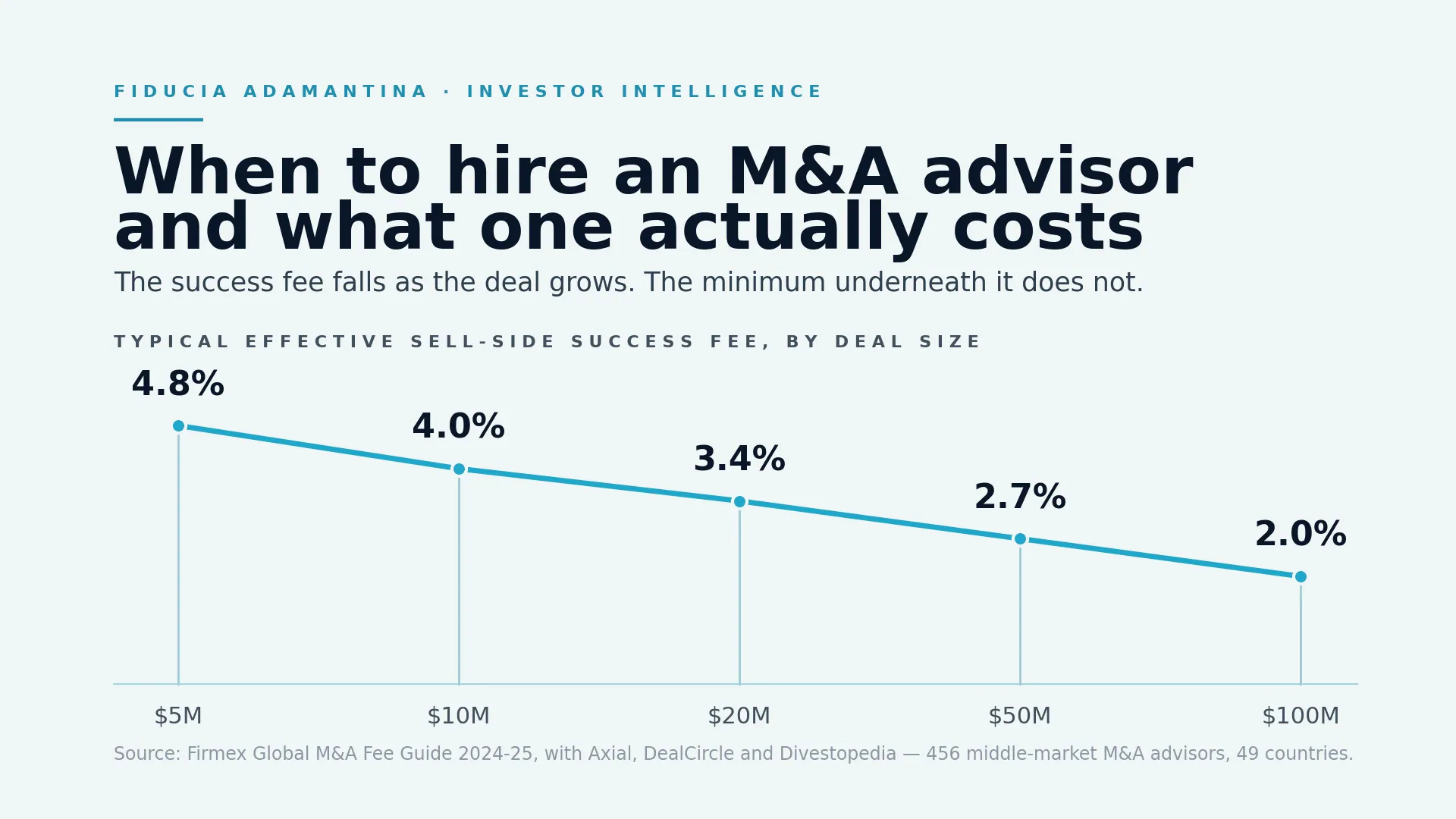
A success fee, paid on completion, as a percentage of transaction value. The typical effective rate by deal size:
| Deal size | Typical success fee |
|---|---|
| $5 million | 4.8% |
| $10 million | 4.0% |
| $20 million | 3.4% |
| $50 million | 2.7% |
| $100 million | 2.0% |
Two honest caveats. The $5 million rate fell from 5.5% the year before, so this is not a fixed price list. And the sample is 47% North American and 45% European. There is no GCC line in it, and no credible public benchmark for merger and acquisition consultants in this region exists. Anyone quoting you a “standard Gulf fee” is quoting their own rate card. Use these numbers as a reference point for the shape of the deal, not as a local comparable.
The headline percentage is not the number to argue about
41% of firms use some version of the Lehman formula, where the rate falls as the deal grows — classically 5% of the first million, 4% of the second, down to 1% above five. 27% charge a flat percentage. 21% now use an accelerator, where the rate rises above a threshold, which is the structure most aligned with a founder’s interests and the one worth asking for.
Founders spend their negotiating capital on that percentage. The money usually moves elsewhere.
Three lines in the engagement letter that matter more
Whether the work fee is credited. 57% of firms deduct work fees paid from the eventual success fee. That is now the majority position, so it is a reasonable thing to ask for rather than a concession to be grateful for. Six months of retainer credited against completion is real money.
The tail and the exclusivity period, read together. The tail entitles the advisor to a fee if you sell after the engagement ends. Tails of up to two years appear in first drafts. Transaction counsel — Thompson Coburn’s list of engagement-letter issues to negotiate is a clean summary — consistently advise narrowing this: six or nine months is usually sufficient, and the tail should apply only to buyers the advisor formally introduced under an executed NDA. A broad tail on a company that later sells to a buyer the advisor never contacted is the most expensive clause in the document.
When the success fee is due against when you are paid. 53% of firms require the full success fee at closing regardless of when the seller actually receives the consideration. If a third of your price sits in an earn-out payable over two years, you are funding the advisor’s fee in full out of the cash portion, today, against money you may never collect. 41% now agree to spread the fee as consideration arrives. Ask which one you are signing. This single clause has moved more founder cash than any percentage argument I have watched.
Related: the same instinct that skips these clauses tends to skip the financial preparation underneath them. Our Financial Model Mistakes Guide covers the modelling errors buyers reprice against in diligence — the ones that quietly cost multiples of any fee you negotiate.
The Gulf layer
Regional context is not decoration here, because it changes the buyer map. EY’s MENA M&A Insights recorded 884 deals worth US$106.1 billion across MENA in 2025, up 26% in volume from 701 the year before. The GCC accounted for 685 of them and US$102.1 billion of the value.
The number that matters for this decision is a different one: cross-border deals were 54% of volume and 61% of value. Mergers and acquisitions in the UAE are not mostly local transactions between people who already know each other. The likely buyer for a Dubai company is often a strategic in Riyadh, a fund in Singapore or a corporate in Europe — and that is precisely the pool a founder’s own network does not reach. Add sovereign-linked vehicles and family conglomerates, which do not advertise appetite and are not found by asking around, and the case for a mapped process gets stronger the more cross-border your likely buyer is.
For the mechanics of running the sale itself in this market, how a sale actually runs in Dubai covers the steps.
What the advisor will need from you
Founders underestimate this and then resent it. Three or four years of clean financials with owner adjustments defensible line by line. Contracts, cap table, licences, litigation, related-party arrangements. A real answer on customer concentration. Then availability — for the pitch, the management sessions, the diligence calls. An advisor cannot compensate for a seller who will not produce documents. The engagements that go badly usually go badly here, not at the negotiating table.
How to make the call
Three questions, in order. Is there more than one credible buyer, or one? Is the value in the headline price, or in structure I cannot evaluate alone? Can I carry a diligence process that runs in months and still keep the numbers moving up?
Two or three yeses and the fee is arithmetic rather than a leap. Three noes and you likely need a lawyer, not an advisor.
And if the honest answer is that you are not selling at all — that the pressure is capital, not an exit — then the Investor Readiness Sprint is the shorter, cheaper conversation, and the Financial Model Mistakes Guide is the free place to start.
If a buyer has approached you and you want an unsentimental read on whether the offer, the timing and the structure are worth a process, book a strategy session. The most useful thing an advisor does is often the first thing: tell you honestly whether to go at all.