
A founder told me last year that he could name eleven venture funds off the top of his head and not one company that might buy him. He had been building for seven years. He had spent maybe forty hours reading about how to raise and none at all thinking about who, in the end, writes the cheque that lets him stop.
That asymmetry is almost universal, and it is not the founder’s fault. Fundraising content is written by the industry that benefits from fundraising. Very little gets written about buyers from the seller’s chair, because buyers have never needed founders to find them.
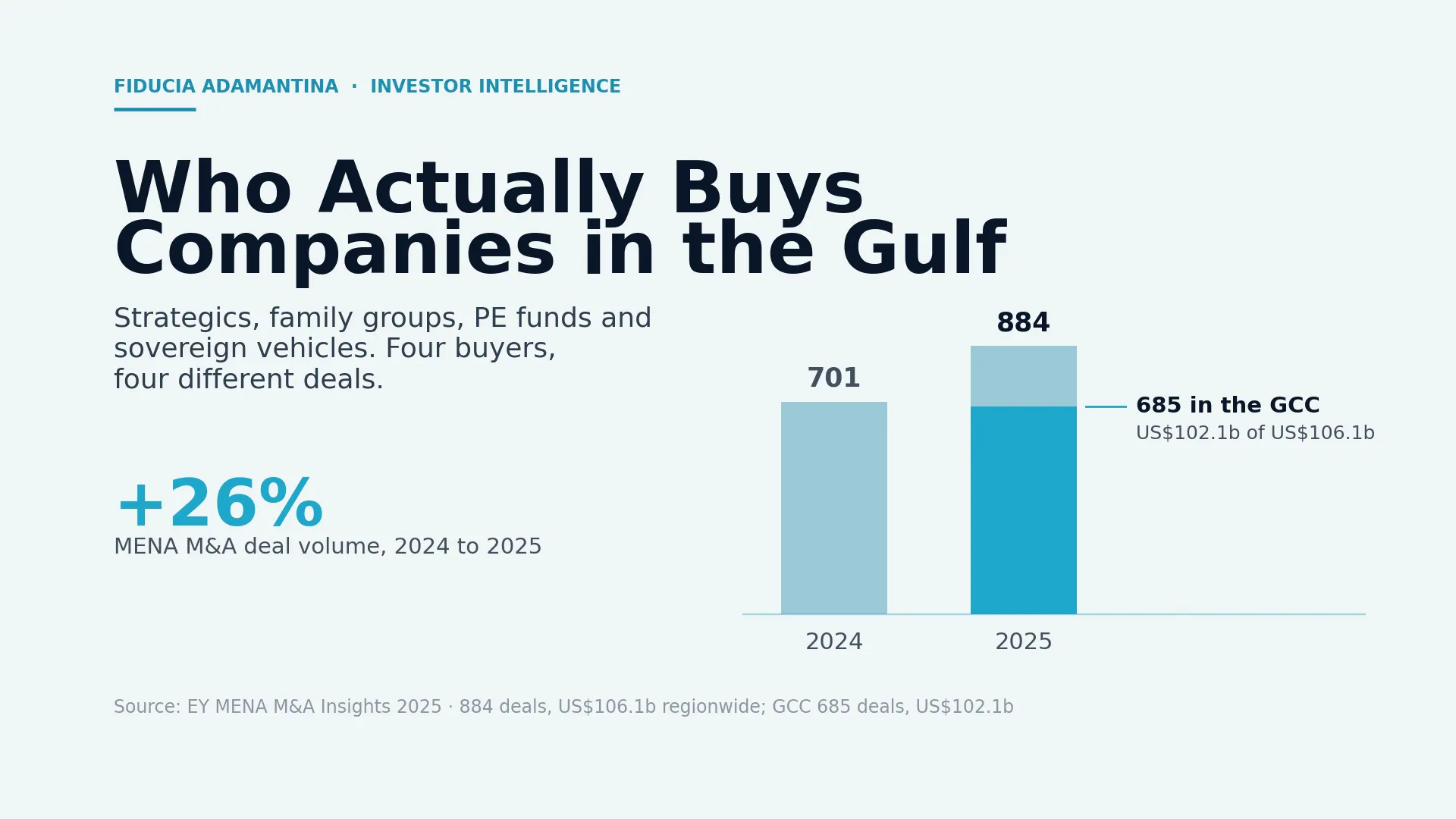
So here is the map. In 2025 the MENA region recorded 884 M&A deals worth US$106.1 billion, up 26% in volume from 701 the year before, according to EY’s MENA M&A Insights. The GCC accounted for 685 of those deals and US$102.1 billion of the value. Separately, Wamda’s 2025 year in review counted 66 startup acquisitions across MENA, a 54% increase on the prior year.
Somebody is buying. It is worth knowing who.
The buyer pool here does not look like the one you have been reading about
Most founders arrive with a mental model imported from American writing: you get bought by a bigger version of yourself, or by a private equity fund, and those are the options.
In the Gulf, four buyer types are worth understanding, and two of them barely feature in that model. Each is paying for something different. That difference is not cosmetic. It sets the price basis, the speed, the diligence you face, and what your life looks like in the eighteen months after close.
Strategic buyers pay for what you would cost them to build
A strategic buyer is an operating company. A regional group that wants your product line, your licence, your engineering team, or your customer relationships in a market they have failed to crack twice.
They price against their own alternative. What sits in their head is not a multiple of your profit but the cost of building the same thing internally, in money and, more importantly, in time. A strategic buyer who is two years behind a competitor will pay for those two years.
That is also why, in my experience, strategics produce both the highest headline numbers and the least reliable ones. The price is a function of somebody’s strategy, and strategies change when the executive sponsoring them moves on.
I have written elsewhere on how strategic and financial buyers price the same company differently, because that gap is usually where a seller has the most influence. For the map, two things matter: a strategic is the buyer most likely to pay a premium, and the buyer most likely to go quiet in month four.
Family conglomerates: the buyer nobody pitches
This is the group the founder in my opening could not name. In our own practice it is the buyer type that comes up most often for profitable, mid-sized Gulf businesses, and the one founders are least prepared for.
Gulf family groups largely began as trading houses sixty or seventy years ago and diversified into conglomerates spanning retail, logistics, construction, healthcare and financial services, a history PwC sets out in its family business succession paper with the World Governments Summit. They hold operating capital rather than fund capital. They have distribution built over decades. And a good number of them are looking for businesses to bolt onto what they already run.
They also behave nothing like a fund, and founders read that behaviour as disinterest almost every time.
A family group’s decision is concentrated in very few hands, and those hands are busy running the businesses the family already owns. The same PwC research found that 28% of Middle East family-business respondents have only family members on their board. In more than a quarter of these groups, in other words, there is no outside voice in the room at all.
Take that as a description of how a decision gets made rather than as a criticism of it. Where the board is entirely family, there is no investment committee memo to write and no independent director to satisfy, which is why a process that has looked dead for six weeks can close in a single afternoon once the principal decides. It also means trust and relationship carry weight that financial polish does not substitute for. I have watched a well-run process lose to a worse offer because the other founder had spent a year having lunch with the family.
The other force here is timing. That same paper describes a generational handover already under way across the region, a process it says could collectively see trillions of dollars change hands from one generation to the next. A transition on that scale creates buyers on both sides: groups consolidating around what the next generation wants to run, and groups selling what it does not.
Private equity firms in Dubai are buying smaller companies than they used to
The standard objection is that PE funds here only look at large-cap deals, so a founder doing fifteen million dirhams of revenue is wasting his time.
I would put it differently now than I would have five years ago. Regional funds have moved down-market, pushed by the same family-succession dynamic above and by regional groups shedding non-core divisions. In our own deal flow the practical threshold is closer to profit than revenue: a business with three to five million dirhams of clean, repeatable EBITDA is a conversation, and one below that is generally too small for the fees and governance a fund has to carry. That is a Fiducia read on our own pipeline, not a published statistic.
A financial buyer is buying your cash flow and a plan to increase it. The price is a multiple of a normalised earnings figure, and “normalised” is where most of the negotiation lives. They will recalculate your EBITDA, accept some add-backs and refuse others, and whatever survives is the number that gets multiplied.
Two things follow. Because their entire return depends on the numbers being real, financial buyers put more weight on financial diligence than any other buyer type. And they usually need you to stay, which means rolling some of your equity into the new structure and a second payout when they exit in four or five years.
If you want to know which firms operate in this market and how to tell a genuine mid-market fund from a placement agent, I have covered the PE and M&A advisory firms active in Dubai and the UAE in more detail.
Sovereign-linked vehicles: real, large, and almost never your buyer
EY names sovereign wealth funds, including ADIA and Mubadala in the UAE and the PIF in Saudi Arabia, among the primary catalysts of MENA M&A activity. That is accurate, and it drives a lot of founder optimism I end up talking down.
These vehicles buy infrastructure, large platform assets, and controlling stakes in businesses of national or strategic weight. The cheque sizes that make sense for an institution deploying billions do not reach a founder-owned company earning single-digit millions in profit.
Where sovereign capital does reach a company your size, it arrives indirectly: through a fund it anchors, or through a portfolio company making bolt-on acquisitions with its backing. That second route is worth understanding, because from your side of the table it looks like a strategic buyer, and it is one with unusually deep and patient funding behind it. Which is why the count above is four and the buyers you will actually meet are three.
What changes depending on who is across the table
Same company, four buyers, four different deals.
The price basis changes. A strategic prices against building it themselves. A financial buyer prices a multiple of normalised earnings. A family group weighs both against how well you fit what they already own.
The speed changes. Funds move to a defined timetable. Family groups move on a principal’s conviction, which can be far slower or far faster. Strategics move at the speed of an approval process you cannot see.
Your role after close changes. A financial buyer usually needs you to stay and run it. A strategic often needs you through a transition, then absorbs the function. A family group may want you indefinitely, or may already have a successor in mind.
What they scrutinise changes. Financial buyers go hardest at the numbers. Strategics go hardest at your technology, contracts and people. Family groups go hardest at reputation and at whether they can work with you.
One thing does not change. All four will ask for broadly the same evidence, and none of them will wait politely while you assemble it. That evidence base is the same one a raise requires, which is the work the Investor Readiness Sprint exists to do, and it is worth having whichever direction you end up going. If a conversation is already live, the questions to ask a potential acquirer will tell you which of the four you are dealing with faster than anything they volunteer.
The question that decides which of these is your buyer
Most founders mapping the buyer universe are really doing something else. They are deciding whether to sell at all, or to raise and keep going.
That decision deserves better inputs than a list of buyer types. If the answer is raise, the binding constraint is usually readiness rather than access, and the work is building materials an investor can underwrite, which is what the Investor Readiness Sprint is scoped to deliver as a fixed piece of work. If the answer is sell, the work starts earlier than most founders expect, because what makes a business sellable is largely settled in the two years before anyone is approached.
If you are leaning toward raising, our GCC Fundraising Snapshot sets out what the regional capital landscape looks like right now, so you are working from the current picture rather than the one you absorbed three years ago. It is a useful counterweight to a buyer list, and it is the honest starting point if the raise fork is the one you are on.
And if you have read this far because a buyer has already made contact, sequence matters more than the map. Work out which of the four you are talking to, what they are actually pricing, and where your own numbers stand before you engage with theirs.
If you want to think through which of these buyers is realistic for your business, and what would have to be true before one of them takes you seriously, book a strategy session.