
“An investor asked for my data room and I panicked.” That sentence, almost word for word, is one of the most common messages I get from founders a week into a real conversation with a fund. The deck went well. The partner is interested. Then comes the line that turns excitement into dread: can you send through your data room?
Here is the uncomfortable part. By the time an investor asks, you are already being judged on how ready the answer is. A data room is not a document you write the night before. It is a state of organisation you either have or you don’t, and you cannot talk your way through it the way you can talk through a slide. This post is about what actually goes in one, what GCC investors specifically expect to find, and how to build it so the first version an investor opens is the right one.
The data room is the first thing an investor checks that you can’t talk your way through
Founders pour weeks into the pitch. The data room is where the pitch gets verified, and verification is a different test from persuasion.
When a partner opens your room, they read two things before they reach a single number. First, does the company hold together legally: who owns it, who has claims on it, what is contracted. Second, does this founder run a tight operation. A room with mislabelled folders, three versions of the same financial model, and a cap table that does not reconcile answers the second question before the investor gets to the first. Strong numbers in a sloppy room read as luck. The same numbers in a clean room read as competence.
The first investor meeting often fails for a related reason: the founder is selling a story the room cannot yet back up. I have watched a term sheet conversation slow to a stop not because the business was weak but because diligence kept surfacing small surprises. An unsigned IP assignment. A shareholder nobody could explain. Financials that did not match the deck. None of those killed the company on their own. Together they made the investor nervous, and a nervous investor either negotiates harder or walks. The room’s whole job is to remove surprises.
What actually goes in an investor data room
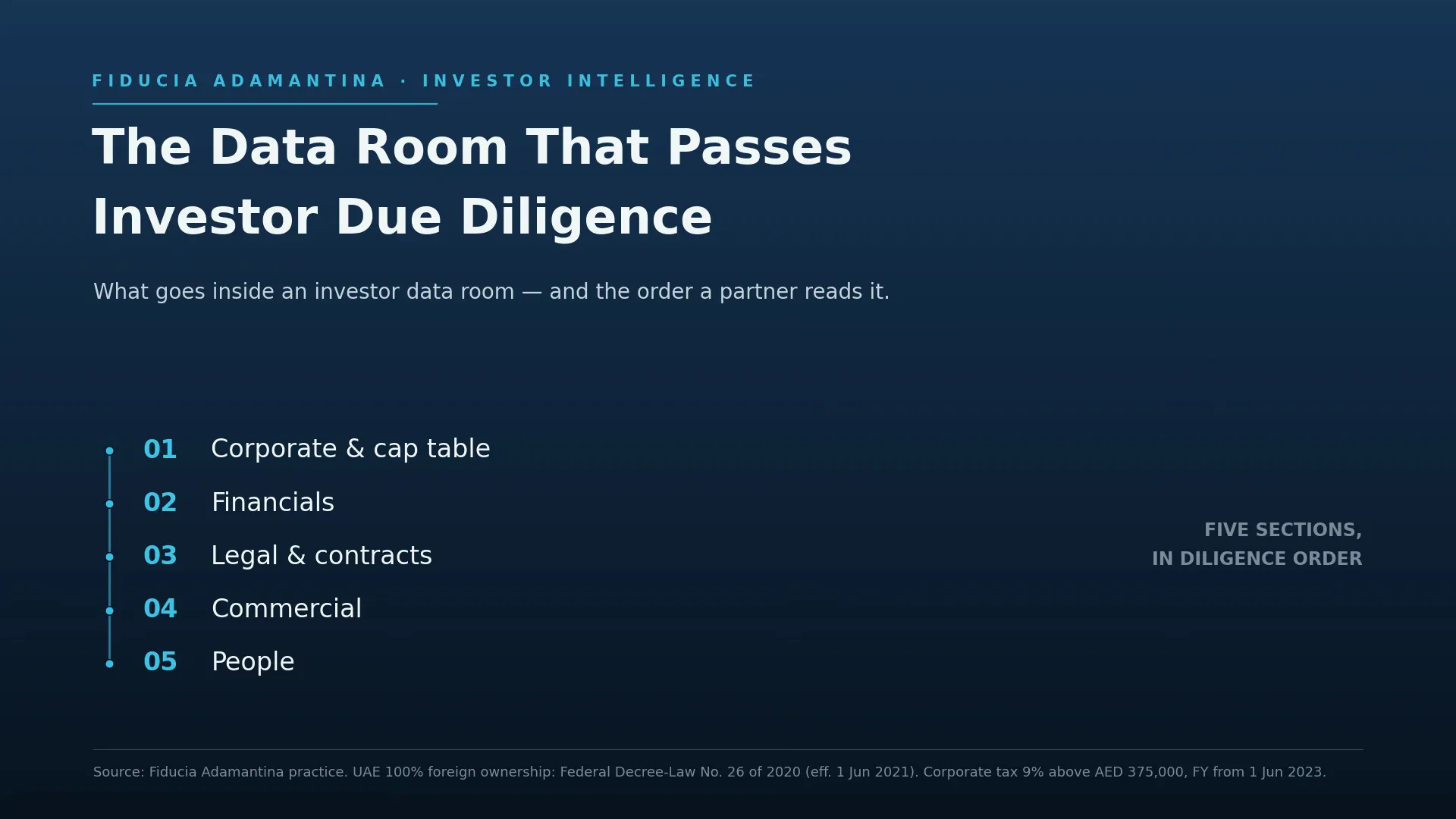
Ignore the vendor checklists that list ninety documents and rank none of them. An investor data room for an early-stage raise has five sections that matter, in roughly the order a partner reads them.
Corporate and cap table. Certificate of incorporation, your trade licence, the memorandum and articles, the share register, and a current cap table that reconciles to the legal documents, including every SAFE, convertible note, and option grant. This section gets opened first and trusted least, so it has to be exact.
Financials. Two to three years of statements, or since inception, management accounts to the most recent month, and a financial model with assumptions a reader can follow. If your model shows revenue jumping, the room should let an investor trace the math behind the jump.
Legal and contracts. IP assignments from every founder, employee, and contractor. Key customer and supplier agreements. Any litigation or dispute, disclosed plainly rather than buried.
Commercial. Your core metrics, cohort or retention data, the pipeline, and a short go-to-market summary. Enough for an investor to test whether the traction story is real.
People. Org chart, key employment contracts, and the founder agreements.
That is the spine. Depth varies by stage and sector, but a founder with those five sections clean is in diligence shape. The data room is really one pillar of a wider readiness frame, the same one I lay out in the investor readiness framework; the room is where that readiness either shows up or doesn’t.
What GCC investors look for that a US-built checklist misses
Here the generic checklists fail you, because the GCC corporate layer does not look like Delaware.
Your licence and structure are diligence items, not background. A regional investor will want the trade licence, the activities it permits, and clarity on whether you are a mainland or free-zone entity, each of which carries different ownership, tax, and substance implications. If you run an offshore holding company over a local operating entity, the room has to show how they connect.
Ownership history is the common trap. Until recently, most mainland companies needed a 51% Emirati shareholder, with the foreign founder holding 49%. The UAE removed that requirement for most mainland activities under Federal Decree-Law No. 26 of 2020, effective 1 June 2021. Many founders restructured to full ownership but never cleaned up the paper trail: an old side agreement, a nominee arrangement, a former sponsor still sitting on a registry. An investor’s lawyer finds these in week one. Surface them yourself, with the documents that resolve them, before you are asked.
Tax registration is now a live question. Since the UAE introduced corporate tax at 9% on profits above AED 375,000 for financial years starting on or after 1 June 2023, investors expect to see your corporate-tax registration and, where relevant, your VAT and economic-substance position. A mid-stage company that is not registered is a flag.
Language matters too. DIFC and ADGM operate in English, but mainland official documents, including your memorandum and certain notarised filings, exist in Arabic. Put clean English translations alongside the originals so a non-Arabic-speaking investor can read the room without friction. Use the regional layer where it sharpens the picture, not as decoration: if your investor is a GCC fund, these are the items they check first, because they know exactly where local companies get loose.
The Day 1 vs Day 30 build
The mistake is treating the data room as something you assemble after an investor asks. By then you are building it under time pressure, in public, while the partner watches the clock.
Build it in two layers instead.
Day 1, the always-ready core. Corporate documents, current cap table, last full-year financials, IP assignments, and a clean model. These do not go stale quickly and should exist before you take a single investor meeting. If a partner asked tonight, this is what you send within the hour.
Day 30, the diligence-depth layer. The detailed contracts, customer references, granular cohort data, and the schedules a serious investor requests once they are leaning in. You assemble this as the round progresses, but into folders that already exist, not into a scramble.
This two-layer build is work the company must own before serious diligence. The Investor Readiness Sprint may identify data-room gaps while reviewing the source materials, but the fixed AED 25,000 scope does not build or populate the room. A founder with the Day 1 core in place signals something a deck cannot: that the raise is not the first time they have organised the company.
The presentation layer: what “tidy” signals
How the room is built is itself a data point.
Use one logically foldered virtual data room, not a shared drive with a long link and loose permissions. Number the top-level folders so they read in diligence order. Give every file a clear, dated name and keep a single current version of each, because nothing erodes trust faster than a folder full of “Model_v7_FINAL_v2.” Set read-only access and grant it deliberately. A clean, permissioned, version-controlled room tells an investor that the founder treats confidential information the way the investor’s own LPs expect them to.
The four things that quietly slow a raise
In our practice the same four issues surface again and again, and none of them are about the business itself.
First, a cap table that does not reconcile to the legal documents. Second, missing IP assignments, where a contractor or early co-founder never signed, so the company may not fully own its own product. Third, financials that do not match the deck, which forces the investor to re-underwrite every number you showed them. Fourth, undocumented or unresolved historical holders, especially the legacy ownership structures above.
Each one is fixable before a raise and nearly impossible to fix gracefully during one. The advantage of building early is that you fix these on your own timeline, quietly, instead of in front of the person setting your valuation.
Build the room before you need it
A data room does not win you a raise. A bad one loses you leverage at the moment you have the most to gain. A good one compresses the time between interest and term sheet, because there is nothing for diligence to trip on.
If you are months out, start now. The free Investor Readiness Checklist walks the Day 1 core document by document, so you can see what is ready and what is missing before an investor ever asks. For a sharper read on where you stand across the whole raise rather than just the room, the Investor Readiness Scorecard scores you against the dimensions a diligence team will test.
When the source inputs exist, the Investor Readiness Sprint can turn them into the defined deck, financial model, cap-table scenario, and pitch preparation in 2–3 weeks from complete intake. It does not assemble the data room or fix the legal, cap-table, or accounting issues diligence exposes. Those are prerequisites or separate work. The founders who raise fastest are rarely the ones with the best story on the day. They are the ones whose underlying evidence was already organised.
Weighing a sale instead of a raise? Buyer diligence is a deeper and more adversarial test than investor diligence. The M&A due diligence checklist covers the sell-side version.