In March 2026, seventeen startups across the entire Middle East and North Africa raised $48.3 million between them, according to Wamda. That is one bad Series A in California. In the same calendar quarter, global venture funding hit an all-time record of roughly $300 billion, on Crunchbase’s count.
Both numbers are true. Founders keep putting them side by side and drawing the wrong conclusion from the pair.
I get a version of this question most weeks, usually from a founder who has been told Dubai is booming and has then gone and read the monthly funding prints. The honest answer is that the Gulf in 2026 is a good place to raise for a specific and identifiable kind of company, and a poor one for everybody else. The data says which is which. Below is that read, with the parts that argue against the Gulf left in.
The two numbers founders keep putting side by side
The $300 billion record is not a market you are competing in. About $242 billion of it went to artificial intelligence companies, and US-based companies took 83 percent of the global total. A handful of frontier-lab rounds moved the entire average. I have written separately on what raising looks like when you are not an AI company, because that is the more useful comparison for almost everyone reading this.
The $48.3 million print is not a market either. It was one month, during an acute escalation in regional conflict, and April recovered to $150 million. Single months in a region this size are noise. Treating one as a signal is how founders talk themselves out of a raise that was viable.
Neither number tells you anything about your company. The half-year data does.
The first half of 2026, counted two different ways
Two providers published H1 2026 numbers in mid-July, and they do not agree.
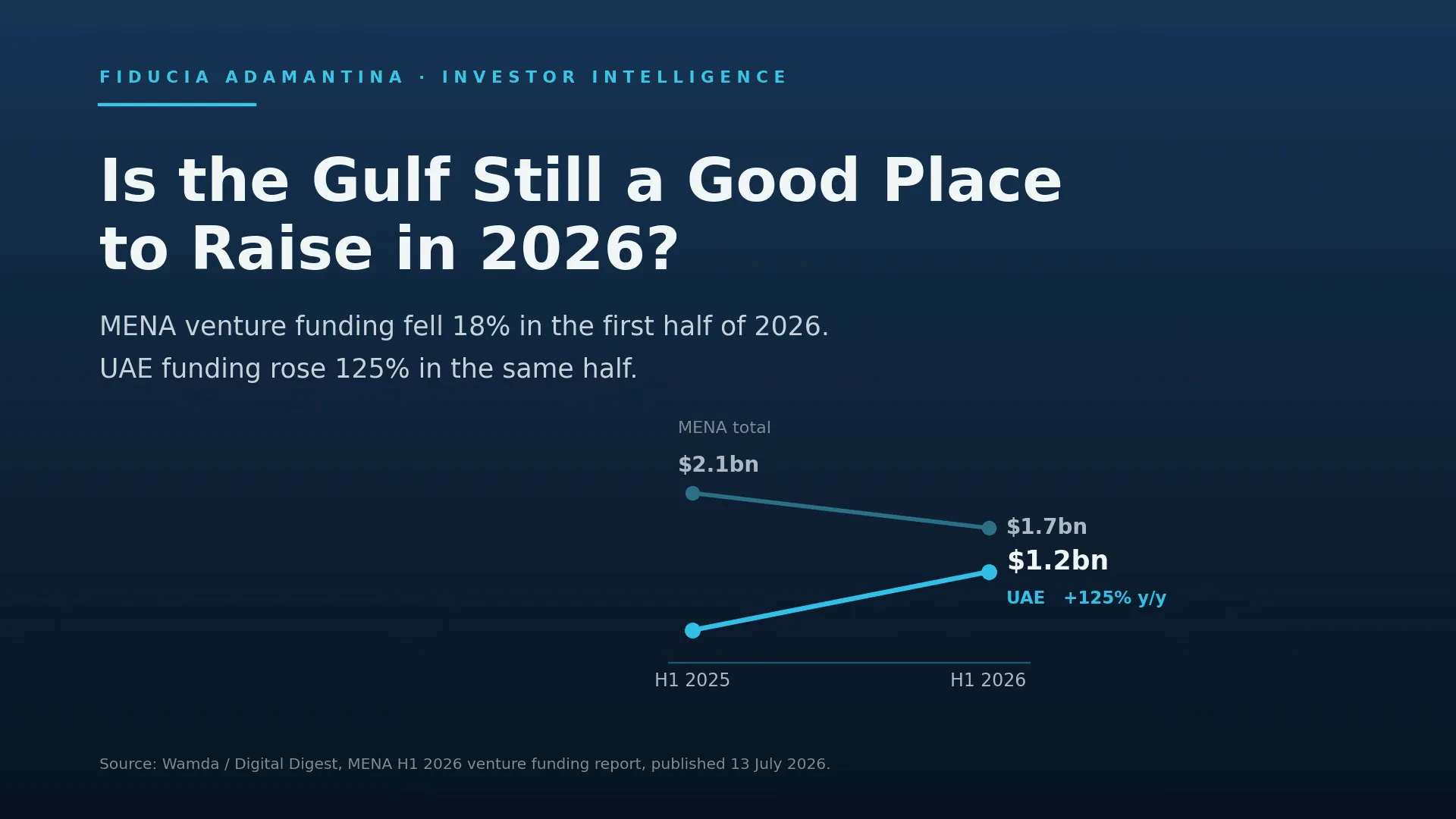
Wamda, working with Digital Digest, counted $1.7 billion across 242 rounds, down 18 percent on the $2.1 billion raised in H1 2025, with deal volume down 28 percent. Magnitt counted $1.35 billion across 214 deals, down 22 percent, with deal count down 41 percent, the fewest in any half since at least 2022.
The gap between them is methodology, not error: different disclosure thresholds and different treatment of debt and undisclosed rounds. I flag it because founders quote whichever figure supports the decision they have already made, and because the shape both providers agree on matters more than either total.
That shape is this. Capital held up better than deal count. Money did not leave the region, it went into fewer companies. Two deals alone accounted for 36 percent of all H1 capital on Magnitt’s count, and the ten largest absorbed 58 percent. Strip the top of the table and the market underneath is materially thinner than the headline suggests.
The number that actually predicts your raise
Here is the part almost nobody quotes, and it is the reason I would not plan a Gulf raise off the H1 headlines.
Capital reported in the first half reflects agreements struck six to nine months earlier, before the regional conflict began. Magnitt’s founder Philip Bahoshy made the point directly in EnterpriseAM in July: the H1 total is a rear-view mirror. The forward indicator is early-stage deal count, which he calls the truest measure of ecosystem appetite, and it fell by more than 50 percent year on year. His expectation is that the real effect surfaces in third-quarter data, once the pre-committed pipeline runs dry.
If you are starting a process now, you are raising into the quarter that has not been reported yet. Plan against the early-stage deal count, not the half-year dollar total. In practice that means assuming a longer process, a smaller round, and more diligence than the 2025 comparables in your head suggest.
The UAE grew while the region shrank
“Is the Gulf good for raising” is the wrong unit of analysis. The regional aggregate hides two opposite stories.
UAE startups raised $1.2 billion across 83 deals in H1 2026 on Wamda’s count, roughly 70 percent of all capital deployed across MENA, and up 125 percent year on year. Magnitt’s narrower count puts it at $895 million, about two-thirds of the region, up 53 percent, with deal count down 37 percent. Both counts agree on the direction: the UAE grew, sharply, in a half when the region contracted.
Saudi Arabia went the other way, raising $259 million across 80 deals, down 81 percent on Wamda’s numbers. Read that decline carefully before you act on it. Saudi led regional fundraising through 2025 on the back of several unusually large transactions, so the comparison base is doing most of the work in that percentage. The two markets also did comparable deal volume: 79 in the UAE against 72 in Saudi Arabia on Magnitt’s count. What collapsed in the Kingdom was cheque size at the top, not the number of companies getting funded.
One further split matters. Eight of the region’s later-stage rounds happened in the UAE. Saudi recorded none at all, and its funding was overwhelmingly early stage. If you are raising a Series B or later, that is not a preference, it is a constraint.
Foreign money left. Regional money stayed.
This is the structural change of 2026, and it should change who you build your investor list around.
The number of active international investors in MENA fell 48 percent year on year to 95, and the capital they deployed fell 65 percent. Regional investors filled the gap: MENA-based funds accounted for 81 percent of the region’s venture funding in H1 2026, up from 58 percent a year earlier, and the highest share in more than five years.
If your plan assumed a US or European fund would find you because you are in Dubai, that plan is running against a 65 percent decline. The money that is still writing cheques is regional, and regional capital behaves differently: relationship-led, slower, more sensitive to governance, more interested in cash generation than a narrative about the next round. Family offices are the deepest and least understood pool in that set, and they do not respond to a VC pitch. I have written the GCC family-office playbook separately. Regional private-equity and growth capital is a second underused route, where the first thing to get straight is the difference between an advisor and a fund.
Sector concentration follows the same logic. Fintech took $708 million across 51 rounds in H1, logistics $315 million, proptech $241 million across 18 deals. Debt fell from 44 percent of capital raised a year ago to 29 percent, so equity is a larger share of a smaller pot.
I keep the funding figures, country splits, and stage breakdown in one reference, the GCC Fundraising Snapshot. If you are building a target list this quarter, start there rather than from a VC directory.
The exit market is the other half of the case
Venture funding is one channel. It is not the whole capital market, and in the Gulf it is the smaller half.
MENA recorded 884 M&A deals worth $106.1 billion in 2025, according to EY, up 26 percent in volume and 15 percent in value. The GCC accounted for 685 of those deals and $102.1 billion of the value. Cross-border transactions made up 54 percent of volume and 61 percent of value. Sovereign wealth funds were among the primary drivers.
For a founder deciding whether to build here, that is the more relevant number. A market where a hundred billion dollars of acquisitions clear in a year is a market with a working exit path, and a working exit path is what makes regional investors willing to fund the round before it. Venture is soft. The strategic market is not.
Who the Gulf genuinely works for in 2026
On the evidence above, the Gulf is a strong raise environment if most of the following describe you.
- You are, or are willing to become, substantively UAE-based. Not a mailbox in a free zone — an entity, a bank account, a person in the room.
- You are raising early stage. Pre-seed through Series A is where deal count still exists.
- You are in fintech, logistics, proptech, or B2B software with a regional revenue story.
- Your target list is regional: family offices, GCC funds, corporate and sovereign-linked capital.
- You can show real revenue and defensible unit economics rather than a growth narrative.
Who it does not work for
Equally, on the same evidence.
- Later-stage companies outside the UAE. The rounds are not there.
- Founders expecting foreign capital to find them because of the postcode. It is leaving, not arriving.
- Companies with no regional commercial logic, using the Gulf as a fundraising venue rather than a market.
- Anyone whose timeline assumes 2025 speed. Fewer, slower, more selective is the 2026 baseline, and Q3 is likely to be harder than the H1 data reads.
If you are in the second list, the honest advice is not to fix your deck. It is to fix the underlying fit, or raise somewhere else.
What this changes about how you prepare
A selective market does not reject unprepared founders more politely. It rejects them faster, and it rarely tells them why.
In our practice the pattern is consistent: when deal counts fall, the diligence bar rises before the valuation bar moves. Investors who wrote on a deck and a conversation in 2025 now want the model, the cohort data, the cap table, and a use-of-funds mapped to milestones before a second meeting. Founders lose rounds in 2026 on materials that would have passed eighteen months ago.
Two practical consequences. First, do the honest go/no-go before you spend six months on a process the data says will not close. Second, if the answer is go, have the materials finished before the first meeting rather than after the first pass. Most of the Investor Readiness Sprint work I run now starts with a founder who has already had that first meeting and wants to know what went wrong in it.
Founders raising in from London or Singapore should also read what they most often get wrong here, because the pitch that worked at home rarely travels intact.
The Gulf is not booming and it is not broken. It is selective, regional, and early-stage weighted, and it rewards founders who arrive with the work already done.
Start with the numbers: the GCC Fundraising Snapshot has the country splits, sector splits, and stage data behind this article in one place. For a structured read on where your own company stands, the Investor Readiness Scorecard is free and takes a few minutes, and the rest of the raise-side path sits on our founders raising capital page. If the Gulf-corridor go/no-go is the specific decision in front of you, the Gulf-Corridor Capital Fit Assessment is the written version of it. And when the decision is made and it is the materials that need building, the Investor Readiness Sprint is a fixed-fee build of the deck, model, cap-table scenario, and founder narrative, with no mandate attached.