
Most founders we meet in the Gulf can tell you their target valuation to the dirham. Almost none can tell you what percentage of their company they should expect to give up to get there — because, unlike valuation, dilution has no published benchmark in this region. That gap is not harmless. A founder with no anchor accepts whatever a single investor proposes, tops up an option pool out of their own equity without noticing, and signs protective terms they never negotiated. This is the benchmark we wish every GCC founder had before their first term sheet: what you actually give up, where it comes from, and the terms that decide whether dilution is fair or quietly punitive.
First, an honest caveat — and why it matters
You will find a figure circulating online that “Middle East founders give up ~24.8% at seed.” We could not trace it to any primary source — it appears only in secondary blogs that attribute it vaguely to data providers without citing a specific report, and the region’s actual primary authority for early-stage data, MAGNiTT, publishes valuations and round sizes but not dilution percentages. So we will not repeat a number we cannot stand behind.
What we can stand behind is the rigorous global spine — and the honest position that the absence of a regional benchmark is itself the problem. Founders who anchor to nothing over-dilute. So anchor to this.
What founders actually keep, by stage
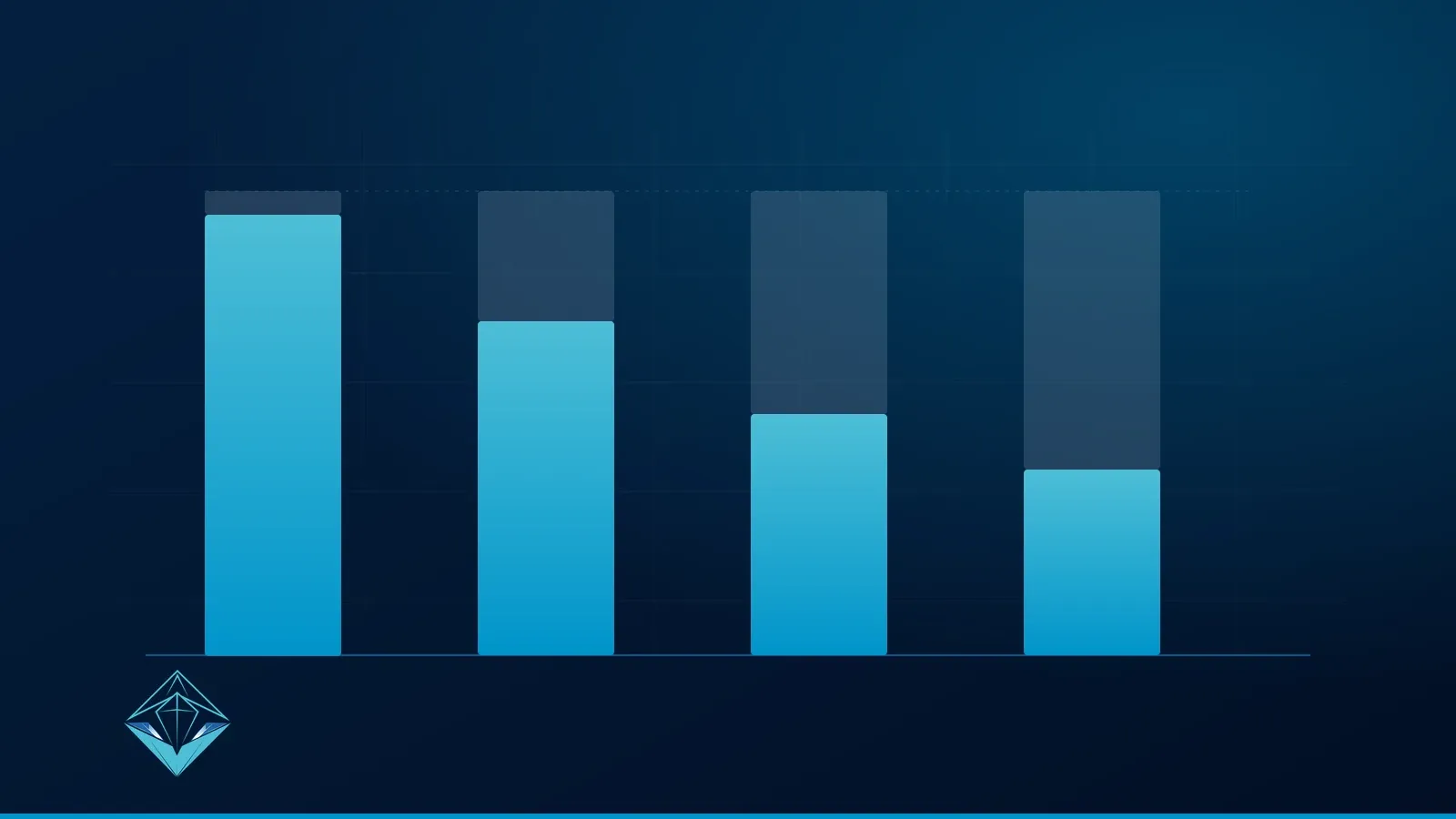
The cleanest primary dataset is Carta’s Founder Ownership Report 2025 (US venture-backed companies, rounds raised 2020–2024). It tracks the median founding team’s ownership as it falls round by round:
| Stage | Median founder-team ownership | Median investor ownership |
|---|---|---|
| After priced seed | 56.2% | 32% |
| Series A | 36.1% | 50% |
| Series B | 23% | 61.6% |
Source: Carta Founder Ownership Report 2025. Investors cross 50% ownership at Series A.
Two things jump out. First, the steepest single drop is seed → Series A — more than 20 percentage points of the company gone in one round. Second, outside investors own the majority of the company by Series A. That is not a failure; it is the normal arithmetic of venture funding. But it means control and economics shift earlier than most first-time founders expect — and the spread is enormous: a Series A founding team ranges from 10% (bottom decile) to 60% (top decile) ownership. Where you land in that range is negotiated, not given.
The “give up ~20% a round” rule — and the direction of travel
Per-round, the canonical benchmark is that a priced early round sells roughly 18–22% of the company. Carta’s data has put median dilution near 20% at seed and Series A, though it has been falling: the median Series A round involved 17.9% dilution in Q1 2025, down from 20.9% a year earlier as the market tightened and founders held more.
Anchor on this: if an investor’s offer implies you are selling 30%+ in a single early round, you are diluting well above market — usually a symptom of too low a valuation, too large a round, or an oversized option pool. Screen the valuation half of that equation with our business valuation calculator before you accept the percentage.
The ESOP trap: the dilution founders don’t see coming
Here is the lever most first-time founders miss. The employee option pool — typically 10% of equity at seed, topped up toward ~15% at Series A (Index Ventures; Carta’s data shows a median employee pool of 11.8% at seed) — is almost always carved out of the pre-money valuation. In plain terms: the pool is created before the new investor’s money goes in, so the entire dilution falls on existing shareholders — you — not the incoming investor.
A 10% pre-money pool top-up on top of a 20% round is not 20% dilution. It is closer to 28–30%. Negotiating the pool size (does the plan really need 10%, or 7%?) and its pre/post-money treatment is one of the highest-return conversations on the whole term sheet — and one of the cap-table red flags that quietly scares off the next investor if it is mishandled.
The terms that decide whether dilution is fair
Dilution is only half the story. The non-price terms decide what your remaining equity is actually worth in an exit. The good news: the institutional standard has moved decisively in founders’ favour, and GCC founders should hold their counterparties to it.
- Liquidation preference: 1x non-participating. Used in roughly 94–98% of recent priced rounds (Cooley). Participating preferred — where the investor double-dips — has nearly vanished, down to around 4% of new term sheets.
- Anti-dilution: broad-based weighted-average. Full ratchet is effectively extinct in clean rounds — Cooley reported 100% broad-based weighted-average and 0% full ratchet in Q3 2024.
If a Gulf term sheet proposes a participating preference, a multiple liquidation preference, or a full ratchet, it is off-market — and a signal you are either negotiating from weakness or with an investor who expects you not to know the standard. That is precisely the gap an advisor closes.
What this means for a GCC founder
The MENA backdrop is supportive: MENA seed valuations ran a mean of $18.2M and a median of $11.6M in H1 2024 (MAGNiTT), with Saudi Arabia and the UAE taking the overwhelming majority of regional funding. Those numbers imply early-round dilution broadly in line with the global ~20% — if you negotiate to it rather than past it.
The practical sequence: fix your valuation case first, size the round to ~18–22% dilution, scrutinise the option pool, and hold the line on 1x non-participating with broad-based weighted-average. Founders who do all four keep materially more of their company through to the exit that matters.
Before your next raise, pressure-test where you stand: the free Investor Readiness Scorecard surfaces the cap-table and terms gaps investors notice first, and if you are raising in or into the Gulf, our capital-raise advisory exists to make sure you are negotiating the whole term sheet — not just the headline number — from the institutional standard, not a blank page.
Sources
Founder & investor ownership by stage, per-round dilution, employee pool: Carta Founder Ownership Report 2025 and State of Private Markets Q1 2025. ESOP norms: Index Ventures, Rewarding Talent. Term-sheet prevalence (liquidation preference, anti-dilution): Cooley Venture Financing Reports, Q3 2024 / Q1 2025. MENA valuations: MAGNiTT. US/global data is used as the benchmark spine because no primary GCC-specific founder-dilution dataset is published; figures are as reported for the periods stated.
Frequently asked questions
How much equity do founders give up at seed and Series A?
On the best primary data (Carta, US venture-backed), the median founding team holds about 56% after a priced seed round and about 36% by Series A — a drop of more than 20 percentage points, the single steepest dilution step in a company's life. As a rule of thumb, a priced early round sells roughly 18–22% of the company. There is no published GCC-specific benchmark, but MENA round sizes and valuations imply broadly similar dilution.
Why does the option pool dilute me and not the investors?
Because the pool is almost always created (or topped up to ~10–15%) out of the pre-money valuation — before the new money goes in. That means the dilution comes entirely from existing shareholders, i.e. you, not the incoming investor. Negotiating the pool size and the pre-vs-post-money treatment is one of the highest-leverage moves on a term sheet.
What liquidation preference and anti-dilution terms are standard now?
The institutional standard is a 1x non-participating liquidation preference (used in roughly 94–98% of recent priced rounds) and broad-based weighted-average anti-dilution — full ratchet has effectively disappeared from clean rounds. If a GCC term sheet proposes participating preferred or a full ratchet, that is off-market and worth pushing back on.
Is dilution worse for founders raising in the GCC?
There is no robust regional dataset that says so. What is true is that the Gulf has no published dilution benchmark, so founders often anchor to whatever a single investor proposes. The fix is to anchor to the global standard — round size, valuation, pool size and the protective terms above — and negotiate from there rather than from a blank page.