In June 2026, Hub71 in Abu Dhabi announced its eighteenth cohort: 27 startups selected from 2,453 applications across 112 countries. Every one of the 27 was headquartered outside the UAE, the first fully international intake in the programme’s history.
That is a 1.1 percent acceptance rate on the most explicitly pro-international programme in the Gulf.
Most founders read that number as a story about competitiveness. It is really a story about intermediation. Capital in the Gulf is not hidden and it is not hostile to outsiders, but somewhere between you and the cheque there is almost always a third person. The founders who raise here worked out who that person was before they started sending emails.
Cold outreach is not the problem. Sequence is.
The pattern I see repeatedly in our practice: a founder in London or Singapore decides the Gulf is worth a serious attempt, builds a list of forty funds from a directory, sends a personalised note to each, gets two polite passes over six weeks, and concludes the market is closed to outsiders.
The market is not closed. The instrument is wrong.
Gulf capital is concentrated and personal in a way London and Singapore capital is not. A significant share sits with family offices, sovereign-adjacent vehicles, and a small number of institutional funds where the decision-maker and the relationship-holder are frequently the same person. In that structure a bad introduction is not an administrative cost. It is a reputational one, borne personally by whoever made it.
The referral requirement is not gatekeeping for its own sake. It is how a small, personally networked capital market prices risk before it spends time. So the question is not how to write a better cold email. It is who the third person is going to be, and what makes it easy for them to say yes.
Four dated capital windows sit between now and year-end
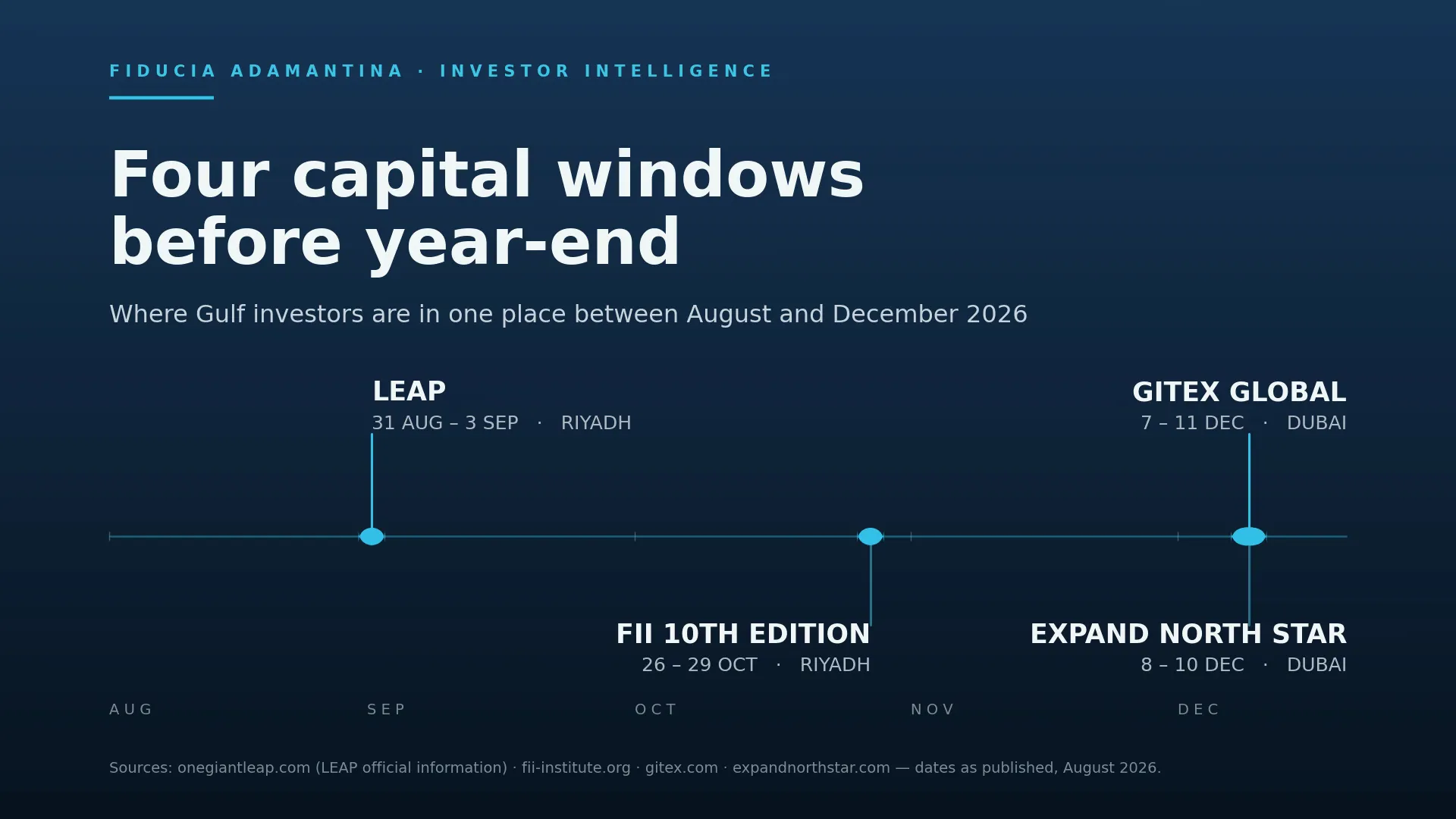
The Gulf capital calendar is unusually concentrated. Instead of a steady drip of meetings across the year, a large share of first contact happens in a handful of weeks. As of early August 2026, four dated windows sit ahead:
- LEAP, Riyadh, 31 August to 3 September 2026. Riyadh Exhibition and Convention Centre. LEAP drew over 201,000 attendees in 2025, and its Rocket Fuel pitch competition took more than 2,500 applications from over 30 countries against a one-million-dollar equity-free prize pool (LEAP organiser information, onegiantleap.com).
- Future Investment Initiative, 10th edition, Riyadh, 26 to 29 October 2026. King Abdulaziz International Conference Center.
- GITEX Global, Dubai, 7 to 11 December 2026. The 46th edition, and the first to run at the Dubai Exhibition Centre at Expo City.
- Expand North Star, Dubai, 8 to 10 December 2026. Same venue, alongside GITEX, positioned specifically as the startup and investor side of that week.
Two things about how to use this calendar.
First, the value is not the event. It is the six weeks before it. Every investor who will be in Riyadh at the end of this month is having their diary filled right now by people who booked ahead, and turning up with a badge and no meetings is an expensive way to walk around a hall. Use the event as the reason a meeting is convenient, not as the mechanism by which it occurs.
Second, match the event to the counterparty. LEAP, GITEX and Expand North Star are founder-dense: useful for meeting funds, corporates, and the programme managers who run the intermediary layer. FII is allocator-dense, and largely a wasted flight if you are an operating company hoping to meet a partner who writes three-million-dollar cheques.
The intermediary layer: who can actually make the introduction
Four groups can credibly introduce an unknown international founder to Gulf capital.
Programmes and accelerators are the most systematic route, and the Hub71 numbers show both why and at what cost. Cohort 18’s 27 companies span 12 countries, from pre-seed to Series A, and had raised roughly USD 230 million between them before selection, an average of USD 8.5 million each. The twelve-month Access Programme includes up to AED 250,000 in in-kind support and AED 250,000 in cash via a SAFE, plus investor introductions. Hub71’s portfolio has passed USD 2.7 billion in cumulative funding.
Read those figures carefully. The average selected company had already raised USD 8.5 million. A programme is a filter that confers credibility, not a shortcut around needing it, and a 1.1 percent acceptance rate makes it a poor primary plan.
Advisors, put honestly: a capital-raise advisor already known to your target investors is selling you their relationship, not only their process. That is a legitimate thing to buy and the thing most poorly disclosed in this market. The questions worth asking are about specific relationships and specific outcomes, not sector logos — I have set out how to assess that in Top M&A Advisory and PE Consulting Firms for Founders.
Law firms and corporate service providers are underrated. A partner who has structured three of your prospective investor’s deals can make an introduction that costs them almost nothing.
Portfolio founders are the highest-conversion route and the slowest to build. A founder already backed by the fund you want carries information a cold approach cannot: they have been through that diligence process and can say whether you will survive it.
The family-office channel behaves differently from all four, and founders consistently pitch it as if it were a VC. I have set out how it actually works in How to Raise From Family Offices in the GCC.
What a warm introduction costs the person making it
Every guide tells founders to get a warm introduction. Almost none explain what they are asking for.
An introduction costs the referrer reputation, not time. If they send you to an investor and you are unprepared, off-thesis, or simply not ready, the investor does not conclude you were a bad founder. They conclude the referrer’s judgement is unreliable. That cost is paid quietly, over years, and it is why people who like you will still not introduce you.
Once you understand that, the ask changes shape. Make the referral cheap:
- Send a forwardable paragraph, not a request for a call. Three or four sentences the referrer can paste without editing: what you do, the traction number that matters, the stage and size of the raise, and why this specific investor.
- State the fit explicitly. If you cannot articulate why this investor and not the next one on the list, you are asking your referrer to do your research for you.
- Give them an exit. “No pressure at all if the timing is wrong” is not politeness. It removes the social cost of declining, which is what makes the yes real when it comes.
- Close the loop. Tell the referrer what happened. People introduce repeat-reporters far more readily than strangers, and it is the cheapest thing most founders never do.
LinkedIn in the Gulf: good for warmth, useless for cold
A connection request with a pitch attached is ignored here at roughly the rate it is ignored everywhere. What LinkedIn does well in this market is slower: it makes you recognisable before you ask for anything.
The founders I have watched do this properly spend six to eight weeks commenting substantively on what a target investor actually publishes, sharing operating detail from their own business rather than commentary about the region, and building second-degree overlap. The objective is that the meeting at LEAP or GITEX is a second contact, not a first. It is unglamorous, takes a quarter to work, and is the only part of Gulf access a founder in another country can start today with no budget.
What a UAE entity signals, and what it does not
An entity in DIFC or ADGM does three real things: it makes you contractable and bankable locally, it gives a regional investor a vehicle they understand to invest into, and it signals that your interest in the region survives contact with paperwork. That third signal matters more than founders expect, because most inbound interest in the Gulf evaporates the moment it becomes work.
What an entity does not do is manufacture a network or move the diligence bar. I have watched founders spend four months and meaningful money on a structure, land in Dubai, and discover they still know nobody. It is never the access itself.
For the jurisdiction trade-offs, see Raising in the UAE as a Foreign Founder. If what you need first is a picture of where regional capital sits and what it has been funding, the GCC Fundraising Snapshot is the shortest route to that view.
Where founders waste the access they finally get
Access is the cheap half of this problem. I have watched founders spend nine months building a route into a room and lose it in forty minutes.
The failures are consistent: a deck built for a different market, a global growth story pitched to a room that wanted to know why the region specifically, a model that cannot survive one round of questions about its assumptions, and no answer to what the money buys beyond runway. Gulf investors are not slower or less sophisticated than their London counterparts. In my experience they are more direct when the preparation is thin, which founders sometimes mistake for hostility. The specific ways international founders lose these rooms are worth reading in full: What London and Singapore Founders Get Wrong About Raising in the Gulf.
Preparation is also why an Investor Readiness Sprint exists as a fixed piece of work rather than an open-ended engagement. The materials either hold up under a partner’s questioning or they do not, and that is knowable before you get on a plane.
What to have ready before the first meeting
Before you spend a referrer’s reputation, have these in place:
- A deck that answers “why here.” Not a regional slide bolted onto a global deck — a real reason the Gulf is the right capital for this company at this stage.
- A model whose assumptions you can defend line by line. Bottom-up, not a top-down market-share estimate.
- A clear stage and number. Vagueness about how much you are raising and what it buys reads as indecision, and indecision is the most common reason a first meeting does not become a second.
- A current cap table with no unexplained entries. Structures that made sense in another market frequently need explaining here.
- One sentence on your regional commitment. An entity, a hire, a partnership, or a stated intention with a date.
For the capital picture itself — where regional money has been going and who has been writing cheques — start with the GCC Fundraising Snapshot. To test where you stand before spending introductions, the five-minute investor readiness self-assessment is the fastest honest read and the Investor Readiness Scorecard goes a level deeper. If the materials are the gap rather than the map, the Investor Readiness Sprint is the fixed-scope build that closes it, and the capital raise practice page sets out where that sits in a wider raise.
The Gulf rewards founders who arrive prepared and on time. Both are within your control, and the next window opens at the end of this month.