Every founder preparing to raise eventually asks the same question: am I actually ready, or do I just feel ready? Most answer it the expensive way — by taking the meeting and finding out in the room. In a deep ecosystem, that experiment costs one meeting. In the Gulf, it can cost the round.
Here is the asymmetry that makes readiness worth measuring before an investor measures it for you. The GCC investor pool is small, and it behaves like one room. Family offices in Dubai co-invest with funds in Riyadh and Abu Dhabi; partners sit on the same boards and compare notes on the same deals. A pitch that lands badly does not stay in the room where it happened — it circulates. The warm introduction that got you the meeting, usually someone spending their own credibility to open a door, does not regenerate once spent. And “come back when you’re further along,” however warmly delivered, is usually permanent: investors rarely re-engage a company they have filed as not ready, and almost never at a higher valuation than the one they declined.
Set that against the cost of waiting. Delaying your raise by three weeks to close a gap costs you three weeks. Going to market three weeks early can cost you the introduction, half a year of calendar, and the only first impression you will ever get with the ten investors who matter most for your sector. The downside is not symmetrical, so the burden of proof sits on “I’m ready,” not on “I should wait.”
This piece moves that judgment out of the investor meeting and onto this page: five questions, one per readiness pillar, scored honestly in five minutes. The number at the end tells you whether to take the meetings, postpone them three weeks, or take them off the calendar entirely.
Why “probably ready” is the most expensive answer in fundraising
Most founders who come to us at Fiducia Adamantina arrive saying some version of “I think we’re ready, but I want a sanity check.” The instinct is right. The problem is the word probably.
“Probably ready” is not a midpoint between ready and not ready. In practice it almost always means not ready in at least one pillar, and not yet sure which one. The founder who is genuinely at the bar tends to know it, because they have already survived hostile questions from advisors or board members. The founder who says “probably” is carrying a gap they have not yet been forced to look at — and the first person to force the look will be a partner with a chequebook and a long memory.
The self-assessment below converts probably into a number. Score it on present-tense readiness: what you could say and show in an investor meeting tomorrow morning, not what you could assemble after a strong weekend.
The five-minute self-assessment
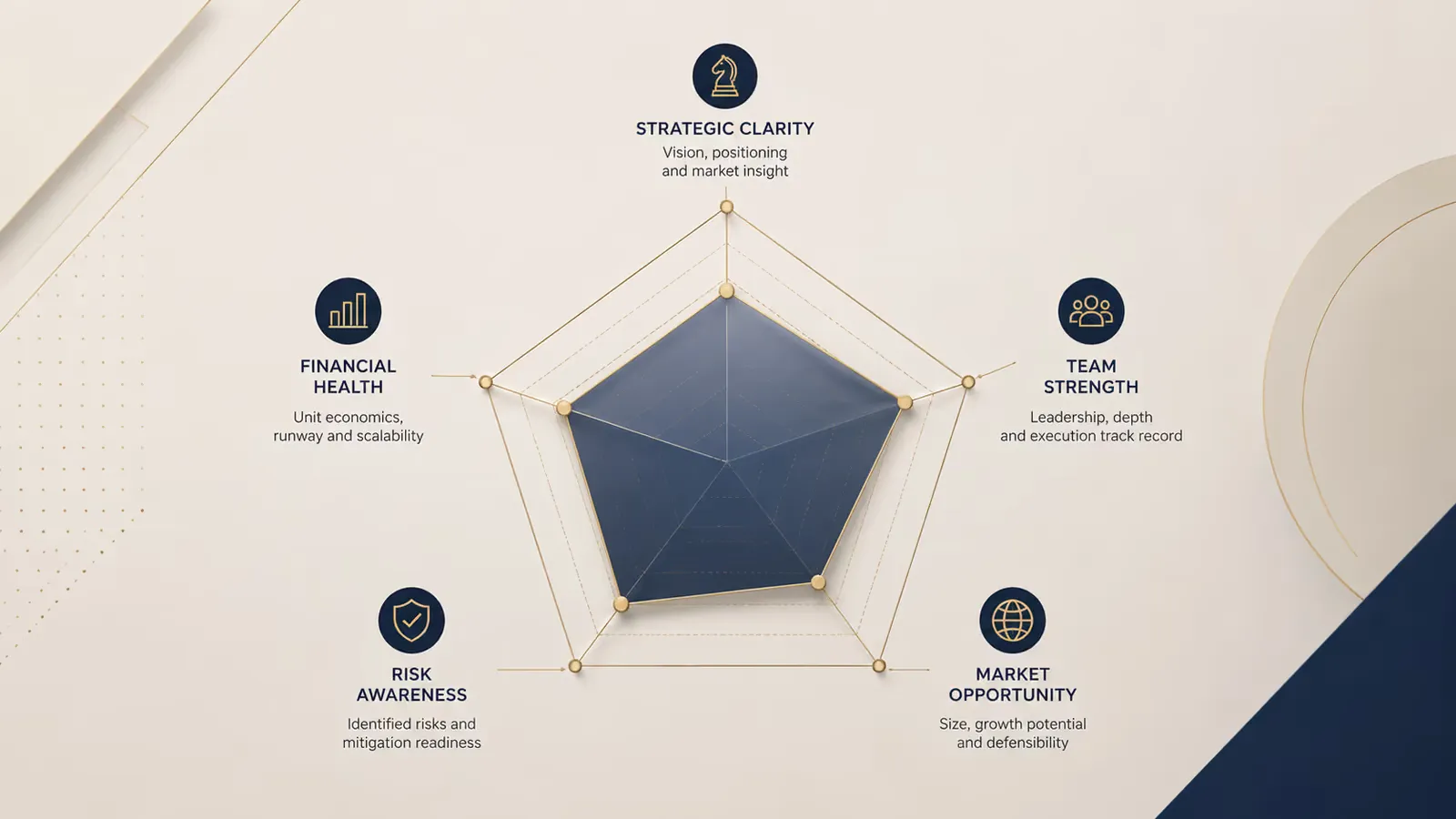
The five questions map to the five pillars of our Investor Readiness Framework — narrative, financial model, documentation, valuation, and investor targeting; the full treatment of why these five decide rounds lives there. Here, each pillar compresses into a single question you score 0, 1, or 2:
- 0 — not in place today.
- 1 — partially in place, or in place but untested under pushback.
- 2 — in place, and it would survive an investor’s follow-up questions tomorrow.
Maximum score: 10. Be ruthless. A generous 1 that should be a 0 does not change your readiness — it just changes which room you discover it in.
Question 1 — Narrative. Can you say what this business is, who it is for, and why now — in three sentences that survive direct pushback?
Not whether you can talk about the business for an hour. Whether you can compress it, then defend the compression when an investor pushes on “why now” or “why you.” If the answer lives in the deck rather than in your mouth, score 0. If it is tight but has never been stress-tested by someone with an incentive to break it, score 1.
Question 2 — Financial model. Pick any revenue line in your model. Can you trace the number to evidence in two follow-up questions or fewer?
“Where does that assumption come from?” is the question that cools more first meetings than any other. A top-down market sizing scores 0. A bottom-up build that exists but leans on conversion rates you have not actually observed scores 1. A build tied to your own pipeline, cohorts, and unit costs — one you can walk through without opening the file — scores 2. Gulf capital, family-office capital in particular, is structurally less tolerant of growth-without-economics than founders calibrated on Silicon Valley expect; this pillar is judged hardest here.
Question 3 — Documentation. If an investor asked for your data room at nine tomorrow morning, what would you send?
A folder you would need a week to assemble scores 0. A folder that exists but holds a cap-table surprise — a departed co-founder with a meaningful stake, friends-and-family notes with no documented terms, a dormant local sponsor from an earlier mainland setup — scores at most 1, because the investor will find it, and finding it themselves is what kills the deal. Score 2 only if the room is assembled, current, and reads well without you there to explain it.
Question 4 — Valuation. Can you justify your number without referencing your last round?
“We raised at X eighteen months ago” is not a valuation story; it is an anchor an investor will discount on contact. Score 2 only if you can walk through two or three defensible methods and know which comp set the investor across the table will be using. If your number came from a fundraising conversation in your WhatsApp, score 0 and be glad you found out here.
Question 5 — Targeting. Can you name your first five investors and explain why each one, in the order you will approach them?
A generic list of every fund with a MENA mandate scores 0. A real list — segmented by thesis, stage, cheque size, and warm-path availability, sequenced so the conversations you most need to win do not happen first — scores 2. In a market where circles overlap this heavily, wrong targeting is not just inefficient — it is how a small market learns you are raising before you are ready.
Scoring: what each band actually costs you
Add the five scores. The bands below are calibrated against the founders we have worked with — and the band you least want to be in is not the bottom one.
8–10: you are at the bar — your risk is now sequencing, not readiness
The preparation work is done; what can still hurt you is order of operations. Open your process with one or two named investors you would learn from but do not need to close, so the live feedback lands before the meetings that count. Confirm the target list, book the first intros for two weeks out, and protect the calendar — readiness decays if a raise drags. If you want one independent check before spending a warm introduction on finding out, the Investor Readiness Scorecard gives you a structured second opinion in about fifteen minutes.
5–7: the dangerous band — close enough to feel ready, far enough to burn the network
This is the band that destroys the most rounds, precisely because nothing about it feels like an emergency. At 5–7, the gaps are invisible to you and visible to a partner within the first half hour. The meeting does not blow up; it cools. You get a warm pass, the partner mentions it to two co-investors, and an introduction that took a year of relationship to produce converts into a closed door. The specific ways those meetings come apart — the model that folds on the second follow-up, the cap table that tells the wrong story — are documented in why most founders fail their first investor meeting. None of them is rare, and none is visible from inside the company.
The standard response in this band is three to four weeks of focused work on your two lowest-scoring pillars — typically a financial-model rebuild and a cap-table clean-up, with a narrative pass on top. The mistake is taking meetings while doing that work: every meeting taken before the gaps close converts a first-tier introduction into a second-tier reputation.
Below 5: take the meetings off the calendar
At this level, going to market is not a long shot — it is an anti-marketing campaign. Each pitch builds a record, in a market with a long memory, of a company that approached investors unprepared. Remediation here runs longer than a sprint, typically eight to twelve weeks, and the order matters: narrative before model, model before valuation, all of it before outreach. The honest move is to stand down from fundraising mode entirely, fix the foundations, and re-score in a month.
One important exception. If you have been operating for seven or more years with real revenue and a real team, and you still score below 5 on a framework built for fundraising, the right question may not be “how do I get investor-ready faster” — it may be whether another raise is the right move at all. For a business at scale, a sale or partial exit to a strategic acquirer, in a GCC acquisition market that is genuinely active, can be a better outcome than a two-year fundraising cycle. That path runs on different mechanics, and it starts with a different conversation.
From a feeling to a number to a plan
The self-assessment above is deliberately the lightest instrument in the sequence — five questions, five minutes, free, dependent on your own honesty. Its job is to tell you whether there is a problem.
The second pass is the Investor Readiness Scorecard: fifteen questions, about fifteen minutes, across four categories — legal structure, pitch materials, financial clarity, and strategic positioning. Where the self-assessment gives you a band, the Scorecard gives you a category breakdown and the specific gaps inside it, scored against what investors actually check. It is free, and it is the difference between “I think the model is the weak spot” and knowing exactly where the scrutiny will land.
If the diagnosis comes back with work to do, the Investor Readiness Checklist is the free, pillar-by-pillar remediation plan — the artefact we open every readiness engagement with — telling you what to fix and in what order if you want to run the work yourself.
When investor interest is live but the materials are not at the bar, the Investor Readiness Sprint can rebuild the defined deck, model, cap-table scenario, and founder narrative in 2–3 weeks from complete intake for AED 25,000. It does not close every company-level gap the assessment may identify. Paid fees are eligible for the optional 90-day raise-mandate credit. Credited only if we take the raise mandate.
The honest next step
If you scored 8 or higher, take the meetings — sequenced, with the learning conversations first. You do not need us yet. When you build that sequence, the Dubai investor list sets out who invests at which stage and how each one takes a pitch.
If you scored 5 to 7, do not take the meeting next week. Take the Scorecard this week, see which pillars carry the gap, and decide — with a number rather than a feeling — whether to close it yourself with the Checklist or compress it into a Sprint. Preparation is cheap. The introductions you would spend finding out the hard way are not.
If you scored below 5, the kindest thing anyone will tell you this quarter is to stop pitching. Fix the foundations, re-score in a month, and go to market once — properly — instead of twice, badly.