
Selling a company is not one mandate. It is a chain of decisions that moves through commercial positioning, financial evidence, legal documentation and tax treatment. Those decisions are connected, but they do not belong to the same profession.
That distinction matters. A strong M&A adviser can run the process and coordinate the group, but cannot give the legal opinion on a share transfer. Your lawyer can negotiate the sale and purchase agreement, but should not be expected to establish normalised EBITDA. Your transaction advisory team can test earnings and working capital, but does not decide the tax structure on its own.
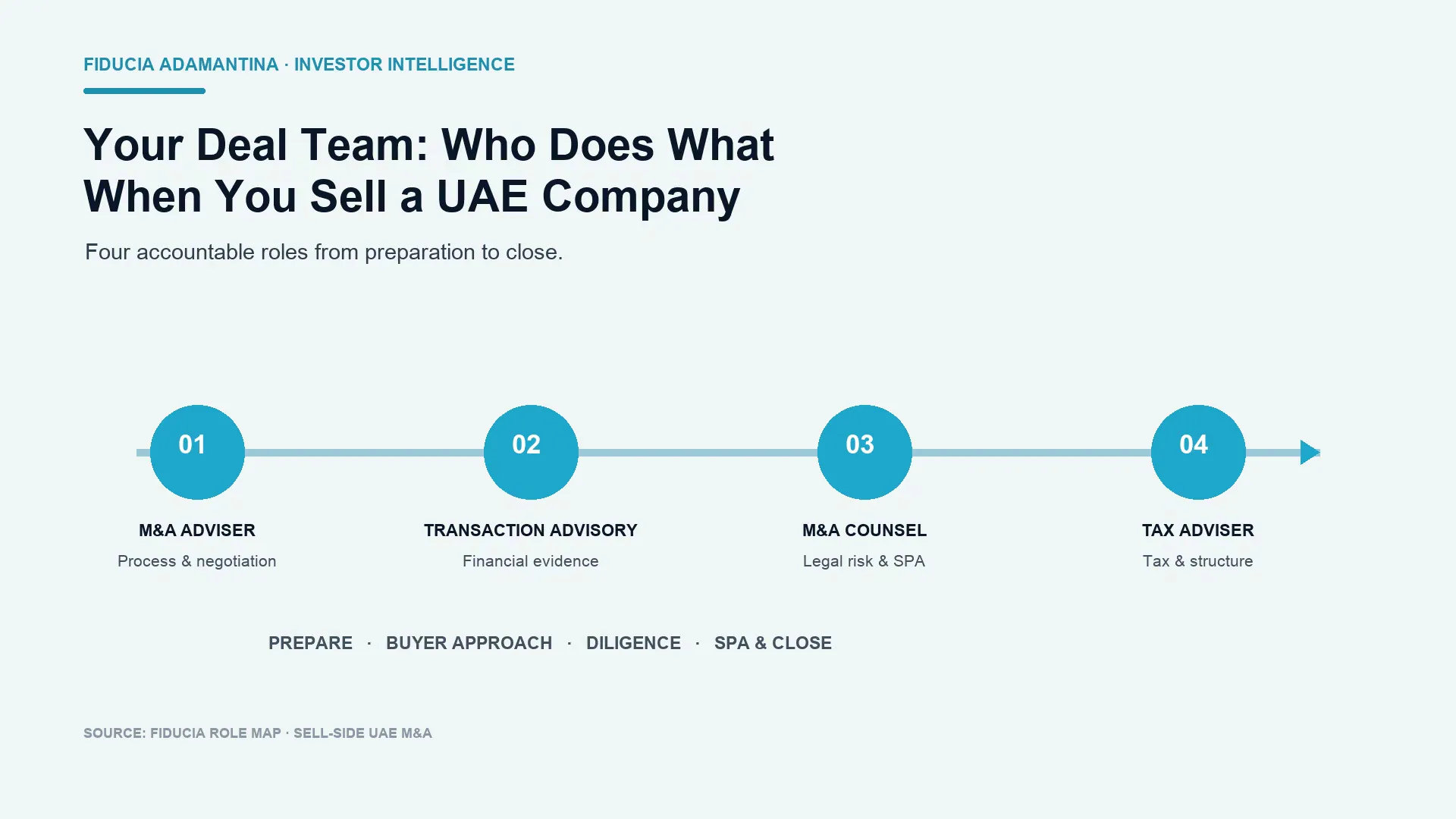
For most UAE sellers, the core deal team has four roles:
- M&A adviser: owns the sale process, positioning, buyer dialogue and commercial negotiation.
- Transaction advisory team: owns the financial diligence analysis, including quality of earnings, working capital and net debt.
- M&A counsel: owns legal diligence, transaction documents, disclosure and closing mechanics.
- Tax adviser: owns tax diligence, structuring and tax provisions in the transaction documents.
The team can be lean or extensive. What cannot be ambiguous is who owns each decision and when that person must be in the room.
Why the buyer appears to have more advisers
The buyer’s team is built to protect capital: deal lead, financial diligence, counsel, tax and sometimes commercial or technical specialists. That apparent asymmetry is not a reason for the seller to copy every role. It is a reason to prepare one evidence owner for each buyer workstream and route every request through the process lead. The seller’s advantage comes from readiness and clear accountability, not matching headcount.
The M&A adviser owns the process
The M&A adviser is usually the seller’s process lead. That mandate starts well before buyer conversations. It includes testing sale readiness, shaping the equity story, organising materials, identifying and approaching suitable buyers, controlling information flow, comparing offers and keeping the timetable moving.
The adviser also coordinates the specialists. If financial diligence identifies a working-capital issue, the adviser translates it into the negotiation. If counsel flags a change-of-control consent, the adviser makes it part of the timetable. If the tax adviser proposes a pre-sale restructuring, the adviser assesses how it affects buyer messaging and execution risk.
Coordination is not substitution. The M&A adviser should not sign off legal, tax or accounting conclusions. A useful division is simple: the adviser owns the process and commercial decision, while the relevant specialist owns the professional analysis behind it.
For a closer look at the day-to-day mandate, see what an M&A adviser actually does. If you are deciding when to appoint one, read when to hire an M&A adviser.
Transaction advisory owns the financial evidence
Transaction advisory services in the UAE sit between the company’s reported accounts and the buyer’s view of sustainable performance. The team tests how revenue converts into earnings and cash, then isolates items that may change the price or closing adjustment.
Typical work includes:
- quality of earnings and EBITDA normalisation;
- revenue, margin and customer-concentration analysis;
- normalised working capital;
- net debt and debt-like items;
- cash conversion and one-off costs;
- financial data-room support;
- review of completion accounts or locked-box inputs; and
- financial input into price-adjustment clauses.
BDO UAE describes financial due diligence as analysis of earnings quality, normalised working capital and debt, among other matters. Grant Thornton UAE’s transaction advisory overview also places sell-side preparation, data-room work, completion accounts and SPA support within the transaction advisory scope.
This is why the M&A adviser versus transaction advisory distinction matters. The M&A adviser decides how to position a finding and negotiate around it. The transaction advisory team establishes the financial basis for that decision.
A statutory audit is not the same exercise. Audited accounts provide an important historical baseline, but a buyer asks a different question: what level of earnings, cash generation and working capital should carry forward under new ownership? The answer often requires deal-specific analysis. Our guides to sell-side due diligence and quality of earnings and EBITDA add-backs explain that work in more detail.
M&A counsel owns legal risk and the transaction documents
M&A counsel should be involved before documents begin circulating. Early legal work can surface ownership, licence, authority, employment, intellectual-property, material-contract and change-of-control issues while the seller still has time to address them.
Counsel normally owns:
- legal due diligence and remediation planning;
- transaction structure from a legal perspective;
- the letter of intent’s legal terms;
- the sale and purchase agreement;
- warranties, indemnities, limitations and disclosures;
- conditions precedent, consents and regulatory steps;
- escrow, retention and closing documents; and
- signing and completion mechanics.
BDO Legal’s UAE overview notes that legal diligence covers authority, licences, contracts and change-of-control restrictions, and explains that identified risks may be handled through conditions precedent, price adjustments, escrow or indemnities. It also highlights the formal requirements that can apply to transfers of interests in UAE limited liability companies.
For the contractual boundary between factual disclosure and seller liability, see representations and warranties explained.
Your existing company lawyer may know the business well, which is valuable. But familiarity does not always equal transaction capacity. Ask whether the lawyer has recent sell-side experience, can lead an SPA negotiation, understands disclosure practice and has the resources to manage a compressed diligence timetable. If not, the existing lawyer can remain a key source of company history while specialist M&A counsel leads the transaction.
Where M&A tax and reorganisation advice fits in the UAE
Tax work should begin during preparation, not after the price is agreed. The transaction form, ownership structure, historic exposures and timing of any reorganisation can affect proceeds, execution and the protections requested by a buyer.
An M&A tax adviser in the UAE typically examines:
- historic corporate tax and VAT positions;
- tax attributes and contingent exposures;
- the tax consequences of a share sale versus an asset sale;
- participation exemption or other relief conditions;
- pre-sale restructuring and the time needed to implement it;
- management rollover or reinvestment; and
- tax warranties, indemnities and covenants in the SPA.
KPMG Lower Gulf explains that tax diligence surfaces hidden exposures and value-driving opportunities that can influence deal pricing, structure and negotiation, and includes buy-side and sell-side tax diligence, transaction structuring and tax provisions in the SPA within its M&A tax work. The UAE Federal Tax Authority’s corporate tax FAQ states that gains may form part of taxable income, while participation exemption or other relief may apply when their conditions are met.
The practical point is not that every transaction needs a complex reorganisation. It is that the seller should test the position early enough to have a real choice. Tax and legal conclusions depend on the facts; obtain advice from appropriately qualified professionals.
Who joins when: a seller-side responsibility map
| Phase | M&A adviser | Transaction advisory | M&A counsel | Tax adviser |
|---|---|---|---|---|
| Preparation | Readiness, positioning, buyer strategy, timetable | Earnings, working capital and net-debt analysis | Legal health check and remediation | Exposure review and structure options |
| Buyer approach | Outreach, NDA process, information control | Prepare financial evidence and Q&A support | NDA and legal information boundaries | Confirm that planned steps preserve intended treatment |
| Indicative offers / LOI | Compare value, terms and certainty | Test assumptions behind price mechanics | Negotiate exclusivity and legal terms | Review tax effect of proposed structure |
| Due diligence | Coordinate workstreams and responses | Answer financial diligence; test buyer findings | Manage legal diligence and disclosures | Run tax diligence and respond to findings |
| SPA and closing | Lead commercial trade-offs and timetable | Support working-capital, net-debt and completion-account mechanics | Draft and negotiate SPA; manage signing and completion | Negotiate tax warranties, indemnities and covenants |
This sequence should fit the broader M&A process, but it is not a relay in which one adviser finishes and disappears. The workstreams overlap. The operating discipline is to keep one owner for every deliverable and one coordinator for the full process.
A lean team and a full team use the same ownership logic
A straightforward owner-managed sale may use one M&A adviser, one deal-experienced finance team, one M&A lawyer and one tax specialist. A larger or more complex transaction may add sector experts, regulatory counsel, technology or cyber diligence, environmental specialists, pensions advice, insurance advisers and communications support.
Team size should follow risk, not prestige. Consider adding depth where the target has regulated activities, multiple jurisdictions, intellectual-property dependence, complex employee incentives, significant property, environmental exposure or a carve-out from a wider group.
Even a lean team needs clear boundaries. Combining providers can reduce coordination cost, but it does not remove professional independence or accountability. Record who prepares, who reviews and who signs off each critical output.
When a Big Four transaction-services team may be excessive
For a straightforward SME sale with one entity, orderly records and limited financial complexity, a full-scale transaction-services team may create more process than the risk requires. A tightly scoped specialist team can often cover earnings, working capital and net debt. Big Four depth becomes more proportionate when the group spans entities or jurisdictions, the accounts need extensive reconstruction, price mechanics are complex, or a buyer requires institutional-grade vendor diligence. Choose the scope from the risk and buyer expectation, not the logo.
Five mandate questions—and where to start
Before appointing the group, ask each adviser:
- What do you own? Request a deliverable list, not a broad service description.
- What do you rely on another adviser to provide? Hidden dependencies cause late surprises.
- When must you be appointed? Work backwards from the intended buyer approach and signing date.
- Who makes the final call when findings overlap? For example, a tax issue may also affect the SPA and price.
- How will fees change if the timetable or scope expands? Agree change-control rules before the process becomes urgent.
The engagement letters should align. If two advisers assume the other owns a workstream, the seller owns the gap.
Start with the gaps, not the job titles.
The right deal team is not the longest adviser list. It is the smallest group that can establish the evidence, protect the seller and keep the process moving without blurred accountability.
Start by mapping the decisions that a buyer will force: sustainable earnings, working capital, net debt, legal transferability, historic tax exposure, transaction structure and contractual protection. Then assign an owner and a deadline to each one.
Use Fiducia’s Exit Readiness Scorecard to identify which workstreams need attention before buyer contact. If you want to map the team and sequence around your specific company, book a strategy session.