
You have agreed a price for your UAE company. Then the buyer’s lawyers ask who will pay corporate tax on the gain. Your answer, until that moment, was that selling a business in the UAE was tax-free.
That assumption is too broad. The Federal Tax Authority’s capital-gains FAQ says gains generally enter taxable income; share disposals and certain reorganisations can qualify for exemptions or relief. The transaction’s label does not establish eligibility.
The useful starting point is the seller. You selling personally held shares, your holding company selling a subsidiary, and your operating company selling its business are different transactions. Establish that distinction before comparing the proceeds you expect to keep.
This is an explanation of the UAE corporate tax framework, checked on 2026-10-05, rather than tax advice. It is written for an owner preparing a sale, not as a substitute for a transaction-specific opinion.
Start with the seller named in the documents
Put the ownership chart beside the proposed sale agreement. Mark the legal owner of the shares or assets being sold, the contracting seller and the recipient of the consideration.
Those names may all point to you. They may instead point to a company you own. Calling yourself the founder does not answer the question.
Use a simple working map:
| Proposed transaction | Position to establish |
|---|---|
| You sell shares held personally | Whether the income qualifies as personal investment income |
| Your company sells shares in another company | Whether the gain qualifies for participation exemption or another applicable treatment |
| Your operating company sells assets or its business | The company’s gain and whether a specific relief applies |
The map is a prompt for your adviser, not a tax ruling. Add the seller’s tax residence, the ownership history and any previous restructuring. A UAE answer also needs to sit beside any overseas tax analysis that your circumstances require.
For the commercial differences between the structures, read asset sale versus share sale in the UAE. Keep the tax conclusion separate from the buyer’s preference for one structure.
A personal share sale needs a personal-investment test
The FTA’s natural-person guide, section 3.8.2, excludes personal investment income when the activity is on the individual’s own account, neither conducted through nor requiring a licence, and not a commercial business under the Commercial Transactions Law. A personal share sale meeting that definition falls outside UAE corporate tax.
Do not shorten this to “individuals never pay corporate tax.” The FTA separately states that an individual conducting UAE business activities enters the regime when business turnover exceeds AED 1 million in a calendar year. Personal investment income is excluded from that assessment. FTA: basis of taxation for natural persons.
Ask your registered tax agent to classify the income, with the ownership documents and the actual activity in front of them. Your personal signature is evidence of who signed. It is not, by itself, evidence that the income meets the exclusion.
Also separate a sale of your shares from a sale of the business by your sole proprietorship. The word “personal” should describe the applicable investment classification, not replace the analysis.
A company selling shares must establish the exemption
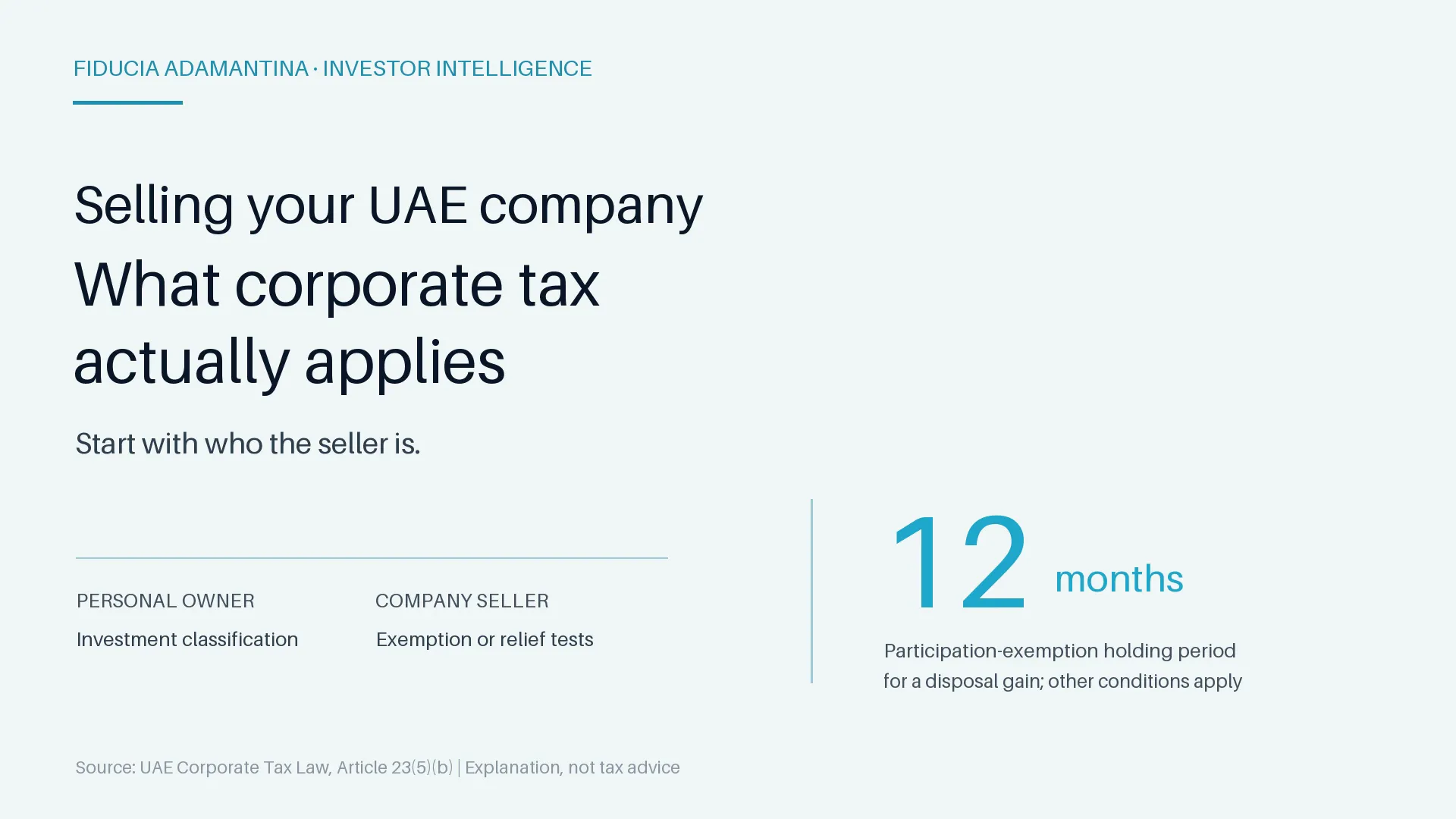
For corporate sellers, participation exemption is a conditional route. The standard starting tests in Article 23 include a 5% ownership interest, entitlement to at least 5% of distributable profits and liquidation proceeds, and a subject-to-tax condition normally linked to a comparable tax rate of at least 9%, with statutory deeming provisions. For a disposal gain, Article 23(5)(b) requires the relevant holding period to have expired: the ordinary period is 12 uninterrupted months. Other conditions also apply. MOF: Corporate Tax Law, Article 23.
These are starting points, not an exhaustive checklist. Article 23 also permits a ministerial acquisition-cost alternative to the ownership threshold. Ask the agent which route applies rather than assuming a smaller percentage necessarily fails.
Be precise about timing. The FTA participation guide, section 5.3, discusses intention to hold and the evidence supporting it. Do not use that intention as a shortcut around the completed holding-period rule for a disposal gain. Separate dividends received during ownership from the gain realised on exit.
The rules have also changed since the first guides appeared. The Ministry’s announcement of Decision 302 of 2024 says the amended decision applies to tax periods starting on or after 2025-01-01, and limits the participation asset test to related parties. Have the agent test current implementing rules, including prior relief transactions, against your dates. A checklist copied from an older article is not enough.
An asset sale puts the gain inside the business
An operating company selling equipment, contracts or a business is not disposing of a participating shareholding simply because its founder calls the transaction an exit. The FTA’s capital-gains FAQ treats other capital gains as ordinary income unless applicable relief changes that result.
Nor should you estimate the tax by multiplying the headline sale price by a rate. The MOF explains that taxable income starts with accounting profit or loss, then applies the required tax adjustments.
Under the ordinary regime, 0% applies to taxable income up to AED 375,000 and 9% above that threshold. These are annual taxable-income brackets, not an allowance on the sale price. MOF: explanatory guide announcement.
Request a proceeds bridge for each credible structure. Show the consideration, the accounting and tax basis used, proposed adjustments, tax, transaction costs and the amount available to the owner. Keep assumptions visibly separate from conclusions. Review VAT, property charges and any multinational minimum-tax obligations as separate workstreams where relevant; the ordinary brackets do not settle those questions.
M&A tax and reorganisation: relief has conditions
A pre-sale transfer can be commercially sensible. It should not be sold to you as an automatic way to erase the exit gain.
Qualifying Group Relief concerns transfers of assets or liabilities within an eligible group. Its ownership test uses at least 75%, directly or indirectly, between the parties or through a common owner. Other conditions and an election apply. Relief can be clawed back when, within two years, the asset leaves the group or the parties cease to qualify together. FTA: Qualifying Group Relief guide.
Business Restructuring Relief covers qualifying transfers of a business or an independent part in exchange for shares or other ownership interests, including certain mergers. It requires an election and conditions including valid commercial reasons. A subsequent business transfer, or certain disposals of the ownership interests received, within two years can trigger clawback. FTA: Business Restructuring Relief guide.
Ask for the whole sequence to be reviewed: transfer, buyer transaction and what happens afterwards. The seller’s need for cash and the buyer’s required structure belong in that review. Do not approve an isolated first step while leaving its exit consequences untested.
Before that work starts, use the Exit Readiness Scorecard to identify preparation gaps around the sale. It is a starting point for readiness, not an exemption calculator or a tax opinion.
A free-zone licence does not settle the answer
Free-zone incorporation and Qualifying Free Zone Person status are different questions. The FTA’s Free Zone Persons guide sets conditions including adequate substance and audited financial statements. A qualifying person receives 0% on qualifying income and 9% on taxable income that is not qualifying income; the ordinary AED 375,000 bracket does not apply to that latter income.
Ask the specialist to test the particular disposal and current qualifying-activity rules, rather than treating the licence as an exemption certificate. Also have them check eligibility before proposing group or restructuring relief. The rules for those reliefs exclude Qualifying Free Zone Persons.
The practical deliverable is a written classification of this seller and this income. A free-zone address on the letterhead is not that deliverable.
Settle the tax position before the LOI
My view is that the letter of intent should follow the structure analysis. Otherwise you may agree a price and exclusivity on assumptions that your specialist later rejects.
Before signing, ask for a short written paper that names:
- the seller, the property being sold and the proposed consideration;
- the tax treatment sought and its current legal basis;
- the documents establishing each relevant condition;
- acquisition, restructuring and planned disposal dates;
- unresolved facts, elections and possible clawbacks; and
- the proceeds comparison, including who bears any tax under the proposed documents.
Give the paper to counsel and the process lead. Counsel should reflect the agreed risk allocation in the transaction documents; the commercial team should use the resulting proceeds comparison when evaluating offers. Our guide to the UAE company-sale deal team explains how these responsibilities fit together.
Obtain the conclusion from an appropriately experienced FTA-registered tax agent. Check the name in the FTA register, then agree the transaction-specific scope. This article cannot establish your eligibility.
If the sale process is still taking shape, start with how to sell a business in Dubai and the Exit Readiness Scorecard. To map preparation and adviser responsibilities around your company, book a strategy session. Bring the ownership chart and proposed structure; keep the specialist tax opinion as a distinct piece of work.