
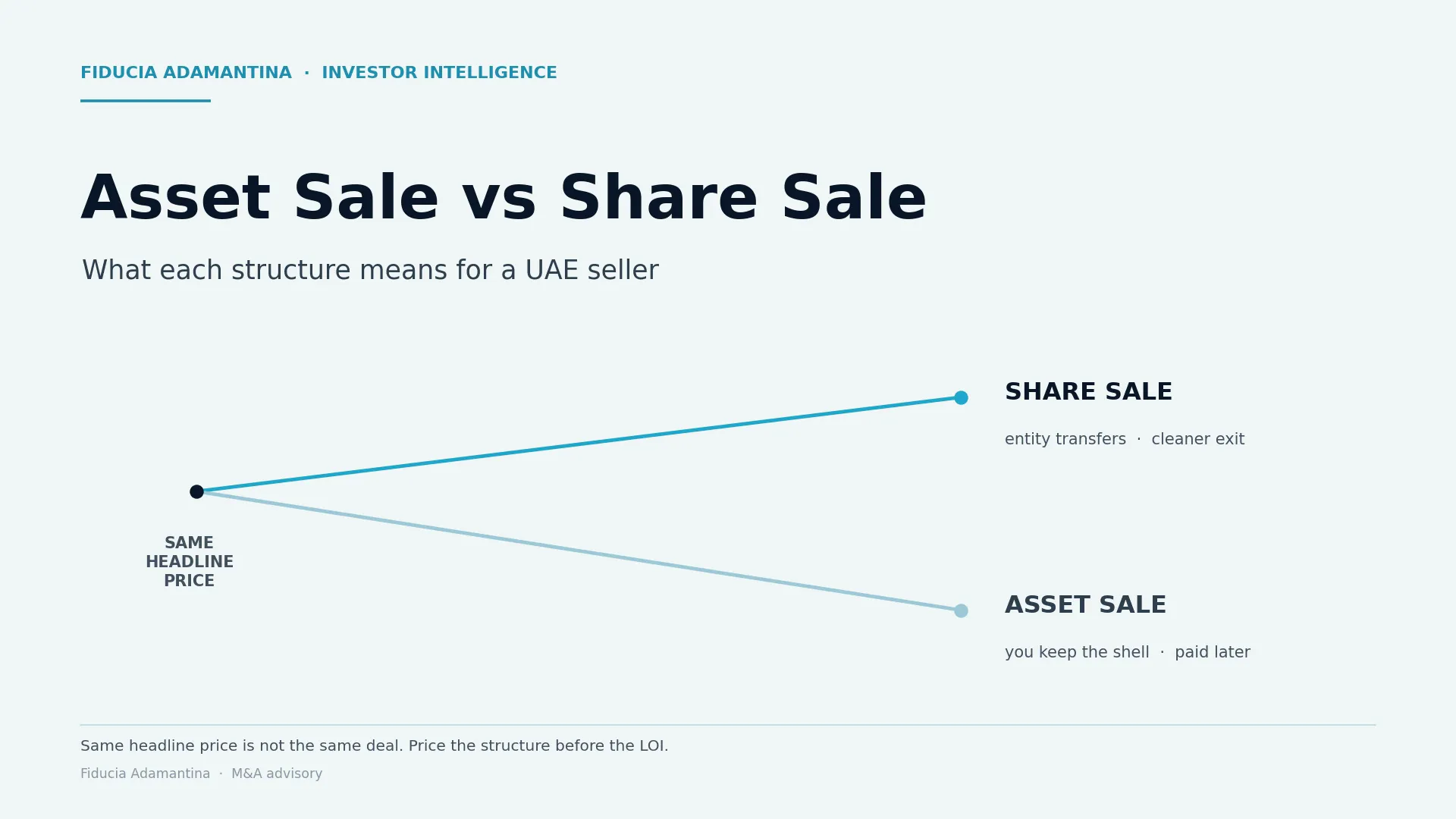
Two buyers table the same number for the same company. The first wants the shares: it takes the entity as it stands — licence, staff, contracts, history and all — and the founder is, in the cleanest cases, finished. The second wants the assets — the customer list, the brand, the equipment, the good contracts — but not the entity. So after the deal “closes”, that founder still owns a company: hollowed out, still licensed, still sponsoring visas, still owing end-of-service gratuity to staff who have left, and months of work ahead to switch it off.
Same headline. Two completely different things to live through. The fork between a share sale and an asset sale is the first structural decision in any exit, and in the UAE it carries consequences founders discover only after their leverage is gone. The broader anatomy of a deal sits in M&A deal structure; this is the deep read on the one fork that starts it — and on why the UAE makes the asset route heavier than the textbooks admit.
The Two Things a Buyer Can Actually Buy
Strip the legal language away and there are only two objects a buyer can take.
- A share sale buys the company itself. Ownership of the entity changes hands, and everything it holds — trade licence, contracts, employees, track record and liabilities — comes along automatically, because none of it has moved. The business is the same the morning after closing; only the shareholder is different.
- An asset sale buys selected things the company owns — the brand, the customer relationships, the equipment, the contracts worth having — and leaves the entity behind in your hands, along with whatever the buyer did not name on the schedule.
That distinction — entity versus things — is the root from which every other difference grows. Buyers favour the asset route for two reasons: liability hygiene (buy shares and you inherit the company’s entire past, including the liabilities nobody has found yet) and cherry-picking (keep the profitable contracts and the productive staff, decline the rest). Both move risk and cost off the buyer and onto you.
The Trade Licence Does Not Travel
The first UAE-specific reality is fundamental. A trade licence is attached to the legal entity, not to the business it runs, and cannot be sold, assigned or handed over as part of an asset package. In a share sale this is a non-issue — the buyer acquires the entity and operates under the same licence the day after closing.
In an asset sale, the buyer has to bring its own licensing — an entity already licensed for the relevant activities, or one it establishes and has approved. If its existing licence does not cover your activities, there is a lead time before the business it just paid for can lawfully run — a real continuity risk the seller usually carries, through transition arrangements that keep the old entity running as a stopgap.
Employees Move One Visa at a Time
The second reality is people. In the UAE, staff are sponsored by the entity that employs them, and their right to work is tied to that sponsorship. In a share sale nothing happens to the workforce — the entity has changed owner, not identity, so visas and continuity of service carry on untouched.
In an asset sale, every employee you want the buyer to keep must be re-sponsored, person by person — cancelled from the selling entity and issued a fresh visa under the buyer’s establishment. Each move takes time, and each is a moment at which a key employee pauses and asks whether they want to make the jump: a business that runs on a handful of people acquires, in an asset deal, a handful of single points of failure a share deal would never have created. And the end-of-service gratuity those employees have accrued must be dealt with explicitly — settled at the cut-over or carried across by agreement, never assumed to follow.
Contracts Need Novation, and Every Novation Is a Door
The third reality is the contract base, where asset deals lose value. In a share sale the contracts come with the entity; counterparties usually need only be notified, unless an agreement carries a change-of-control clause — and most ordinary supplier and customer contracts do not.
In an asset sale, contracts do not move on their own. They must be novated — legally replaced so the buyer’s entity steps into your shoes — and novation generally needs the counterparty’s consent. That word, consent, is the whole problem: every novation is a door you must ask a customer or supplier to walk through, and a counterparty whose signature you suddenly need is one who has just found leverage. Some renegotiate; some exit a relationship they were tolerating; and buyers compound it by making part of the price contingent on key contracts transferring intact — landing the renegotiation risk back on you, precisely when the business needs to look stable. Surfacing the change-of-control and assignment clauses early — the work in sell-side due diligence — tells you which doors are load-bearing before a buyer finds them.
The Shell You Are Left Holding
In an asset sale, the moment the buyer takes what it wanted, you still own a company — and it is your job to switch it off. This is the part founders most underestimate, and the wind-down is neither free nor instant:
- End-of-service obligations for staff not moving to the buyer are paid out of the entity.
- The trade licence must be cancelled — a clearance process of its own: settling dues, closing the establishment card, deregistering for VAT, clearing immigration files.
- Final accounts and filings must be prepared; under IFRS for SMEs the entity owes a clean closing position before it can be struck off.
- Residual liabilities — the unpaid supplier, the disputed invoice, the warranty claim on work already done — stay with the shell, which means they stay with you.
Every dirham of that comes out of your proceeds, and most of it arrives months after the buyer has moved on. A share sale takes the entity off your hands entirely; its past becomes the buyer’s problem, fenced by your warranties. That is what founders mean by a share sale being “cleaner”: no leftover company to feed, file and finally bury.
Why the Same Headline Is Not the Same Offer
Stack those four realities up and an asset deal at the same headline as a share deal is a lower offer in disguise. The gap is not in the price but in the friction — and none of that friction shows up on the term sheet; it all lands on the seller after signing. Apply the discipline from the deal-structure pillar: do not compare offers by their headline, price the structure. An asset deal may be perfectly workable, but it should pay more than a share deal would, not the same, for carrying what the buyer handed back.
Settle Tax Before the LOI, Not After
One question sits underneath all of this: the two structures are not treated the same for tax, and the difference is decided long before completion. Whether the buyer acquires shares or assets changes how the transaction is characterised and how proceeds are treated — under the UAE’s own regime and, for owners whose tax residence sits elsewhere, across borders. The specifics turn on the entity, the assets and the owners’ positions, which is why this is not a question to settle from a blog post or leave to the drafting lawyers. Take structured tax advice before the letter of intent is signed — the LOI is where the share-versus-asset decision is effectively locked, and re-cutting a deal mid-process is expensive, slow and corrosive to a buyer’s confidence. These are precisely the questions our exit and divestiture advisory frames at the outset of a mandate, alongside the specialist tax advice the structure calls for. For the vocabulary first, the GCC M&A deal glossary defines the terms a buyer will use to steer you toward one structure or the other.
Decide the Fork From Strength
The founders who choose their structure rather than inherit it are, almost always, the ones who prepared. A clean entity, transferable contracts, settled staff arrangements and reliable accounts make a share sale easy to underwrite — which lets you hold out for the cleaner exit instead of taking the asset deal a nervous buyer would prefer. That is what the groundwork in how to prepare your business for sale buys you, and knowing when to sell your business keeps you negotiating from numbers still rising.
Ground the number first: the valuation calculator builds an indicative enterprise-value range and walks it down through net debt to what shareholders actually receive — the figure any structure has to clear. When a sale is on your horizon, our exit and divestiture advisory runs the process end to end, so the fork between shares and assets falls in your favour, not the buyer’s. For a direct read on which structure fits your situation, book a strategy session and we will work it through against your actual numbers.
Frequently asked questions
Is a share sale or an asset sale better for the seller in the UAE?
For most UAE sellers a share sale is the cleaner exit. The buyer takes the entity — licence, contracts, staff and history all transfer with the shares — and you walk away, with the past managed through warranties rather than through you keeping a company alive. An asset sale leaves you holding the shell to wind down, and adds licence, visa and novation friction that a share sale avoids. There are real reasons a buyer insists on an asset deal, but the seller should never assume the two structures are equivalent at the same price.
Does the trade licence transfer when I sell my company's assets?
No. In an asset sale the trade licence stays with your entity and does not travel with the assets. The licence is attached to the legal entity, not to the business it operates, so the buyer must already hold — or obtain — its own licence covering the relevant activities before it can run what it bought. In a share sale the question disappears, because the buyer acquires the entity that holds the licence.
What happens to my employees' visas in an asset sale versus a share sale?
In a share sale, employee visas are unaffected — the sponsoring entity has simply changed hands, so staff stay where they are. In an asset sale, each employee must be moved to the buyer's sponsorship one by one, with new visas issued under the buyer's establishment, and end-of-service gratuity has to be settled or formally carried over. That person-by-person process takes time and gives every key employee a natural moment to reconsider.
Why is an asset deal at the same price worth less to me than a share deal?
Because the headline ignores what the structure costs you. In an asset sale you carry the licence and visa friction, the risk that each novated contract gets renegotiated or walks, and the cost of winding down the leftover entity — end-of-service settlements, licence cancellation, final filings — all paid out of your proceeds and all arriving after the deal closes. A share sale at the same number hands you a cleaner exit and fewer post-completion liabilities. Price the difference before you sign the LOI, not after.