
Many first-time buyers who want to buy a business in Dubai or elsewhere in the UAE start on a listing portal. In my experience it is the worst place to start. A business that has sat on a portal for months has often been there because the owner could not sell it to anyone who knew them, and the listing tells you what the seller wants you to believe before you have decided what you are looking for.
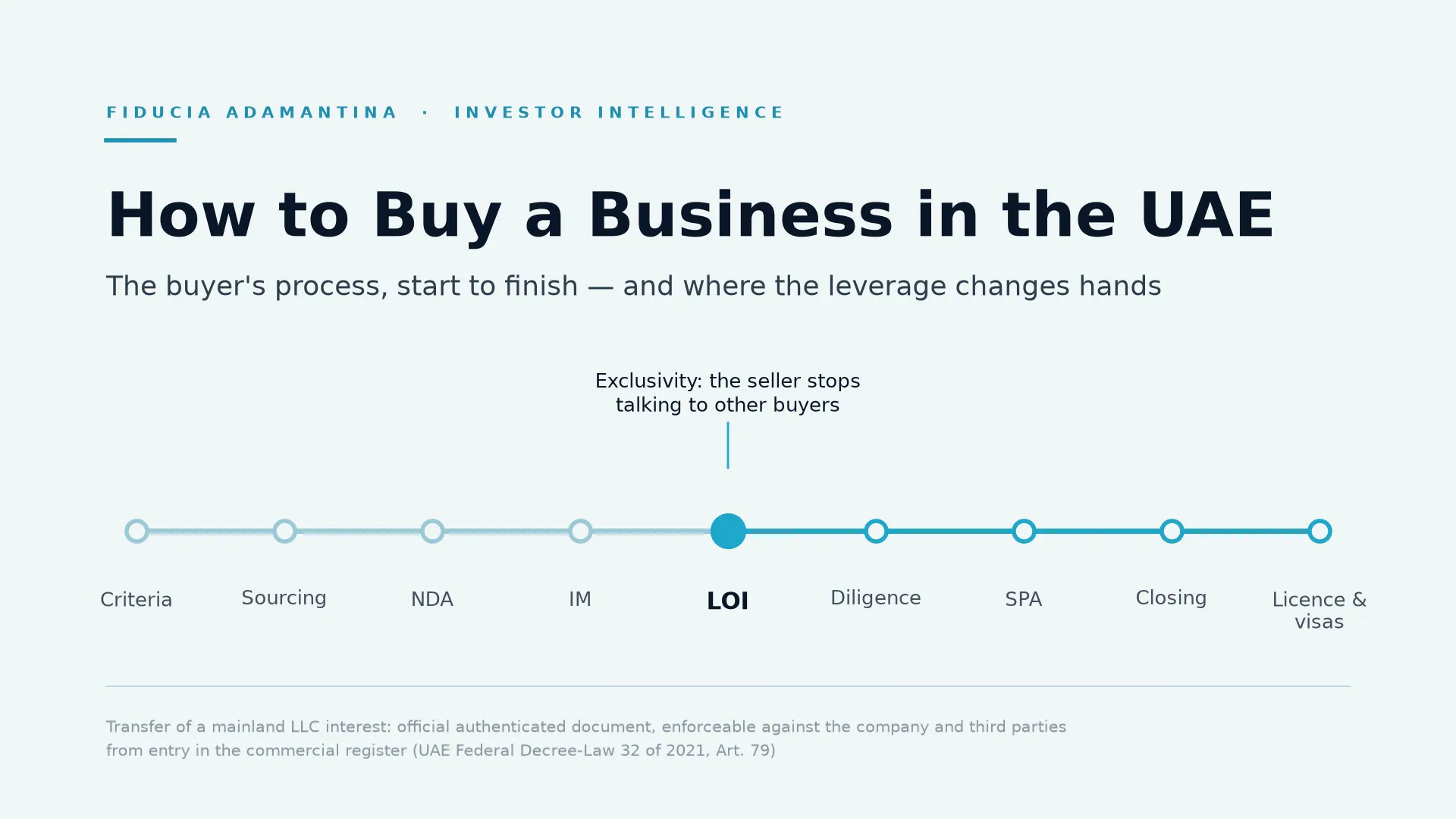
Buying well is a sequence, and the order matters more than any single step: criteria, sourcing, NDA, information memorandum, letter of intent, due diligence, share purchase agreement, closing, and the licence and visa work that follows it. Get the order wrong and you do expensive work on the wrong company, or you sign away your leverage before you know what you are buying.
This is the whole sequence from the buyer’s chair, with what the UAE changes at each step.
Step 1: Write the Criteria Before You Look at a Listing
A buyer without written criteria gets shown whatever is available, and what is available is rarely what fits. Before you look at a single name, write down four things:
- What you are buying for. Cash flow you will manage yourself, a platform you will add to, or a capability your existing business lacks. Each points to a different target and a different price.
- The size you can finance and run. Not only the price, but the working capital the business needs after you own it.
- What you will not buy. Sectors you cannot operate, customer concentration you will not carry, businesses that only work with the founder in the room.
- Your legal shape. Whether you are buying personally or through an existing company, and whether that vehicle sits on the mainland or in a free zone. It decides which licence you end up holding and how the transfer is registered.
Criteria are also your first filter on price. A clear thesis is what lets you walk away from a business that looks cheap and is not.
Step 2: Where Deals Actually Come From
Portals, brokers and your own network are not equal sources. Portals give you the widest choice and, in my experience, the weakest selection: often the businesses that could not be sold quietly. Brokers show you better stock, but they are usually paid by the seller and are running a sale, not helping you buy.
The best acquisitions I see come from the buyer going to owners directly: mapping the companies in a niche, screening them on the criteria from Step 1, and approaching the ones that fit before they ever decide to sell. That is slower and it is where the value is, because you are not bidding against anyone. How disciplined acquirers do this, layer by layer, is set out in how buyers source and screen targets in the Gulf.
Step 3: The NDA, Then the Information Memorandum
A serious seller will not show you the numbers until you sign a non-disclosure agreement. Sign it, and read it: check how long it binds you, whether it stops you approaching the company’s staff or customers, and whether it leaves you free to buy a competitor.
What comes next is the information memorandum, the seller’s own account of the business. Read it as advocacy, not evidence. The questions that matter at this stage are simple: where the profit really comes from, how much of it depends on one customer or one person, and what the seller is adding back to earnings to reach the headline number. Take the answers into a first view of value. How M&A valuation works sets out the methods a buyer should test the asking price against, and the valuation hub covers the common sector cases. What buyers in the region have actually paid is in the GCC buy-side pricing benchmark.
Step 4: The LOI, and Why Exclusivity Is Where Your Leverage Goes
The letter of intent is mostly non-binding, which leads buyers to treat it lightly. It should not be treated lightly. It sets the price, the structure, the conditions and the timetable, and it usually carries two clauses that do bind: confidentiality and exclusivity.
Exclusivity is the moment the leverage in the deal changes hands. Before you sign it, the seller can talk to anyone. After it, the seller has stopped talking to other buyers, and every week of diligence makes it harder for them to walk away. That shift works for you only if the LOI already says what you need: whether you are buying shares or assets, how the price is paid, and what happens to it if diligence finds something.
Decide the structure here, not later. A share purchase takes the entity whole, with its licence, its visa file and its history. An asset purchase lets you choose what you take, but you need your own licence, a fresh visa for every employee you keep and a novation for every contract. The trade-off is laid out in asset sale vs share sale in the UAE, written from the seller’s side, which is exactly the side you are negotiating with.
Step 5: Due Diligence, and What the UAE Adds to It
Diligence is where you find out whether the business in the memorandum exists. The financial, commercial and legal work is the same as anywhere, and the M&A due diligence checklist covers what a buyer asks for. What the UAE adds is a set of checks a foreign buyer tends to miss:
- The licence against the revenue. The licensed activities should cover what the company actually earns money from. Revenue from an activity the licence does not cover is a regulatory risk you inherit.
- Ownership eligibility. Since the 2020 amendment to the Commercial Companies Law, a foreign owner can hold a mainland company outright across most sectors, except activities the government designates as having a strategic impact. Confirm the target is not one of them, and read the memorandum of association for any older shareholder arrangement that the paperwork still carries.
- The visa and labour file. In a share deal every employee’s visa stays with the company, so you inherit the file as it stands: fines, disputes and all.
- End-of-service gratuity. It accrues with service, and small companies often have not set the money aside. It is a liability that should come off the price.
- The premises. The lease is in the company’s name. Check whether the landlord’s consent is needed for a change of owner.
The findings that should re-price or stop a deal are set out in red flags when buying a business in the UAE.
Step 6: The SPA, and the Money: Escrow Is Negotiated, Not Given
The share purchase agreement turns the LOI into obligations: the price and how it is adjusted, the warranties the seller gives you, what you can claim if they prove untrue, and the conditions that must be met before completion.
One UAE point surprises buyers from markets where escrow is routine. Nothing in a private share sale here puts your money into escrow on its own. If the SPA does not provide for an escrow or a holdback, the price goes to the seller at completion. Any warranty claim after that is a claim against a person, possibly one who has left the country, rather than against money you still control. If you want part of the price held back, negotiate it in the LOI and write it into the SPA. How those mechanisms are sized and released is in escrow and holdbacks in M&A.
Step 7: Closing Is a Notary, a Register and a Licence Amendment
On the mainland, the Commercial Companies Law is specific. An interest in a limited liability company is assigned under an official authenticated document, and the assignment is enforceable against the company and third parties only from its entry in the commercial register (Article 79). In practice that means a notarised transfer and an amendment filed with the licensing authority. Until the register shows you, you do not own the company as far as anyone outside the deal is concerned.
Two more mainland points belong on your closing checklist:
- The other partners come first. If you are buying part of an LLC, the remaining partners hold a pre-emptive right to buy the interest before you can (Article 80). Get their written waiver before you spend on diligence, not at the notary.
- The beneficial-owner register must follow you. Cabinet Decision No. 109 of 2023 requires the company to record every natural person who owns or controls 25% or more, directly or indirectly, and to update its beneficial-owner and partner registers within 15 days of becoming aware of a change.
Free-zone companies are different. The Commercial Companies Law gives way to a free zone’s own regulations where they provide for it (Article 5), so the transfer runs through that free-zone authority under its rules. The financial free zones, DIFC and ADGM, have their own companies legislation. Know which regime governs your target before you draft the SPA, because it decides who has to approve the transfer and in what order.
Step 8: After the Transfer: The Part the Listing Never Mentions
Completion is not the end of the work. The company’s bank mandate has to be changed to you, and until it is, the seller still signs the cheques. The seller’s own residence visa, if it was issued through the company, has to come off the file. Suppliers, key customers and staff need to hear from the new owner before they hear it from someone else.
Above all, keep the seller close for a defined period. In an owner-run business the relationships do not transfer on the day the register changes. A paid transition period, written into the SPA with clear deliverables, is cheaper than discovering which customers were loyal to the founder rather than the company.
Buying Is a Process You Run
The buyers who overpay are rarely the ones who misjudged a multiple. They are the ones who let the seller run the process: they found the business on a listing, read the memorandum as fact, signed exclusivity with the structure still open, and learned at the notary what the law required.
If you are weighing an acquisition in the UAE, our buy-side acquisition support covers the sequence above from criteria to closing, and the investors and buyers page sets out how we work with acquirers. For a direct read on a specific target or a live deal, book a strategy session and we will work through it against your numbers.
Frequently asked questions
Can a foreigner buy 100% of a mainland company in the UAE?
For most activities, yes. The 2020 amendment to the Commercial Companies Law opened full foreign ownership across economic sectors, with an exception for activities the Cabinet designates as having a strategic impact, which are licensed under their own controls. Separately, the emirate's licensing authority may apply its own local-ownership conditions. Check the target's licensed activities against that list before you spend money on diligence, and read its memorandum of association for any legacy shareholder arrangement left over from before the change.
Is escrow required when buying a business in the UAE?
No. Nothing in a private share sale forces the price through escrow. If the share purchase agreement does not provide for an escrow or a holdback, the money goes to the seller at completion, and any later warranty claim becomes a claim against a person rather than against money you still control. Escrow is a term you negotiate in the LOI and write into the SPA.
How is ownership of a UAE LLC actually transferred?
Under the Commercial Companies Law, an interest in a mainland LLC is assigned under an official authenticated document and only becomes enforceable against the company and third parties once it is entered in the commercial register. In practice that means a notarised transfer and an amendment filed with the licensing authority. The other partners also hold a pre-emptive right to buy the interest first. Free-zone companies follow their own free zone's regulations instead.
Should I buy the shares or the assets of a UAE business?
A share purchase takes the whole entity, licence, staff visas, contracts and history included, which keeps the business running on day one but brings its past with it. An asset purchase lets you pick what you take but needs your own licence, a fresh visa for every employee you keep and a novation for every contract. For a small owner-run business I usually prefer the share route for continuity, with the past fenced off by diligence, warranties and a holdback.