
Your division has customers, revenue and a management profit report. It still uses the group’s finance team, software and warehouse. A buyer wants the division. You want to keep the rest of the company.
The difficult part is proving what the buyer can actually take over, what it will cost to run, and what you will still be paying for after the sale.
A carve-out sale separates a business from its parent for a buyer. A divestiture is the disposal decision and transaction; the carve-out work makes the separation possible. Selling a subsidiary can involve this work even when it already sits in a separate legal entity. Shared operations do not disappear when shares change hands. KPMG’s divestiture overview distinguishes the transaction from the separation work supporting it.
For an owner deciding how to divest a business unit, the starting point should be a credible separation case. An attractive profit number without that case leaves too much for the buyer to guess.
Define the business you are actually selling
Start with a written perimeter: what transfers, what stays, and what needs a temporary arrangement. A division name is too vague for this job.
Take an illustrative family-owned group that wants to sell its maintenance business while retaining distribution. The same sales team may serve both. Customers may buy both services under a group agreement. The warehouse may hold both divisions’ stock. Calling maintenance a separate business does not resolve those dependencies.
Map the revenue-producing contracts, people, equipment, inventory, intellectual property, premises and supporting systems. For each, identify the current owner or contracting entity and the proposed treatment. Include liabilities and obligations in the discussion with counsel, rather than leaving them outside the commercial story.
Then test the perimeter against an ordinary working day. Can the buyer quote, deliver, invoice and collect? Who approves purchases? Where do customer records sit? Which employee knows how the operation works?
My starting test would be whether the buyer can explain how the business will serve customers after closing. If that answer requires assets or people excluded from the perimeter, the package needs another pass.
Build a bridge from divisional profit to standalone earnings
A management P&L answers how the group reported the division. A buyer also needs to understand its economics outside the group. Those are different views.
Show the historical results, explain the shared-cost allocations, and separately model the costs of operating independently. Reconcile each view so that an adjustment can be followed back to a ledger, contract or explicit assumption.
EY’s guide to carve-out financial statements discusses including relevant parent-incurred costs and using reasonable allocation methods. It also distinguishes historical allocations from what an independent business may spend. The guide addresses US accounting practice; it is a useful reference for the distinction, rather than a UAE filing requirement.
For the seller’s commercial analysis, ask the finance team to separate:
- Costs directly attributable to the division.
- Shared costs allocated from the group, with the allocation basis explained.
- Recurring replacement costs after separation.
- One-off costs needed to establish independent operations.
A payroll allocation based on headcount may be reasonable for historical reporting. It does not tell the buyer the price of a replacement payroll service. Nor should a one-off software migration be treated as a permanent annual expense.
Keep buyer-specific synergies separate. A strategic acquirer might absorb finance into its existing team; another buyer might need to hire. The seller’s baseline should make those choices visible without assuming the most favourable buyer is already at the table.
Price the costs that stay with your group
The sale can remove revenue while leaving the seller with expenses it cannot immediately remove. These are stranded costs: the office lease, systems contract or central team that remains after the division leaves. KPMG identifies stranded-cost reduction as part of the separation work.
Do not confuse an accounting allocation with a cash saving. Removing a share of the headquarters charge from a spreadsheet does not reduce the landlord’s invoice.
Prepare a separate view for the business you retain. Identify which costs stop at closing, which can change later, and which support the remaining business. Assign an owner to any proposed reduction and check the practical constraint behind it.
The question for the shareholder is whether the sale proceeds justify the separation costs, the ongoing obligations and the effect on the retained business. A division can attract a reasonable offer while its disposal still produces an unattractive outcome for the group.
This is also where a family group should challenge its own objective. If the aim is to free management attention, a long support commitment to the buyer may delay that benefit. If the aim is cash, the net proceeds and continuing costs deserve more attention than the headline price.
Make temporary shared services an exit plan
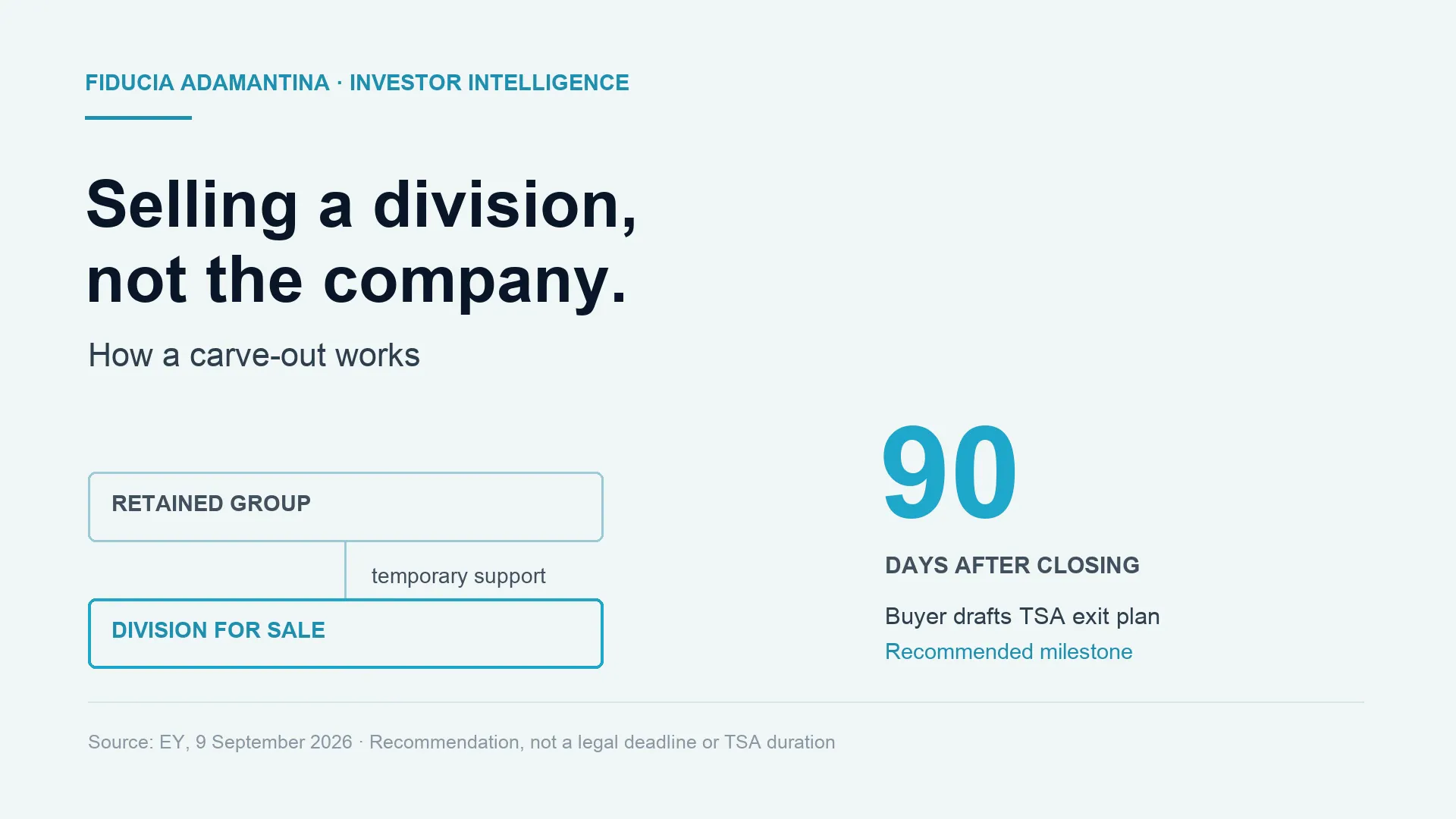
A transition services agreement, or TSA, can give the buyer temporary access to agreed seller services while replacements are put in place. Potential areas include finance, IT and payroll. The agreement needs specific service boundaries, pricing, responsibilities and an end point.
Avoid a promise to provide “the same support as before.” Before the sale, an informal arrangement may have worked because everyone answered to the same owner. After closing, the parties have different priorities.
For each proposed service, ask what must work at closing, who delivers it, what the buyer must do to replace it, and how both sides will know the service can end. Check whether the seller has the capacity and contractual rights to provide it at all.
In its September 2026 carve-out guidance, EY recommends agreeing that the buyer will provide a draft TSA exit plan within 90 days of closing. That is a recommended planning milestone. It is neither a legal deadline nor a statement that every TSA should last 90 days.
Use the principle rather than copying a duration: negotiate the exit work as carefully as the initial support. A signed TSA should give the retained business a credible route out of the obligation.
In the UAE, map the entities before promising a transfer
For a UAE group, put the legal entities next to the operational map. Ask which entity contracts with customers, holds the relevant licence, employs staff and controls the software or premises. Send that factual map to the legal and tax advisers before presenting a transfer route as settled.
The seller-side questions are practical. Which documents need review for consent or change-of-control terms? Which people are proposed to move? Which authority processes, employment arrangements or permissions must counsel and HR verify for the chosen structure? What happens if a critical approval or customer decision takes longer than expected?
Keep unresolved items visible in the timetable and sale materials. Avoid promising that licences, contracts or employees will move automatically. This article does not prescribe a UAE employee-transfer procedure; that needs advice on the actual entities and arrangements.
Our asset sale versus share sale guide covers the broader structure decision. For a carve-out, first establish the proposed perimeter and dependencies, then have counsel test the available structures against them.
If the separation exposes wider weaknesses in reporting or owner dependence, use the Exit Readiness Scorecard to take a broader readiness view. It is a starting point for the sale discussion, rather than a carve-out implementation plan.
Give buyers a consistent package they can test
Before launching the divestiture process, assemble a buyer-facing explanation that connects the perimeter, financials and transition plan. Do not let each document describe a different business.
The pack should show what is included and excluded, how historical results reconcile, how standalone costs were estimated, and which dependencies need temporary support. Name unresolved assumptions. A clear gap is easier to discuss than an assurance the finance or operations team cannot substantiate.
Keep a separation-risk register alongside the pack. For each issue, record the dependency, the evidence, the proposed solution and the person responsible. The purpose is to make diligence answerable, rather than produce a longer slide deck.
My view is that unresolved separation work becomes a negotiating problem when the seller asks a buyer to accept a price before explaining who will bear that work. The buyer may seek a lower price, a condition to closing or additional seller obligations. Preparation cannot guarantee a better offer, but it gives you a basis for challenging the assumptions behind one.
Different buyers can also see different packages. An acquirer with the necessary infrastructure may require less temporary support. That difference belongs in the buyer assessment and negotiations; it should not erase the baseline economics presented to everyone.
Decide what you retain before you go to market
A carve-out works best when the shareholder has a clear view of both businesses after closing. The buyer needs an operable acquisition. You need a retained group whose economics and obligations still make sense.
Before approving the launch, ask management to reconcile the sale perimeter with the financial case and explain the remaining dependencies. Resolve disagreements about who carries separation costs while you still control the preparation process.
The advisory role is to prepare the seller’s decision, position the business for buyers and run the transaction process. The client’s finance, HR, IT and operations teams, together with legal and tax specialists, do the implementation work within their respective responsibilities.
Start with the Exit Readiness Scorecard. If a division sale is the direction you are considering, a strategy session can focus on the proposed perimeter, standalone economics and readiness gaps. Our Exit & Divestiture Advisory page sets out the sell-side advisory scope.