“I can’t afford an advisor right now.” I hear that sentence more than almost any other from founders about to raise. The line that follows is usually the real problem: “but I also can’t afford to spend six months pitching and come back empty-handed.”
Both things are true at the same time. That is the bind. And the way most founders resolve it, by going to market alone to save the fee, quietly costs more than the fee ever would.
Here is the number that frames it. In DocSend’s research on startups raising seed capital, the average founder contacted 58 investors and sat through about 40 meetings to close a round, across roughly twelve weeks of concentrated effort. That is what the process looks like when it goes well. The cost of going to market unprepared is not the advisor fee you skipped. It is what happens to those twelve weeks, those 58 relationships, and the price you eventually accept.
The fee you can see, and the three costs you can’t
When founders price “advisor versus no advisor,” they put one figure on the spreadsheet: the fee. It is the only cost that arrives as an invoice, so it is the only one that feels real.
The three costs that actually decide the outcome never get a line. They are the months a stalled raise adds, the introductions you burn by pitching too early, and the valuation you concede when you negotiate from a weak position. None of them appear until after the decision is made, which is exactly why they are easy to skip and expensive to ignore.
This is not a scare tactic. It is the arithmetic I run with founders before they decide, and sometimes it points to going alone. Often it does not.
Cost one: the months a DIY raise quietly adds
A raise that is run well is short. The DocSend data puts a clean seed round at about twelve weeks of focused work. A raise that is run unprepared does something worse than drag. It restarts.
The pattern repeats. A founder goes out with a deck that is not ready, takes fifteen meetings, collects fifteen versions of “interesting, keep us posted,” and only then realises the model does not survive scrutiny. So they fix the model. But the fifteen investors who saw the weak version are already gone. The clock resets. The runway does not.
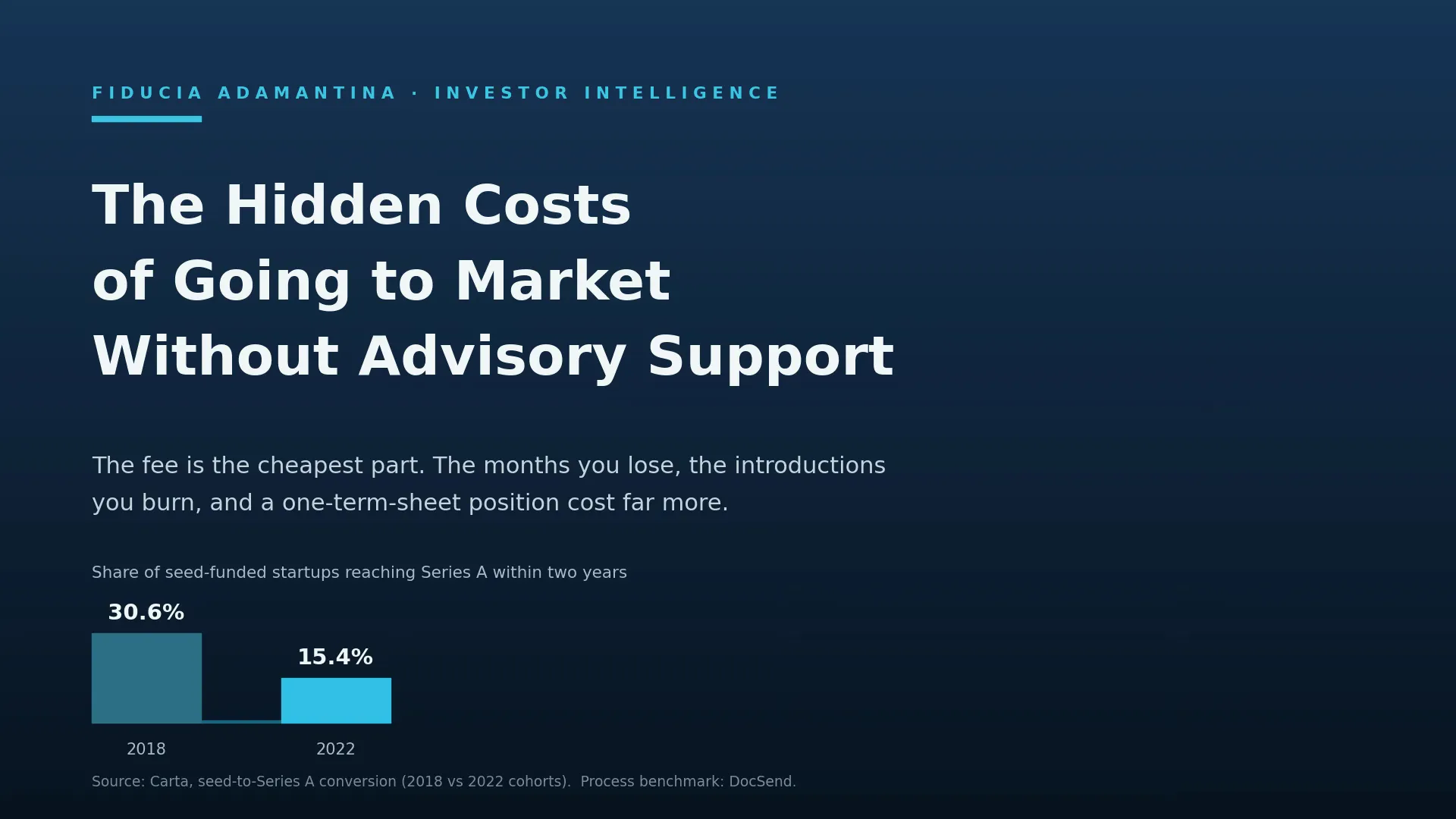
That delay matters more than it used to. Carta’s data shows the median gap between a seed round and a Series A has stretched to roughly 2.1 years, around 774 days as of late 2024. Founders are already being asked to make a round last longer. Adding three or four months of avoidable fundraising on top of that is runway spent with nothing to show for it.
Cost two: the introduction you only get to spend once
An investor introduction is not a renewable resource. You get one clean shot at a first impression, and the warm introduction that produced it can rarely be spent twice.
When a founder pitches before the business is ready to be pitched, they do not get a useful “not yet.” They get a quiet “no,” and that no is sticky. The investor’s memory of the company becomes the unprepared version. Going back six months later with a fixed deck does not overwrite that first read. It competes with it, and usually loses.
This cost is sharper in the Gulf corridor than founders expect. The relevant-investor pool for a given stage and sector is smaller and more relationship-driven than in London or the Bay Area, and word moves between funds. Burn three introductions in a market where there were only a dozen worth having, and you have not lost three meetings. You have lost a quarter of your realistic raise. More first meetings fail on preparation than on the quality of the idea, a pattern I cover in why most founders fail their first investor meeting.
Cost three: the valuation you give away from a weak position
The most expensive hidden cost is the one founders never trace back to preparation: the terms they accept.
Leverage in a raise comes from one thing, more than one interested party at the same time. DocSend’s 58-investors-to-close figure is really a leverage figure. A founder who runs a tight, prepared process can compress those conversations into a single window and create genuine competition. A founder who limps through one meeting at a time, fixing problems as they surface, usually arrives at a single term sheet with no alternative. One term sheet is not a negotiation. It is an ultimatum you are relieved to receive.
The distance between a competitive round and a take-it-or-leave-it round is rarely small. It shows up in valuation, in the option pool the investor pushes onto you, in liquidation preferences, in board seats. Founders who would never hand over ten points of equity on purpose give it away by accident, because they went to market without the position to hold the line. How a credible number gets built and defended is its own discipline, one I walk through in how to value your startup before fundraising.
“I can’t afford an advisor right now”: the actual math
Now the fee, which deserves an honest accounting of its own, because the market price of fundraising help is genuinely high.
A typical fundraising advisor charges a monthly retainer somewhere between $10,000 and $25,000, plus a success fee of three to eight percent of the capital raised. On a $2M round that is real money, and a founder’s instinct to flinch is rational. If that were the only option on offer, “do it myself” would often be the right answer.
But that structure is built for running a full raise, not for getting ready to raise. The mistake is treating “advisor” as a single switch: hire a placement agent for the whole round, or do everything alone. The decision that actually moves the numbers sits upstream of that. Are you ready to go to market at all?
That is the question the Investor Readiness Checklist is built to answer. It is a free, fast way to pressure-test whether your deck, model, cap table, and data room would survive a real investor process, before you spend a single introduction finding out the hard way. Almost every hidden cost above traces to one root: going to market before the materials were ready. You can catch that for nothing.
When going it alone is the right call, and when it isn’t
I am not going to claim every founder needs an advisor. Plenty do not.
If you have raised before, your network already includes the right investors for this stage and sector, your metrics are unambiguous, and you have the weeks free to run a focused process, you can probably run it yourself. So do. The honest self-test is whether you can answer, cold, the questions an investor will ask in the first ten minutes. If you can, you may not need help getting ready.
If you cannot, if you are unsure the model holds, if your cap table carries structures you would struggle to defend, if your network does not reach the right room, then “saving the fee” saves nothing. It defers a larger cost to a worse moment. The five-minute investor-ready self-assessment is a good place to learn which founder you are before the market tells you.
A note for founders going to market to sell rather than raise: the same arithmetic applies, only harder. In an M&A process the introductions are fewer, the counterparty negotiates deals for a living, and the cost of a weak position is measured in millions, not equity points. If that is your road, transaction advisory and the wider M&A process are a separate read, but the principle holds exactly: preparation is leverage.
What advisory support actually changes before you go to market
Getting ready is not about polish. It is about removing the reasons an investor says no before they have the chance to say it.
The free Investor Readiness Scorecard is the most direct way to see where you stand. It scores you across the dimensions investors actually weigh, the narrative, the model, the cap table, the data room, the metrics, and shows you which gaps would cost you a round. It is the first question I ask any founder who comes to us. Not “are you ready to raise,” but “where, precisely, are you not?”
That diagnosis is where readiness work earns its fee, and where the Investor Readiness Sprint picks up. Not in a prettier deck, but in the three costs you then do not pay: the months you do not lose, the introductions you do not burn, and the valuation you do not surrender.
The cheapest raise is the one you run once
Going to market unprepared has a price. It is simply paid later, by your runway, your relationships, and your cap table, instead of on an invoice you can see in advance.
If the Scorecard shows materials and presentation gaps, the Investor Readiness Sprint can rebuild the defined deck, financial model, cap-table scenario, and founder narrative for AED 25,000 in 2–3 weeks from complete intake. It does not build the data room or cure legal, financial, governance, traction, or evidence gaps. Paid Sprint fees are eligible for the optional 90-day raise-mandate credit, but the Sprint is independently buyable and its value is the work delivered. Credited only if we take the raise mandate.