
Most founders I meet walk into their first valuation conversation with a number they cannot defend. They have either heard a comp on a podcast, anchored to a friend’s last round, or run a discounted cash flow model in a spreadsheet that turns whatever they want it to turn. None of those numbers survive the second question from a serious GCC investor.
Valuation is where founders get over-confident or over-cautious, rarely both right. The over-confident ones price themselves out of the room before the conversation starts. The over-cautious ones give up equity that takes three rounds to claw back. Both versions are expensive.
This piece is a practical guide for founders preparing to raise in the Middle East. Not a textbook. The frameworks that hold up here, the numbers that GCC investors actually anchor to, and how to set a valuation you can hold a line on without flinching.
Why valuation feels harder in the Gulf than in San Francisco
The standard valuation playbook was written for a market with deep public comparables, dense private deal data, and a tolerance for losses that goes back twenty years. Most of that does not transfer cleanly to the Gulf.
The MENA market sized $7.5 billion in startup funding in 2025, according to Wamda — a record year. But Q1 2026 saw funding slip to $941 million, a 37% drop year-on-year, on the back of geopolitical pressure and tighter capital. The mood among GCC investors right now is more disciplined than it has been in three years.
That discipline shows up in valuation conversations. Gulf investors will not pay for narrative alone. They want revenue quality, a defensible regional thesis, and a path to profitability they can underwrite. Founders who arrive with a Silicon Valley-flavoured valuation and a deck full of TAM slides get politely thanked and shown out.
The good news: the bar is lower than founders fear, but the lens is different. Once you understand what GCC investors are actually pricing, your number becomes easier to defend, not harder.
The four methods that survive contact with GCC investors
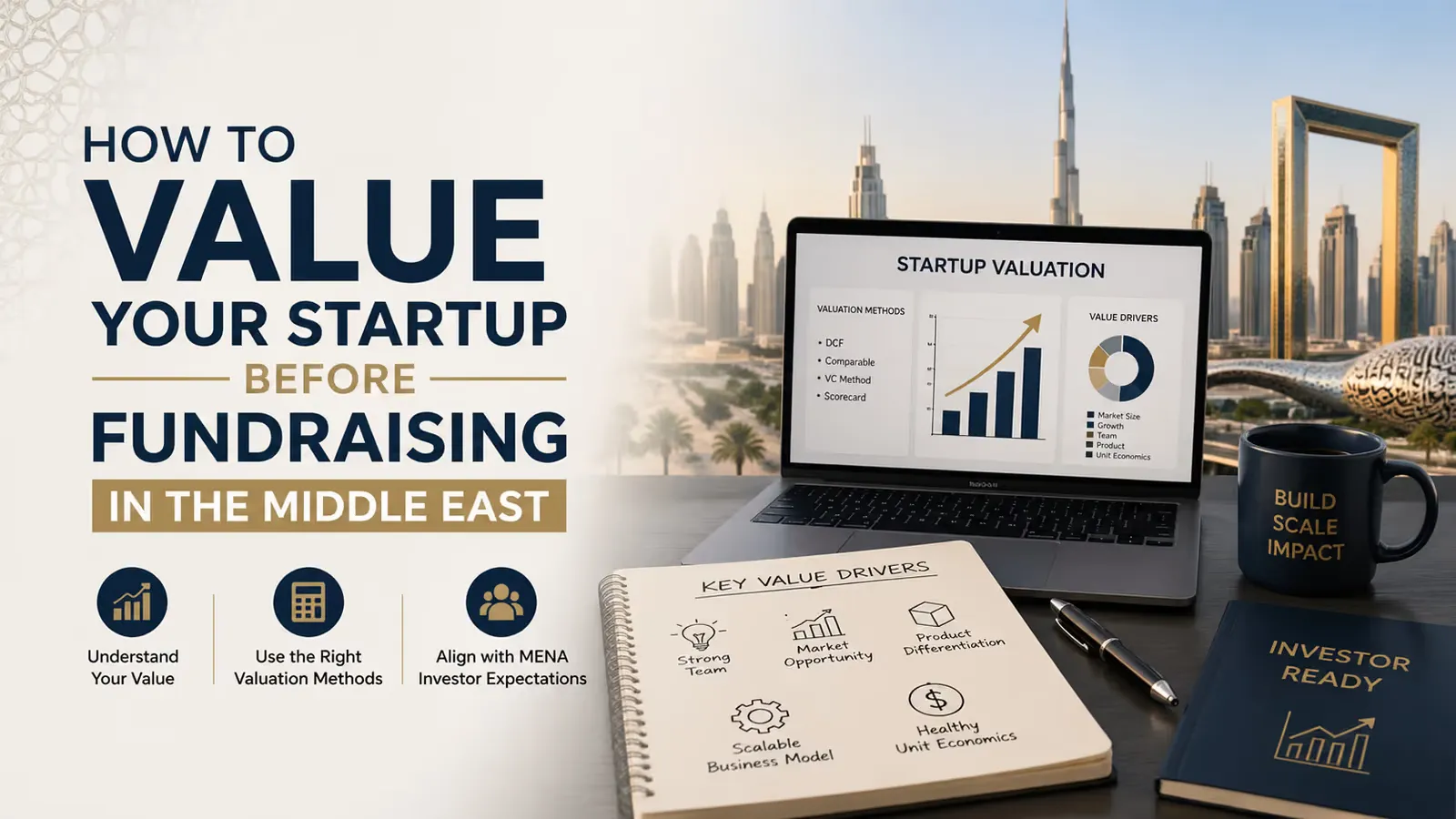
For pre-Series A founders, four valuation methods do most of the work. None of them are perfect. All of them are useful as triangulation. Use them together, not in isolation.
Comparable transactions. The cleanest method when you have data. Look at recently funded peers in your sector and stage, in your region. Adjust for revenue, growth rate, and team. The constraint in MENA is that private deal data is patchy. MAGNiTT and Wamda are the two best sources, but neither gives you the full picture for free. Use them as a floor, not an answer. Our MENA startup funding benchmark for 2026 pulls the public round sizes and valuations into one place to widen that floor.
Venture capital method. Work backwards from a credible exit value, discount aggressively for risk, and back into a current valuation. This is the method most institutional VCs in the region use to test your number. If you do not understand what your business looks like at exit, the rest of the conversation is academic. That exit-and-discount logic only holds up on a model an investor believes — how to build a financial model MENA investors trust covers what that takes.
Scorecard method. Useful for pre-revenue or near-revenue companies. Compare yourself to a baseline of recently funded peers across team, market size, product, competition, and partnerships. Adjust the baseline up or down. The reason it works in the Gulf is that GCC investors price the team and the regional fit heavily, both of which are hard to capture in a DCF.
Risk factor summation. Lighter touch. Take a baseline valuation and adjust for twelve risk factors (regulatory, technology, sales, competition, founder experience, and so on). It is too crude to use alone, but a sharp scorecard plus risk factor pass will surface the parts of your business an investor will discount.
If a founder shows me one method, I push them to triangulate with the other three. A range is more credible than a point estimate. Investors know it. They want to see you have done the work. Once there is real revenue in the business — recurring revenue especially — one further cross-check is worth running: the Business Valuation Calculator is a free sell-side screen that returns an indicative enterprise-value range, never a single point number, anchored to the sector multiple bands (EV/EBITDA, SDE, ARR for software businesses) that buyers and later-stage investors actually price against. If the number you plan to defend sits well outside that range, it is better to know before an investor tells you.
What Gulf investors actually anchor to
Once you have a triangulated range, you need to know what an investor in the room is going to challenge. In our practice, three things come up in every GCC investor conversation about valuation, regardless of sector.
Regional revenue, not global TAM. A $50 billion global TAM number does not impress a Dubai or Riyadh investor. They want to see the addressable revenue in MENA, the share you can credibly capture in three to five years, and the regulatory and cultural reality of getting there. Founders who size the regional opportunity from the bottom up, by customer segment, by country, by realistic price point, anchor much higher than founders who lead with a global slide.
Defensibility in a small market. The Gulf is not a winner-takes-all market the way the US is. It is a relationship market with concentrated buyers, especially at the enterprise tier. Investors will probe how defensible your position is once a well-capitalised competitor enters. If your answer is “we will out-execute,” you will get marked down. If your answer involves regulatory positioning (DIFC, ADGM, DET), an existing distribution partnership, or a real network effect, you will get marked up.
Founder-market fit in this region. GCC investors back operators who understand the Gulf, not parachute-in tourists. A non-regional founder is not a deal-killer, but you will need a credible regional partner, a UAE entity, or a senior MENA hire on the team to clear that hurdle. This is one of the most under-rated valuation drivers in the region.
Revenue quality counts more than revenue size
This is the single biggest valuation gap I see between founders and GCC investors.
A founder will walk in proud of $2 million in annual revenue. The investor will ask three questions and price the business on the answers. Is this revenue recurring or project-based? What is the gross margin? How concentrated is it in your top three customers?
$2 million of recurring SaaS revenue at 70% gross margin from a diversified customer base is a different business from $2 million of project-based services revenue at 30% margin from one anchor client. The first might price at 8–12x ARR. The second might price at 1–2x revenue, if it prices at all.
The mistake I see most often is founders padding revenue with one-off project work to hit a top-line number, then being surprised when investors discount it to near zero. Revenue quality is what gets paid for. If your model does not separate recurring from non-recurring, fix that before you pitch.
This is also where most pre-Series A financial models fall apart. We cover the most common errors in our Financial Model Mistakes Guide. Worth a read before you anchor a valuation conversation around numbers your model cannot defend.
The path-to-profitability premium
Gulf investors are less patient with burn than their US counterparts. This is a structural feature of the market, not a temporary mood. Most regional capital comes from family offices, sovereign-linked funds, and corporate balance sheets — pools of money that are accountable to outcomes that are not pure venture returns.
A founder showing a credible 18-to-24-month path to break-even, even at the cost of slower top-line growth, will often clear a higher valuation than a founder showing 3x growth with no profitability story. That trade-off would look unusual in San Francisco. In Dubai or Riyadh, it is the norm.
This does not mean you have to be profitable to raise. It means your model has to show you understand the lever, that you can flip it if the market turns, and that you have thought about the cost structure that gets you there. The founders who anchor highest in the room are the ones who can answer “what would you do with half the money” with a coherent plan, not a panicked stare.
How to set a number you can defend in the room
A defensible number has four characteristics. The Investor Readiness Sprint can make the assumptions and valuation story explicit inside the pitch materials; it does not guarantee faster fundraising or independently validate the number.
- Triangulated. Backed by at least two of the four methods above, with the assumptions written down.
- Sourced. Tied to real comparables, real revenue, real market data, not a feeling.
- Bounded. Presented as a range, not a point. The range narrows as the diligence deepens.
- Negotiable. You walk in knowing what you would accept and what you would walk away from. The investor can feel that. It changes the conversation.
If your valuation fails any one of these tests, the investor will sense it inside ten minutes. Either you over-correct under pressure and give up too much, or you over-defend and burn the meeting. Both outcomes are avoidable with preparation. Neither happens by accident.
The investor readiness gap behind most bad valuations
The pattern I see in our practice: founders who anchor badly are not bad at valuation. They are unprepared on adjacent fronts — a weak narrative, a model that does not stress-test, a cap table that an investor will discount before they even read the deck. Valuation is downstream of investor readiness. Fix the upstream gaps and the valuation conversation gets much easier.
The Investor Readiness Scorecard is a free fifteen-minute self-assessment that surfaces those gaps, covering the same ground as the five pillars we work through with every client. The valuation pillar is one of them, but not the only one, and most founders find that the scorecard reveals two or three other issues they did not know they had.
For founders preparing to raise in the next 6–12 months, the Investor Readiness Sprint can build the defined deck, model, cap-table scenario, and founder narrative for AED 25,000 in 2–3 weeks from complete intake. It does not close every gap the Scorecard surfaces. Paid fees are eligible for the optional 90-day raise-mandate credit. Whether we take a raise mandate at all is solely our decision, on our capacity and our read of the company. If you prefer to start with the Scorecard, that is the right first step.